Gizem Karaali - Böcker
Visar alla böcker från författaren Gizem Karaali. Handla med fri frakt och snabb leverans.
5 produkter
5 produkter
678 kr
Skickas inom 7-10 vardagar
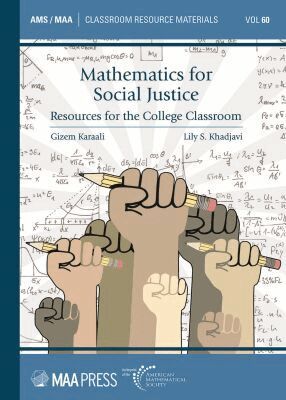
Mathematics for Social Justice offers a collection of resources for mathematics faculty interested in incorporating questions of social justice into their classrooms. The book begins with a series of essays from instructors experienced in integrating social justice themes into their pedagogy; these essays contain political and pedagogical motivations as well as nuts-and-bolts teaching advice. The heart of the book is a collection of fourteen classroom-tested modules featuring ready-to-use activities and investigations for the college mathematics classroom. The mathematical tools and techniques used are relevant to a wide variety of courses including college algebra, math for the liberal arts, calculus, differential equations, discrete mathematics, geometry, financial mathematics, and combinatorics. The social justice themes include human trafficking, income inequality, environmental justice, gerrymandering, voting methods, and access to education. The volume editors are leaders of the national movement to include social justice material into mathematics teaching. Gizem Karaali is Associate Professor of Mathematics at Pomona College. She is one of the founding editors of The Journal of Humanistic Mathematics, and an associate editor for The Mathematical Intelligencer and Numeracy; she also serves on the editorial board of the MAA's Carus Mathematical Monographs. Lily Khadjavi is Associate Professor of Mathematics at Loyola Marymount University and is a past co-chair of the Infinite Possibilities Conference. She has served on the boards of Building Diversity in Science, the Barbara Jordan-Bayard Rustin Coalition, and the Harvard Gender and Sexuality Caucus.
Mathematics for Social Justice
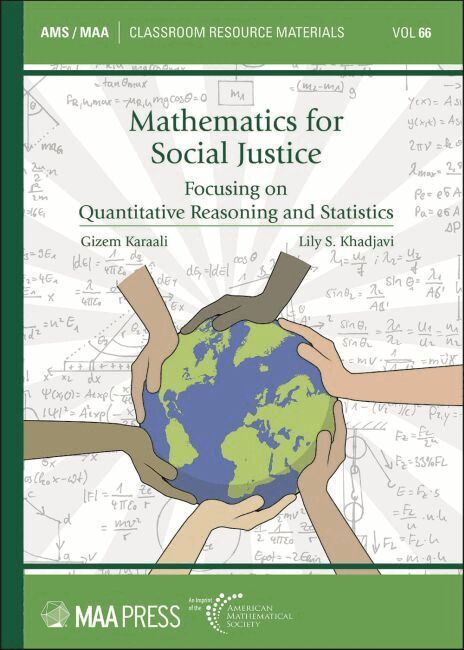
Focusing on Quantitative Reasoning and Statistics
Häftad, Engelska, 2022
691 kr
Skickas inom 7-10 vardagar
Mathematics for Social Justice: Focusing on Quantitative Reasoning and Statistics offers a collection of resources for mathematics faculty interested in incorporating questions of social justice into their classrooms. The book comprises seventeen classroom-tested modules featuring ready-to-use activities and investigations for college mathematics and statistics courses. The modules empower students to study issues of social justice and to see the power and limitations of mathematics in real-world contexts of deep concern. The primary focus is on classroom activities where students can ask their own questions, find and analyze real data, apply mathematical ideas themselves, and draw their own conclusions. Module topics in the book focus on technical content that could support courses in quantitative reasoning or introductory statistics. Social themes include electoral issues, environmental justice, equity/inequity, human rights, and racial justice, including topics such as gentrification, partisan gerrymandering, policing, and more.The volume editors are leaders of the national movement to include social justice material in mathematics teaching and jointly edited the earlier AMS-MAA volume, Mathematics for Social Justice: Resources for the College Classroom.
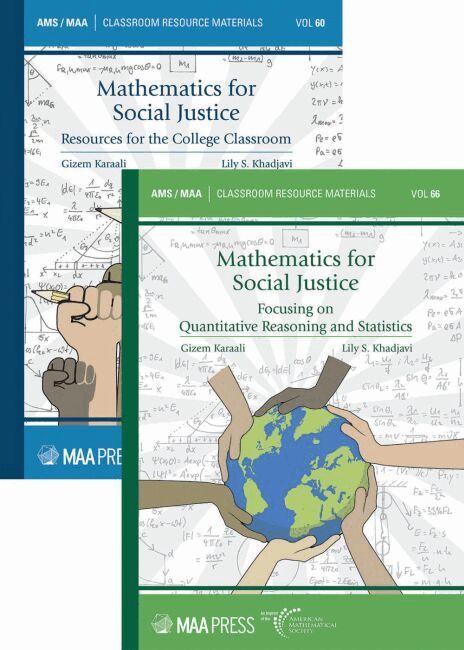
Mathematics for Social Justice: Resources for the College Classroom and Focusing on Quantitative Reasoning and Statistics (2-Volume Set)
Häftad, Engelska, 2022
1 125 kr
Skickas inom 7-10 vardagar
This two-volume set offers a collection of resources for mathematics faculty interested in incorporating questions of social justice into their classrooms.Mathematics for Social Justice: Resources for the College Classroom begins with a series of essays from instructors experienced in integrating social justice themes into their pedagogy; these essays contain political and pedagogical motivations as well as nuts-and-bolts teaching advice. The heart of the book is a collection of fourteen classroom-tested modules featuring ready-to-use activities and investigations for the college mathematics classroom.Mathematics for Social Justice: Focusing on Quantitative Reasoning and Statistics comprises seventeen classroom-tested modules featuring ready-to-use activities and investigations for college mathematics and statistics courses. The modules empower students to study issues of social justice and to see the power and limitations of mathematics in real-world contexts of deep concern. The primary focus is on classroom activities where students can ask their own questions, find and analyze real data, apply mathematical ideas themselves, and draw their own conclusions.
Del 16 - Association for Women in Mathematics Series
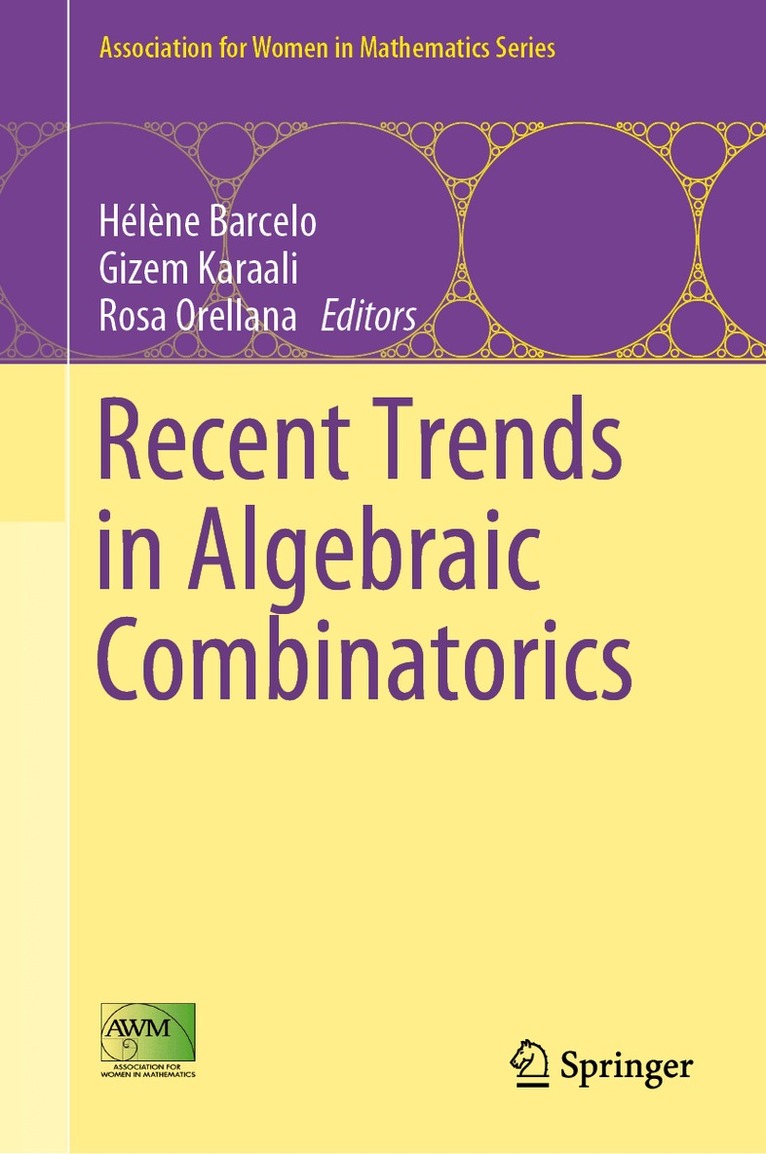
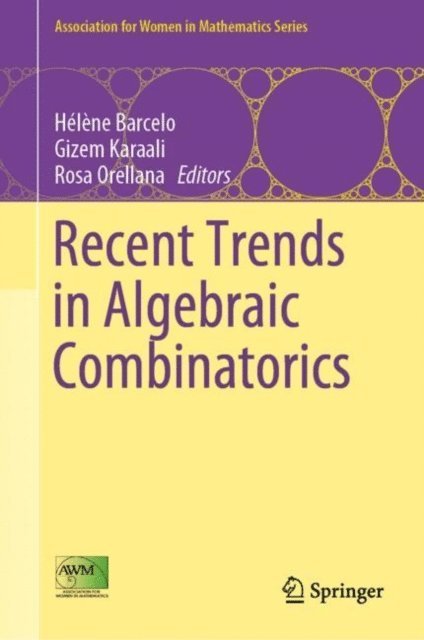
Recent Trends in Algebraic Combinatorics
Inbunden, Engelska, 2019
1 064 kr
Skickas inom 10-15 vardagar
This edited volume features a curated selection of research in algebraic combinatorics that explores the boundaries of current knowledge in the field. Focusing on topics experiencing broad interest and rapid growth, invited contributors offer survey articles on representation theory, symmetric functions, invariant theory, and the combinatorics of Young tableaux. The volume also addresses subjects at the intersection of algebra, combinatorics, and geometry, including the study of polytopes, lattice points, hyperplane arrangements, crystal graphs, and Grassmannians. All surveys are written at an introductory level that emphasizes recent developments and open problems. An interactive tutorial on Schubert Calculus emphasizes the geometric and topological aspects of the topic and is suitable for combinatorialists as well as geometrically minded researchers seeking to gain familiarity with relevant combinatorial tools.Featured authors include prominent women in the field known for their exceptional writing of deep mathematics in an accessible manner. Each article in this volume was reviewed independently by two referees. The volume is suitable for graduate students and researchers interested in algebraic combinatorics.
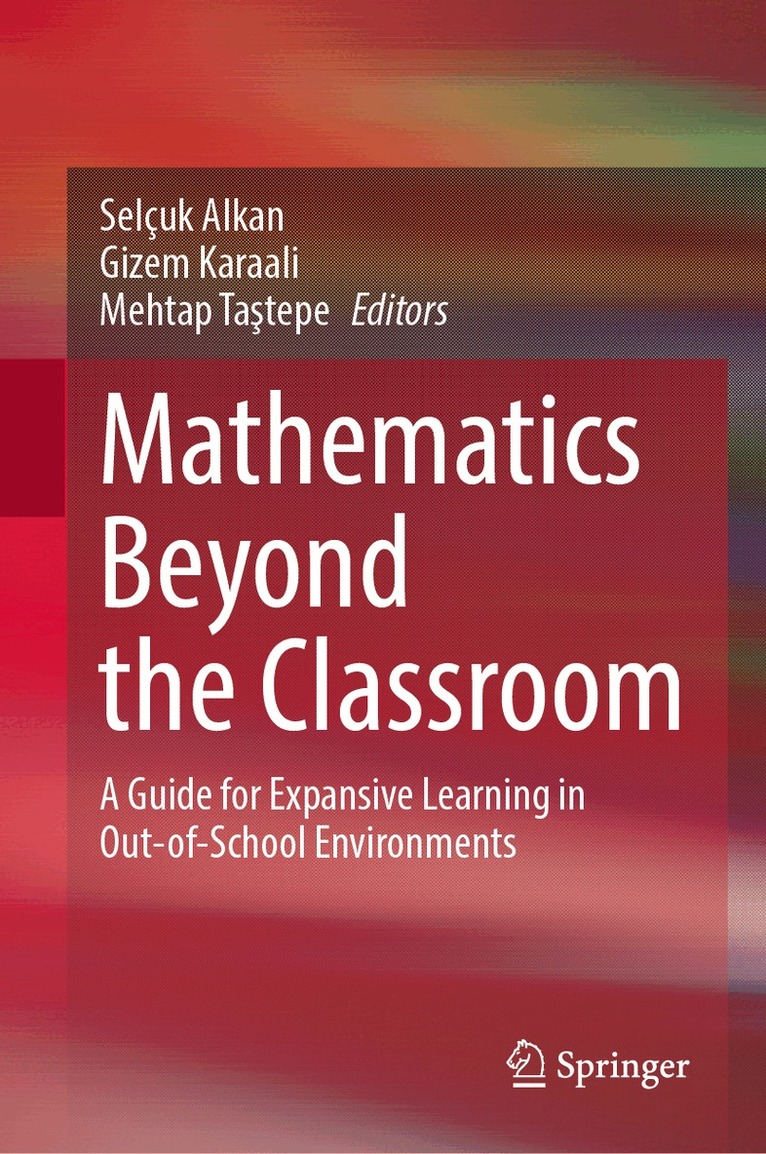
Mathematics Beyond the Classroom
A Guide for Expansive Learning in Out-of-School Environments
Inbunden, Engelska, 2025
1 787 kr
Skickas inom 10-15 vardagar
The aim of this book is to convey to teachers the potential of out-of-school environments for mathematics education. This book is primarily intended to inform teachers about the potential of out-of-school learning environments for mathematics learning/teaching. First of all, these environments will be introduced to teachers. It will be explained in which ways teachers can use these environments to teach mathematical knowledge and concepts. Further, for each chapter addressing challenges identified in the literature regarding the planning of instruction in out-of-school environments, examples of activities will be provided. Accompanied by insights from academics, these activities will illustrate how mathematical concepts can be effectively communicated to secondary school students through engagement with out-of-school environments. This book was written specifically to provide information on how to provide mathematics education in out-of-school environments. A different out-of-school environment will be determined in each department. In this environment, it is aimed to provide students with problem-solving skills by comparing them with original problems in real-life situations. In addition, collaborative education comes to the fore in the activities used in these environments and is expected to help students develop communication skills such as mathematical language. Apart from this, these activities also aim to provide students with some basic skills such as cultural, historical, economic, and nature awareness. The book's target audience includes teachers, educators/facilitators, teacher educators, curriculum developers, and early-career researchers as well as established researchers. Especially after Covid, the importance of mathematics education outside of school has increased. There are not many resources in the literature for teachers to provide mathematics education in out-of-school environments. First of all, in the book, the educational potential of different environments (museums, zoos, science centers, etc.) will be discussed within the framework of the literature, and then activities that can be used in mathematics education in these environments will be designed. This book will guide teachers theoretically and practically on how to provide education in out-of-school environments. It will also be the main source for researchers who want to conduct academic studies in out-of-school mathematics teaching.