• Fri frakt över 249 kr
  • •
  • Snabba leveranser
  • •
  • Billiga böcker
Kundservice

Du är på sajten för privatpersoner.

Företag, bibliotek eller offentlig verksamhet?

Du handlar på classic.bokus.com, där alla dina funktioner finns intakta.
Till classic.bokus.com
Bokus logotyp. Gå till startsidan.
  • Erbjudanden
  • Nyheter
  • Student
  • Topplistor
  • Barn & ungdom
  • Bokus Play
  • E-böcker
  • Pocketböcker
  • Spel & pussel

Må bättre, för mindre! Upp till 50% rabatt på hälsoböcker

Sidfot

Mina sidor

    Hjälp

    • Kundservice
    • Vanliga frågor och svar
    • Frakt och leverans
    • Retur vid ångerrätt
    • Reklamera vara
    • Betalning
    • Köpvillkor
    • Allmänna villkor
    • Information om webbplatsens tillgänglighet

    Om Bokus

    • Om oss
    • Pressrum
    • För studenter
    • För företag
    • För bibliotek och offentlig verksamhet
    • För leverantörer
    • Hållbarhet

    Populärt

    • Aktuella erbjudanden
    • Presentkort
    • Studentlitteratur
    • Nya böcker
    • Topplistor
    • Signerade böcker
    • Engelska böcker

    Inspiration

    • Boktips
    • BookTok
    • Populära bokserier
    • Barnbokskaraktärer
    • Populära författare
    Logotyp för Bokus
    Följ oss på Facebook (extern länk)Följ oss på Instagram (extern länk)Följ oss på YouTube (extern länk)Följ oss på TikTok (extern länk)
    bokus @ CookiesAnpassa cookiesIntegritetspolicyKöpvillkor
    Till Citymail hemsida (extern länk)Till Budbee hemsida (extern länk)Till Postnord hemsida (extern länk)Till Schenker hemsida (extern länk)Till Early Bird hemsida (extern länk)Till Walleys hemsida (extern länk)
    1. Naturvetenskap och teknik
    2. Matematik och naturvetenskap
    3. Matematik

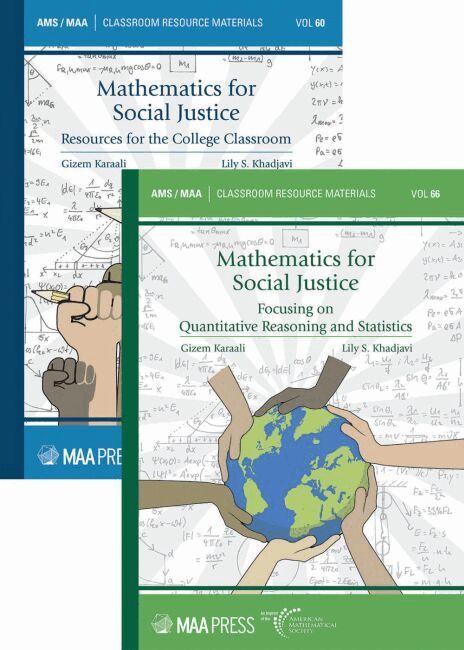
    Mathematics for Social Justice: Resources for the College Classroom and Focusing on Quantitative Reasoning and Statistics (2-Volume Set)

    AvGizem Karaali,Lily Khadjavi

    Häftad, Engelska, 2022

    Del i serien Classroom Resource Materials

    1 170 kr

    Beställningsvara. Skickas inom 5-8 vardagar. Fri frakt över 249 kr.

    Beskrivning

    This two-volume set offers a collection of resources for mathematics faculty interested in incorporating questions of social justice into their classrooms.Mathematics for Social Justice: Resources for the College Classroom begins with a series of essays from instructors experienced in integrating social justice themes into their pedagogy; these essays contain political and pedagogical motivations as well as nuts-and-bolts teaching advice. The heart of the book is a collection of fourteen classroom-tested modules featuring ready-to-use activities and investigations for the college mathematics classroom.Mathematics for Social Justice: Focusing on Quantitative Reasoning and Statistics comprises seventeen classroom-tested modules featuring ready-to-use activities and investigations for college mathematics and statistics courses. The modules empower students to study issues of social justice and to see the power and limitations of mathematics in real-world contexts of deep concern. The primary focus is on classroom activities where students can ask their own questions, find and analyze real data, apply mathematical ideas themselves, and draw their own conclusions.

    Produktinformation

    • Utgivningsdatum:2022-01-30
    • Vikt:1 050 g
    • Format:Häftad
    • Språk:Engelska
    • Serie:Classroom Resource Materials
    • Antal sidor:564
    • Förlag:American Mathematical Society
    • ISBN:9781470469177

    Utforska kategorier

    • Matematik inom Naturvetenskap och teknik
    • Undervisning i specifika ämnen inom Psykologi och pedagogik

    Mer om författaren

    Gizem Karaali, Pomona College, Claremont, CA.Lily Khadjavi, Loyola Marymount University, Los Angeles, CA.

    Recensioner i media

    For mathematics faculty who are interested in incorporating questions regarding social justice into their classrooms, Mathematics for Social Justice offers a variety of resources that can kick start the process. This book is a collection of essays and modules that gives the reader a plethora of ideas for integrating questions of social justice into the mathematics classroom."" —Paula R. Stickles, Millikin University

    Innehållsförteckning

    • Part : Getting started: G. Karaali and L. S. Khadjavi, An invitation to mathematics for social justiceEssays: K. Hamman, Mathematics in service to democracyL. Marano, Preparing for student resistance: Rules of engagement for sensitive topicsJ. Hamilton and T. J. Pfaff, Social justice and sustainability: Two perspectives on the same systemV. Piercey, Quantitative ethicsD. Kung, Math for social justice: A last math class for responsible citizensModules: D. Archey, Sea level change and function compositionJ. Beier, Exploring the problem of human traffickingG. Buhl and S. Q Kelly, Evaluating fairness in electoral districtingS. Cohen and M. Pivarski, Modeling the 2010 Gulf of Mexico oil spillJ. Cullinan and S. Hsiao, Voting with partially-ordered preferencesJ. Curran and A. Ross, Implementing Social Security: A historical role-playing gameJ. Glass and G. Karaali, Matching kids to schools: The school choice problemB. Gonzalez-Arevalo and W. Huang, Modeling the 2008 subprime mortgage crisis in the United StatesB. Gonzalez-Arevalo and W. Urbina-Romero, Using calculus to model income inequalityK. Hamman, What does ""fair"" mean?A. Henderson and E. Kose, Social and environmental justice impacts of industrial agricultureR. Jaafar, Student loans: Fulfilling the American dream or surviving a financial nightmare?A. Vierling-Claassen, Modeling social change: The rise in acceptance of same-sex relationshipsJ. Zobitz, T. Bibelnieks, and M. Lester, Sustainability analysis of a rural Nicaraguan coffee cooperativeG. Karaali and L. S. Khadjavi, PostscriptPart : G. Karaali and L. S. Khadjavi, IntroductionJ. Belock, Understanding over- and underrepresentation via conditional probabilityA. Brisbin, ""I need a job!"": Analyzing unemployment rates in college algebra and introductory statisticsT. M. Brown, A three-part module on povertyF. Fisher and J. Warner, A gentrification module for quantitative reasoningM. M. Franco, Examining human rights issues through the lens of statisticsT. Galanthay and T. J. Pfaff, Normal isn't ``normal'' when it comes to incomeT. Galanthay and T. J. Pfaff, Get the lead out: The connection between lead and crimeD. Greenberg, D. Hughes Hallett, and L. S. Khadjavi, Policing and the issue of racial profilingA. J. Miller, Measures of income inequalityK. Piatek-Jimenez, Super Size Me: Exploring the nutrition of fast foodK. Piatek-Jimenez, Exploring the benefits of recyclingV. Piercey, The new Jim Crow: A racial checkup for the United StatesK. Simic-Muller, Who makes the minimum wage?J. Suzuki, Mandatory drug tests for recipients of public assistance: Mathematical interpretations and implicationsJ. Suzuki, The limits of partisan gerrymanderingZ. Teymuroglu and J. C. Chambliss, Forecasting the past: Teaching regressionsU. Williams, Partisan politics and central tendenciesG. Karaali and L. S. Khadjavi, Mathematics for social justice: Closing thoughts and next steps