Glen Atkinson - Böcker
Visar alla böcker från författaren Glen Atkinson. Handla med fri frakt och snabb leverans.
5 produkter
5 produkter
2 230 kr
Skickas inom 10-15 vardagar
David Hamilton is a leader in the American institutionalist school of heterodox economics that emerged after WWII. This volume includes 25 articles written by Hamilton over a period of nearly half a century. In these articles he examines the philosophical foundations and practical problems of economics. The result of this is a unique institutionalist view of how economies evolve and how economics itself has evolved with them. Hamilton applies insight gained from his study of culture to send the message that human actions situated in culture determine our economic situation. David Hamilton has advanced heterodox economics by replacing intellectual concepts from orthodox economics that hinder us with concepts that help us. In particular, Hamilton has helped replace equilibrium with evolution, make-believe with reality, ideological distortion of government with practical use of government, the economy as a product of natural law with the economy as a product of human law and, last, he has helped us replace the entrepreneur as a hero with the entrepreneur as a real person. These articles provide an alternative to the self-adjusting market. They provide an explanation of how the interaction of cultural patterns and technology determine the evolutionary path of the economic development of a nation. This is not a simple materialist depiction of economic history as some Marxists have advocated, instead Hamilton treats technology and culture as endogenous forces, embedded and inseparable from each other and therefore, economic development. This volume will be of most interest and value to professional economists and graduate students who are looking for an in-depth explanation of the origins and significance of institutional economics.
294 kr
Skickas inom 5-8 vardagar
756 kr
Skickas inom 10-15 vardagar
David Hamilton is a leader in the American institutionalist school of heterodox economics that emerged after WWII. This volume includes 25 articles written by Hamilton over a period of nearly half a century. In these articles he examines the philosophical foundations and practical problems of economics. The result of this is a unique institutionalist view of how economies evolve and how economics itself has evolved with them. Hamilton applies insight gained from his study of culture to send the message that human actions situated in culture determine our economic situation. David Hamilton has advanced heterodox economics by replacing intellectual concepts from orthodox economics that hinder us with concepts that help us. In particular, Hamilton has helped replace equilibrium with evolution, make-believe with reality, ideological distortion of government with practical use of government, the economy as a product of natural law with the economy as a product of human law and, last, he has helped us replace the entrepreneur as a hero with the entrepreneur as a real person. These articles provide an alternative to the self-adjusting market. They provide an explanation of how the interaction of cultural patterns and technology determine the evolutionary path of the economic development of a nation. This is not a simple materialist depiction of economic history as some Marxists have advocated, instead Hamilton treats technology and culture as endogenous forces, embedded and inseparable from each other and therefore, economic development. This volume will be of most interest and value to professional economists and graduate students who are looking for an in-depth explanation of the origins and significance of institutional economics.
1 467 kr
Skickas inom 7-10 vardagar
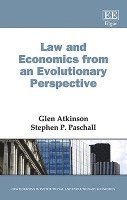
Law and economics are interdependent. Using a historical case analysis approach, this book demonstrates how the legal process relates to and is affected by economic circumstances. Glen Atkinson and Stephen P. Paschall examine this co-evolution in the context of the economic development that occurred in the nineteenth and early twentieth centuries as well as the impact of the law on that development. Specifically, the authors explore the development of a national market, the transformation of the corporation, and the conflict between state and federal control over businesses. Their focus on dynamic, integrated systems presents an alternative to mainstream law and economics.The authors apply John R. Commons's approach to three main law and economics issues: the changing relationship between corporations and the State, the application of the Commerce Clause and the Fourteenth Amendment of the U.S. Constitution to state and federal regulation of business, and the relationship of antitrust law to industrialization. They provide a valuable linking of law with changing economic circumstances, such as antitrust policy changes and the development of the corporate form. This analytical approach to the practice of law and economics will be of interest to researchers, students, and faculty in law and economics, economic history, constitutional law, economic regulation, public policy, and the sociology of law. Business students and researchers will also find value in this book's presentation of court decisions and exploration of economic development.
Evolution of the Corporation in the United States
From Social Control to Financialization
Inbunden, Engelska, 2021
1 473 kr
Skickas inom 7-10 vardagar
This insightful book traces the evolution of corporate power in the United States, from social control over corporate power under early state laws to the modern liberation of the corporation serving primarily private purposes. It illustrates how the transition of attitudes towards corporations and dynamic changes in public policy have ushered in an age of financial fragility, income inequality and macroeconomic instability.The book employs an evolutionary methodology to consider the role of the corporation in the US economy, and how that role as a tool for public purposes, defined by special charters, changed with the widening of markets and increasing industrial capacity for mass production. Evaluating the stages of capitalist development, chapters demonstrate how the co-evolution of law, economics and finance altered economic organization, leading to the evolution of core economic concepts such as capital, income and resources. The book examines the transition of corporate purpose towards generating wealth and enhancing profits in the early twentieth century and analyzes recent trends through illuminating case studies in financialization. It concludes with crucial insights into the future of the corporation, offering potential pathways for economists to intervene and address the systemic problems that are endemic to the modern financial era.A rousing and provocative call to arms for modern economists, this book is key reading for scholars and researchers of economics, particularly those focusing on the evolution of economic and business institutions and its impact on the social fabric of the US. Practitioners and policymakers will also benefit from its empirical perspectives on financialization.