• Fri frakt över 249 kr
  • •
  • Snabba leveranser
  • •
  • Billiga böcker
Kundservice

Du är på sajten för privatpersoner.

Företag, bibliotek eller offentlig verksamhet?

Du handlar på classic.bokus.com, där alla dina funktioner finns intakta.
Till classic.bokus.com
Bokus logotyp. Gå till startsidan.
  • Erbjudanden
  • Nyheter
  • Student
  • Topplistor
  • Barn & ungdom
  • Bokus Play
  • E-böcker
  • Pocketböcker
  • Spel & pussel

10% rabatt på allt med kod: NYSTART10 →

Sidfot

Mina sidor

    Hjälp

    • Kundservice
    • Vanliga frågor och svar
    • Frakt och leverans
    • Retur vid ångerrätt
    • Reklamera vara
    • Betalning
    • Köpvillkor
    • Allmänna villkor
    • Information om webbplatsens tillgänglighet

    Om Bokus

    • Om oss
    • Pressrum
    • För studenter
    • För företag
    • För bibliotek och offentlig verksamhet
    • För leverantörer
    • Hållbarhet

    Populärt

    • Aktuella erbjudanden
    • Presentkort
    • Studentlitteratur
    • Nya böcker
    • Topplistor
    • Signerade böcker
    • Engelska böcker

    Inspiration

    • Boktips
    • BookTok
    • Populära bokserier
    • Barnbokskaraktärer
    • Populära författare
    Logotyp för Bokus
    Följ oss på Facebook (extern länk)Följ oss på Instagram (extern länk)Följ oss på YouTube (extern länk)Följ oss på TikTok (extern länk)
    bokus @ CookiesAnpassa cookiesIntegritetspolicyKöpvillkor
    Till Citymail hemsida (extern länk)Till Budbee hemsida (extern länk)Till Postnord hemsida (extern länk)Till Schenker hemsida (extern länk)Till Early Bird hemsida (extern länk)Till Walleys hemsida (extern länk)
    1. Samhälle och politik
    2. Samhälle och kultur
    3. Kultur och medier
    4. Kulturvetenskap

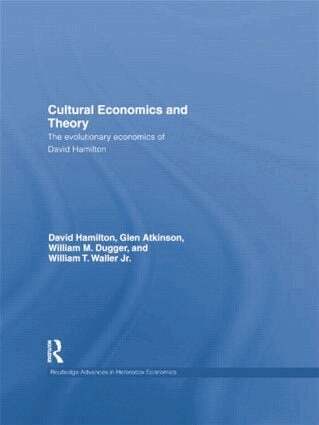
    Cultural Economics and Theory

    The evolutionary economics of David Hamilton

    AvDavid Hamilton,Glen Atkinson

    Häftad, Engelska, 2014

    Del i serien Routledge Advances in Heterodox Economics

    821 kr

    Beställningsvara. Skickas inom 10-15 vardagar. Fri frakt över 249 kr.

    Beskrivning

    David Hamilton is a leader in the American institutionalist school of heterodox economics that emerged after WWII. This volume includes 25 articles written by Hamilton over a period of nearly half a century. In these articles he examines the philosophical foundations and practical problems of economics. The result of this is a unique institutionalist view of how economies evolve and how economics itself has evolved with them. Hamilton applies insight gained from his study of culture to send the message that human actions situated in culture determine our economic situation. David Hamilton has advanced heterodox economics by replacing intellectual concepts from orthodox economics that hinder us with concepts that help us. In particular, Hamilton has helped replace equilibrium with evolution, make-believe with reality, ideological distortion of government with practical use of government, the economy as a product of natural law with the economy as a product of human law and, last, he has helped us replace the entrepreneur as a hero with the entrepreneur as a real person. These articles provide an alternative to the self-adjusting market. They provide an explanation of how the interaction of cultural patterns and technology determine the evolutionary path of the economic development of a nation. This is not a simple materialist depiction of economic history as some Marxists have advocated, instead Hamilton treats technology and culture as endogenous forces, embedded and inseparable from each other and therefore, economic development. This volume will be of most interest and value to professional economists and graduate students who are looking for an in-depth explanation of the origins and significance of institutional economics.

    Produktinformation

    • Utgivningsdatum:2014-05-30
    • Mått:156 x 234 x undefined mm
    • Vikt:500 g
    • Format:Häftad
    • Språk:Engelska
    • Serie:Routledge Advances in Heterodox Economics
    • Antal sidor:268
    • Förlag:Taylor & Francis Ltd
    • ISBN:9781138803022

    Utforska kategorier

    • Kulturvetenskap inom Samhälle och politik
    • Nationalekonomi inom Ekonomi och Ledarskap
    • Ekonomisk politik inom Ekonomi och Ledarskap

    Mer om författaren

    David Hamilton is currently Emeritus Professor at the University of New Mexico.William M. Dugger is Professor of Economics at the University of Tulsa. Glen Atkinson is Professor of Economics at University of Nevada, Reno. William Waller is Professor of Economics at Hobart and William Smith Colleges.

    Recensioner i media

    "The world-wide distribution of David Hamilton’s book, Evolutionary Economics, established his international reputation as a leading figure in the literature of American institutional economics. But his contributions to evolutionary institutional economics are also contained in the steady stream of articles he published over the last half of the twentieth century. This definitive collection of his publications makes that body of work immediately accessible. Hamilton’s refreshingly original ideas, clothed as they are in a graceful prose that is seldom found in economic writing, are as pertinent today as they were when he wrote them. He demonstrates why mainstream economics is generally irrelevant to the world in which we live and how a reorientation of the discipline to an evolutionary perspective would correct this deficiency. "- Paul D. Bush, Professor Emeritus of Economics, California State University, Fresno, USA. 2009 Veblen-Commons Award Recipient."David Hamilton emerged in the 1950s as one of the most important American figures in the original tradition of institutional economics. Among his many forceful and enduring themes is his emphasis on the evolutionary and Darwinian character of Veblenian institutionalism. This is a very useful collection of his writings."- Geoff Hodgson, Research Professor in Business Studies, Business School, University of Hertfordshire, UK.

    Innehållsförteckning

    • Part 1: Economic Thought and Cultural Economics, 1. Veblen and Commons: A Case of Theoretical Convergence, 2. Hobson With a Keynesian Twist, 3. Keynes, Cooperation, and Economic Stability, 4. A Theory of the Social Origins of the Factors of Production, 5. Ceremonial Aspects of Corporate Organization, 6. The Entrepreneur as a Cultural Hero, 7. Why Is Institutional Economics Not Institutional?, 8. Drawing the Poverty Line at a Cultural Subsistence Level, 9. The Great Wheel of Wealth, Part 2: Structural Policy and Economic Theory, 10. Reciprocity, Productivity, and Poverty, 11. The Political Economy of Poverty, 12. The U.S. Economy: Disadvantages of Having Taken the Lead, 13. The Myth Is not the Reality: Income Maintenance and Welfare, 14. The Paper War on Poverty, 15. Welfare Reform in the Reagan Years, 16. What Has Evolutionary Economics to Contribute to Consumption Theory?, 17. Institutional Economics and Consumption, 18. Thorstein Veblen as the First Professor of Marketing Science, 19. On Staying for the Canoe Building, Or Why Ideology Is Not Enough, 20. Ceremonialism as the Dramatization of Prosaic Technology, 21. Economics: Science or Legend?, 22. The Cure May Be the Cancer, Section Four: Elements of Institutionalism, 23. Is Institutional Economics Really "Root and Branch" Economics?, 24. Rickshaws, Treadmills, Galley Slaves, and Chernobyl, 25. Technology and Institutions Are Neither