Gonzalo R. Arce - Böcker
Visar alla böcker från författaren Gonzalo R. Arce. Handla med fri frakt och snabb leverans.
4 produkter
4 produkter
1 339 kr
Skickas inom 7-10 vardagar
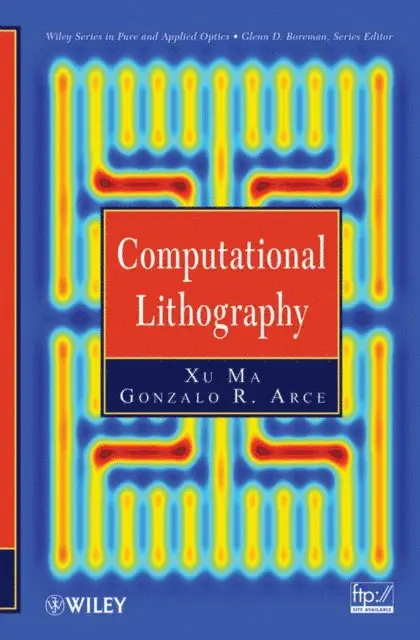
A Unified Summary of the Models and Optimization Methods Used in Computational Lithography Optical lithography is one of the most challenging areas of current integrated circuit manufacturing technology. The semiconductor industry is relying more on resolution enhancement techniques (RETs), since their implementation does not require significant changes in fabrication infrastructure. Computational Lithography is the first book to address the computational optimization of RETs in optical lithography, providing an in-depth discussion of optimal optical proximity correction (OPC), phase shifting mask (PSM), and off-axis illumination (OAI) RET tools that use model-based mathematical optimization approaches.The book starts with an introduction to optical lithography systems, electric magnetic field principles, and the fundamentals of optimization from a mathematical point of view. It goes on to describe in detail different types of optimization algorithms to implement RETs. Most of the algorithms developed are based on the application of the OPC, PSM, and OAI approaches and their combinations. Algorithms for coherent illumination as well as partially coherent illumination systems are described, and numerous simulations are offered to illustrate the effectiveness of the algorithms. In addition, mathematical derivations of all optimization frameworks are presented.The accompanying MATLAB® software files for all the RET methods described in the book make it easy for readers to run and investigate the codes in order to understand and apply the optimization algorithms, as well as to design a set of optimal lithography masks. The codes may also be used by readers for their research and development activities in their academic or industrial organizations. An accompanying MATLAB® software guide is also included. An accompanying MATLAB® software guide is included, and readers can download the software to use with the guide at ftp://ftp.wiley.com/public/sci_tech_med/computational_lithography.Tailored for both entry-level and experienced readers, Computational Lithography is meant for faculty, graduate students, and researchers, as well as scientists and engineers in industrial organizations whose research or career field is semiconductor IC fabrication, optical lithography, and RETs. Computational lithography draws from the rich theory of inverse problems, optics, optimization, and computational imaging; as such, the book is also directed to researchers and practitioners in these fields.
2 037 kr
Skickas inom 11-20 vardagar
Nonlinear Signal Processing: A Statistical Approach focuses on unifying the study of a broad and important class of nonlinear signal processing algorithms which emerge from statistical estimation principles, and where the underlying signals are non-Gaussian, rather than Gaussian, processes. Notably, by concentrating on just two non-Gaussian models, a large set of tools is developed that encompass a large portion of the nonlinear signal processing tools proposed in the literature over the past several decades. Key features include:* Numerous problems at the end of each chapter to aid development and understanding* Examples and case studies provided throughout the book in a wide range of applications bring the text to life and place the theory into context* A set of 60+ MATLAB software m-files allowing the reader to quickly design and apply any of the nonlinear signal processing algorithms described in the book to an application of interest is available on the accompanying FTP site.
1 910 kr
Tillfälligt slut
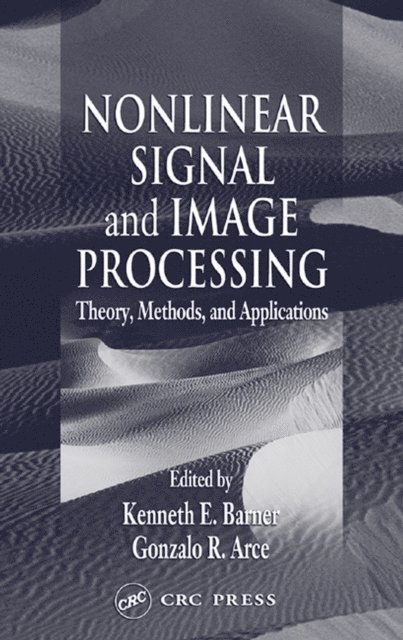
Nonlinear signal and image processing methods are fast emerging as an alternative to established linear methods for meeting the challenges of increasingly sophisticated applications. Advances in computing performance and nonlinear theory are making nonlinear techniques not only viable, but practical.This book details recent advances in nonlinear theory and methods and explores an array of modern signal and image processing applications. The first several chapters focus on nonlinear signal processing theory, targeting three critical areas: filter analysis, nonlinear filter class design, and signal analysis. The remaining chapters explore nonlinear approaches across the broad spectrum of applications with signal processing components, from data traffic modeling and image enhancement to cutting edge applications in genomics.All of the chapters were contributed by well-known theorists and application-driven researchers who explore current and emerging nonlinear methods from their theoretical background and practical algorithms through the potential of these methods for solving important open questions. Nonlinear Signal and Image Processing: Theory, Methods, and Applications thus provides a singular opportunity to build a strong, fundamental understanding of nonlinear theory and methods and a foundation upon which to approach many of today's most interesting and challenging signal processing problems.
3 185 kr
Skickas inom 10-15 vardagar
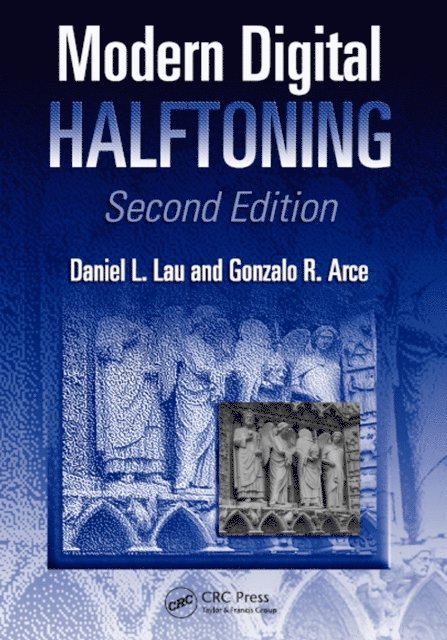
The late 1980s, revolutionary advances in digital halftoning enabled inkjet printers to achieve much higher image fidelity. The rapid rate of progress has resulted in numerous breakthroughs scattered throughout the literature, rendering old technologies obsolete and renewing the need for a centralized source on the current state of the art. Entirely revised and updated, Modern Digital Halftoning, Second Edition provides an integrated and up-to-date treatment of stochastic halftoning and digital printing.Using full-color illustrations to enhance the text, this edition incorporates new topics as well as updated models, algorithms, and methods used to construct and improve the quality of green-noise, blue-noise, and multitone images. Following a review of various halftoning techniques, this edition now covers amplitude modulated dither arrays, adapting to human visual models, direct binary search, and handling stochastic moiré problems. It also presents a new chapter on lenticular printing, a means for printing color holographic images. Accompanying downloadable resources contain MATLAB® software files and illustrated examples employing algorithms, statistics, and other key concepts from the book. Documenting the development of digital printing since the first edition, Modern Digital Halftoning, Second Edition offers a well-rounded and accurate perspective on the technological capabilities of digital printing and provides all the necessary tools for continuing research in the field.