Gordon R. Willey - Böcker
Visar alla böcker från författaren Gordon R. Willey. Handla med fri frakt och snabb leverans.
8 produkter
8 produkter
433 kr
Skickas inom 10-15 vardagar
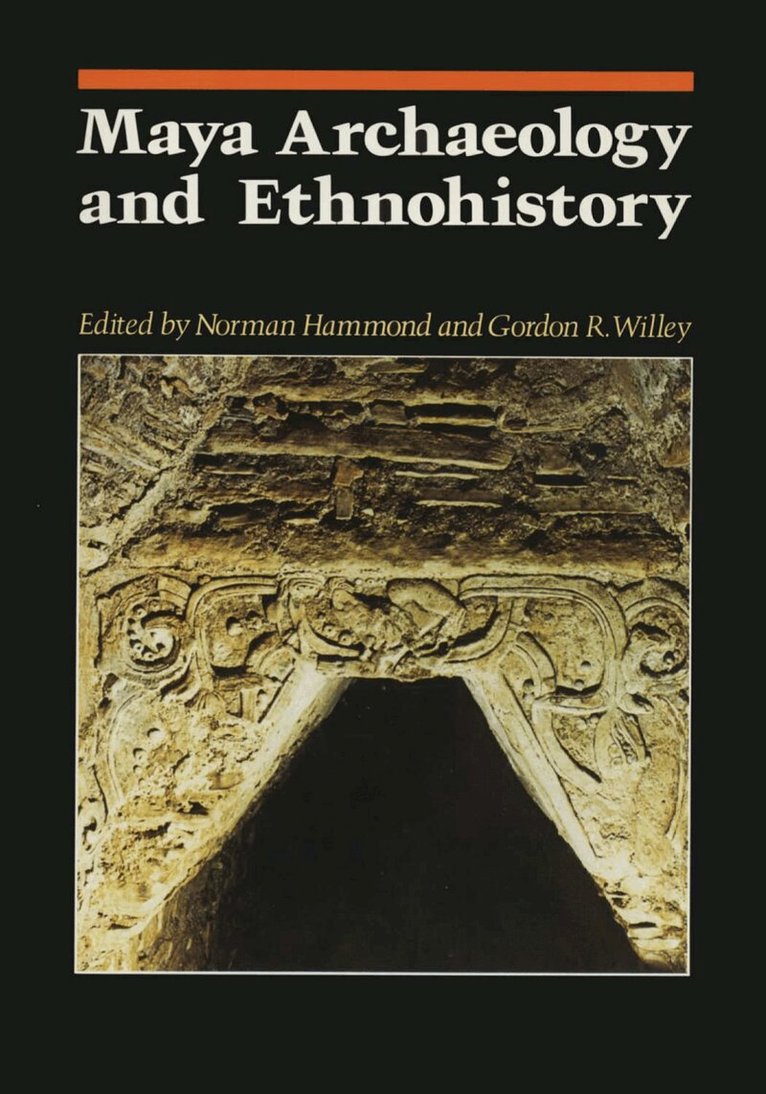
Embracing a wide range of research, this book offers various views on the intellectual history of Maya archaeology and ethnohistory and the processes operating in the rise and fall of Maya civilization. The fourteen studies were selected from those presented at the Second Cambridge Symposium on Recent Research in Mesoamerican Archaeology and are presented in three major sections. The first of these deals with the application of theory, both anthropological and historical, to the great civilization of the Classic Maya, which flourished in the Yucatan, Guatemala, and Belize during the first millennium A.D. The structural remains of the Classic Period have impressed travelers and archaeologists for over a century, and aspects of the development and decline of this strange and brilliant tropical forest culture are examined here in the light of archaeological research. The second section presents the results of field research ranging from the Highlands of Mexico east to Honduras and north into the Lowland heart of Maya civilization, and iconographic study of excavated material. The third section covers the ethnohistoric approach to archaeology, the conjunction of material and documentary evidence. Early European documents are used to illuminate historic Maya culture. This section includes transcriptions of previously unpublished archival material. Although not formally linked beyond their common field of inquiry, the essays here offer a conspectus of late-twentieth century Maya research and a series of case histories of the work of some of the leading scholars in the field.
1 177 kr
Skickas inom 10-15 vardagar
Places on record what is known about prehistoric settlement patterns in several American areas. It provides basic source material and areas of interest for future research.
427 kr
Skickas inom 7-10 vardagar
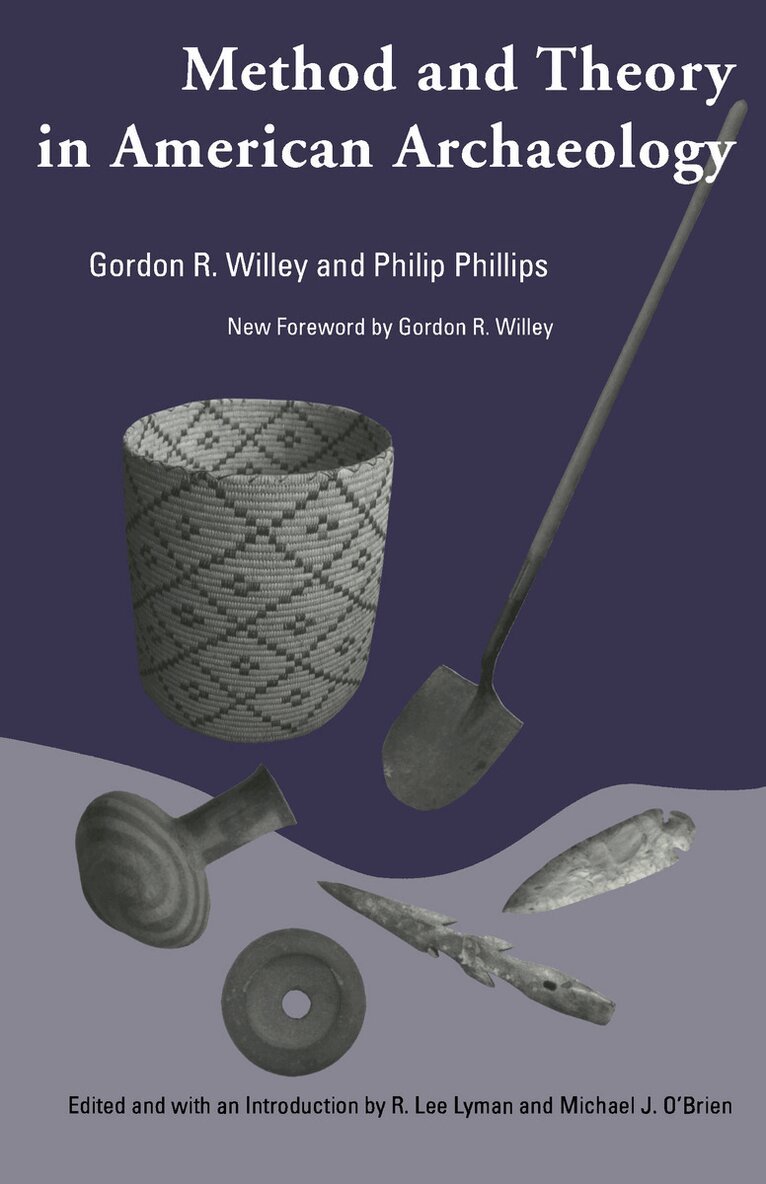
In 1958 Gordon R. Willey and Philip Phillips first published Method and Theory in American Archaeology - a volume that went through five printings, the last in 1967 at the height of what became known as the new, or processual, archaeology. The advent of processual archaeology, according to Willey and Phillips, represented a ""theoretical debate...a question of whether archaeology should be the study of cultural history or the study of cultural process."" Willey and Phillips suggested that little interpretation had taken place in American archaeology, and their book offered an analytical perspective; the methods they described and the structural framework they used for synthesizing American prehistory were all geared toward interpretation. Method and Theory served as the catalyst and primary reader on the topic for over a decade. This facsimile reprint edition of the original University of Chicago Press volume includes a new foreword by Gordon R. Willey, which outlines the state of American archaeology at the time of the original publication, and a new introduction by the editors to place the book in historical context. The bibliography is exhaustive. Academic libraries, students, professionals, and knowledgeable amateurs will welcome this new edition of a standard-maker among texts on American archaeology.
290 kr
Skickas inom 7-10 vardagar
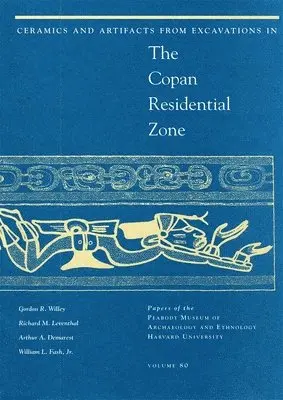
Del 80 - Papers of the Peabody Museum
Ceramics and Artifacts from Excavations in the Copan Residential Zone
Häftad, Engelska, 1995
574 kr
Skickas inom 7-10 vardagar
Del 16 - Peabody Museum Memoirs
1. Peripheral Survey and Excavation. 2. Settlement and Community Patterns
Häftad, Engelska, 1989
614 kr
Skickas inom 7-10 vardagar
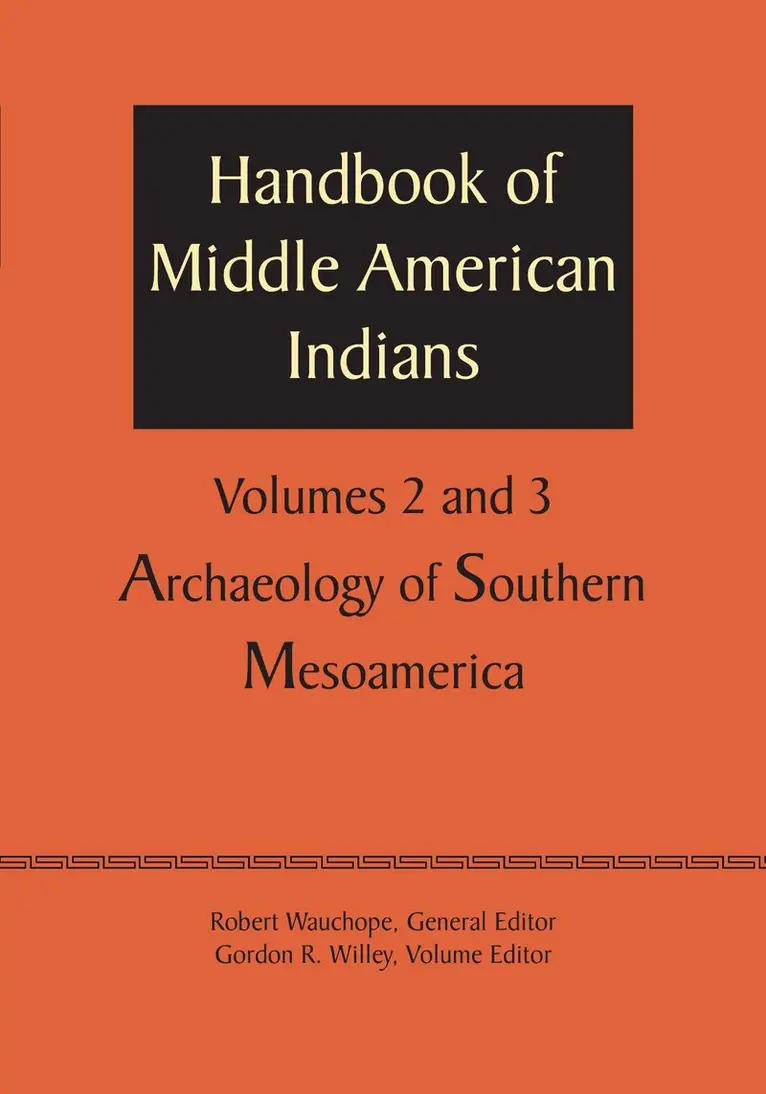
Handbook of Middle American Indians, Volumes 2 and 3
Archaeology of Southern Mesoamerica
Häftad, Engelska, 1965
1 367 kr
Skickas inom 10-15 vardagar
Archaeology of Southern Mesoamerica comprises the second and third volumes in the Handbook of Middle American Indians, published in cooperation with the Middle American Research Institute of Tulane University under the general editorship of Robert Wauchope (1909–1979). The volume editor is Gordon R. Willey (1913–2002), Bowditch Professor of Mexican and Central American Archaeology and Ethnology at Harvard University. Volumes Two and Three, with more than 700 illustrations, contain archaeological syntheses, followed by special articles on settlement patterns, architecture, funerary practices, ceramics, artifacts, sculpture, painting, figurines, jades, textiles, minor arts, calendars, hieroglyphic writing, and native societies at the time of the Spanish conquest of the Guatemala highlands, the southern Maya lowlands, the Pacific coast of Guatemala, Chiapas, the upper Grijalva basin, southern Veracruz, Tabasco, and Oaxaca. The Handbook of Middle American Indians was assembled and edited at the Middle American Research Institute of Tulane University with the assistance of grants from the National Science Foundation and under the sponsorship of the National Research Council Committee on Latin American Anthropology.
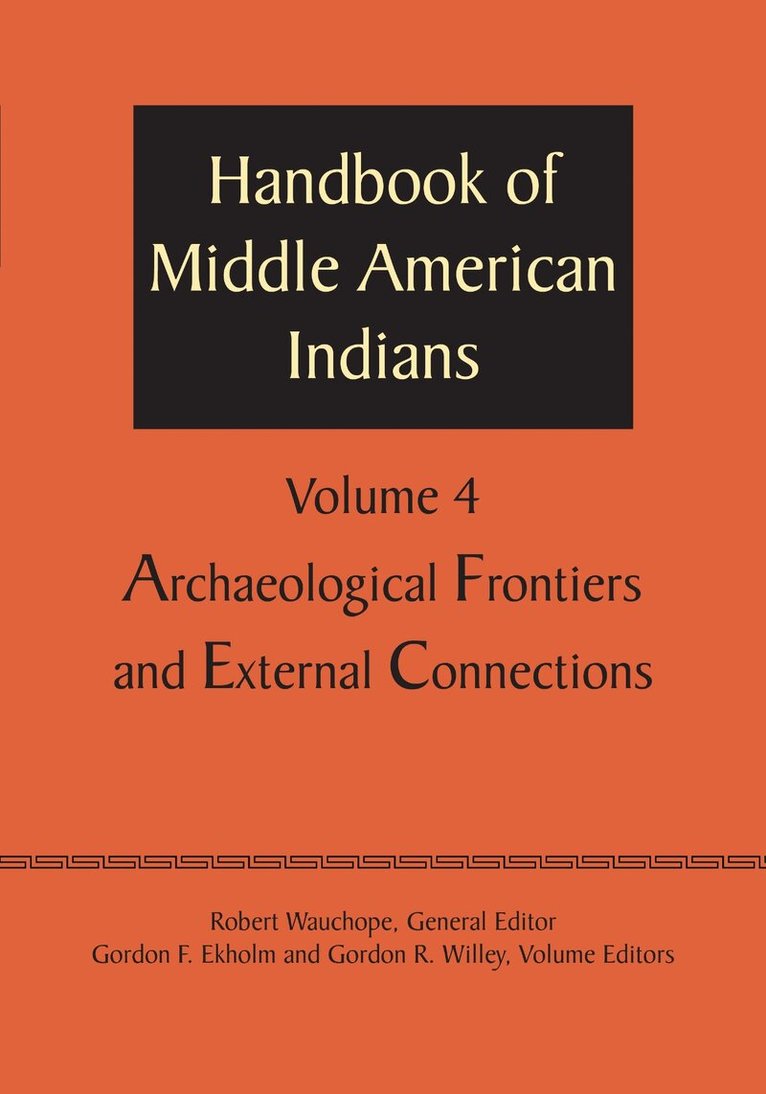
Handbook of Middle American Indians, Volume 4
Archaeological Frontiers and External Connections
Häftad, Engelska, 1966
529 kr
Skickas inom 10-15 vardagar
Archaeological Frontiers and External Connections is the fourth volume in the Handbook of Middle American Indians, published in cooperation with the Middle American Research Institute of Tulane University under the general editorship of Robert Wauchope (1909–1979). Volume editors are Gordon R. Willey (1913–2002), Bowditch Professor of Mexican and Central American Archaeology and Ethnology at Harvard University, and Gordon F. Ekholm (1909–1987), Associate Curator of Mexican Archaeology of the American Museum of Natural History in New York. This volume presents an intensive study of matters of significance in various areas: archaeology and ethnohistory of the Northern Sierra, Sonora, Lower California, and northeastern Mexico; external relations between Mesoamerica and the southwestern United States and eastern United States; archaeology and ethnohistory of El Salvador, western Honduras, and lower Central America; external relations between Mesoamerica and the Caribbean area, Ecuador, and the Andes; and the case for and against Old World pre-Columbian contacts via the Pacific. Many photographs accompany the text. The Handbook of Middle American Indians was assembled and edited at the Middle American Research Institute of Tulane University with the assistance of grants from the National Science Foundation and under the sponsorship of the National Research Council Committee on Latin American Anthropology.