Gordon Wilson - Böcker
Visar alla böcker från författaren Gordon Wilson. Handla med fri frakt och snabb leverans.
16 produkter
16 produkter
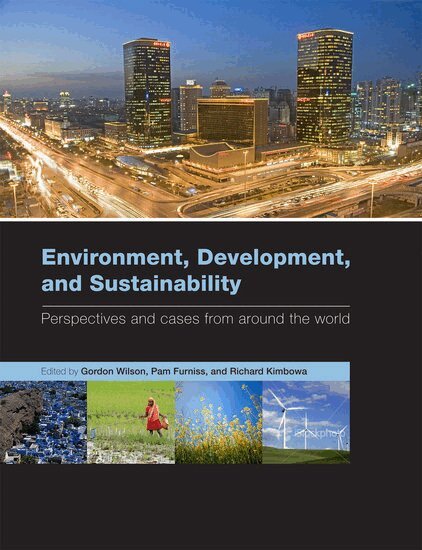
Environment, Development, and Sustainability
Perspectives and cases from around the world
Häftad, Engelska, 2009
687 kr
Skickas inom 5-8 vardagar
As the human population continues to place increasing demands on the planet we inhabit we face the biggest challenge of our time: how can we exploit the natural resources that we need - whether it be for water, food, or energy - in a way that preserves the environment, is equitable and doesn't compromise the long-term future of the planet and its biodiversity?Environment, Development, and Sustainability represents an examination of three integrated issues that form the main ongoing challenge of this century. Featuring a range of perspectives and case studies from North America, Europe, Africa, Asia and Australasia, the book reflects the multiple ways in which environment, development and sustainability are intertwined everywhere - in rich and poor countries, and those in between.Contributions from both practitioners and academics, bringing experiences as technologists, engineers, natural scientists and social scientists, expand further the many perspectives on the challenge. The book celebrates this diversity, using it positively as a resource for a more holistic learning approach to environment, development and sustainability.Environment, Development, and Sustainability is written as a student textbook where individual chapters can be stand-alone, or where, helped by a linking narrative, the book can be read as a whole. Its accessible style, however, makes it suitable for a broader audience, including practitioners, activists and citizens who simply wish to know more.Online Resource CentreFor registered adopters:Figures from the book available to downloadFor students:Library of web links cited in the bookFlashcard glossary
114 kr
Skickas
972 kr
Skickas inom 5-8 vardagar
364 kr
Skickas inom 5-8 vardagar
301 kr
Skickas inom 5-8 vardagar
112 kr
Skickas inom 5-8 vardagar
Darwin's Sandcastle
Evolution's Failure in the Light of Scripture and the Scientific Evidence
Häftad, Engelska, 2023
272 kr
Skickas inom 5-8 vardagar
Different Shade of Green
A Biblical Approach to Environmentalism and the Dominion Mandate
Häftad, Engelska, 2019
236 kr
Skickas inom 5-8 vardagar
974 kr
Skickas inom 10-15 vardagar
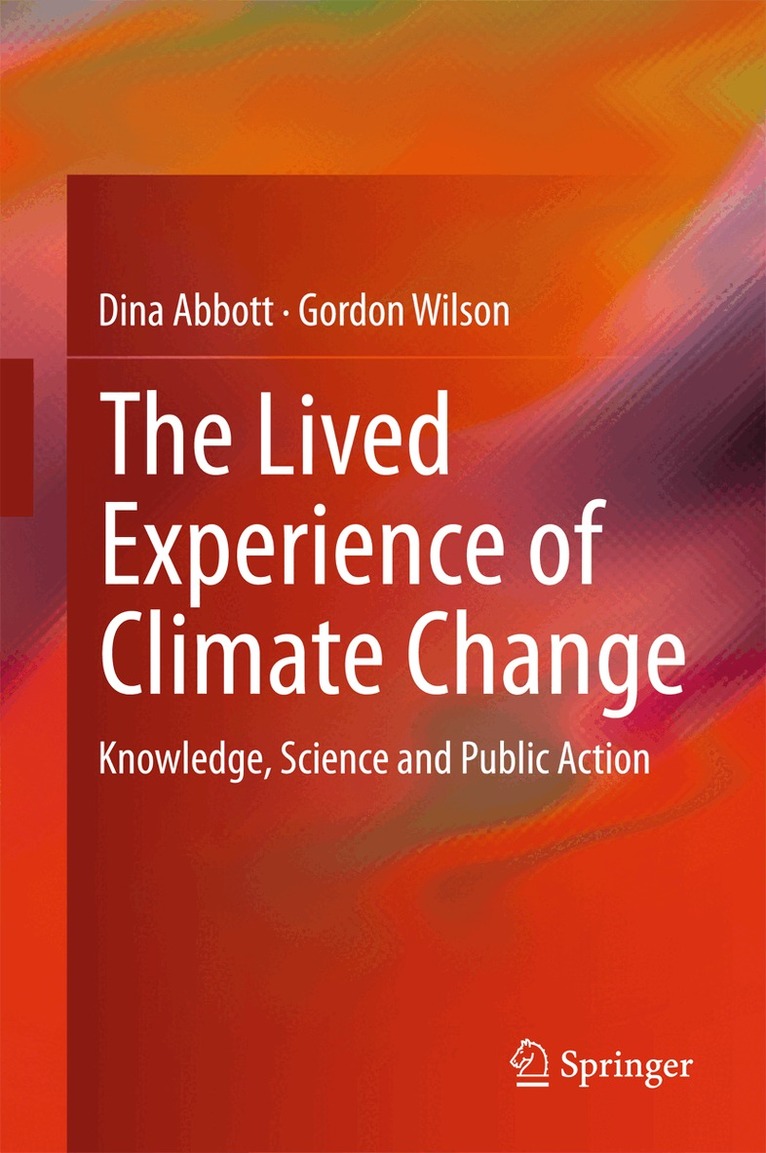
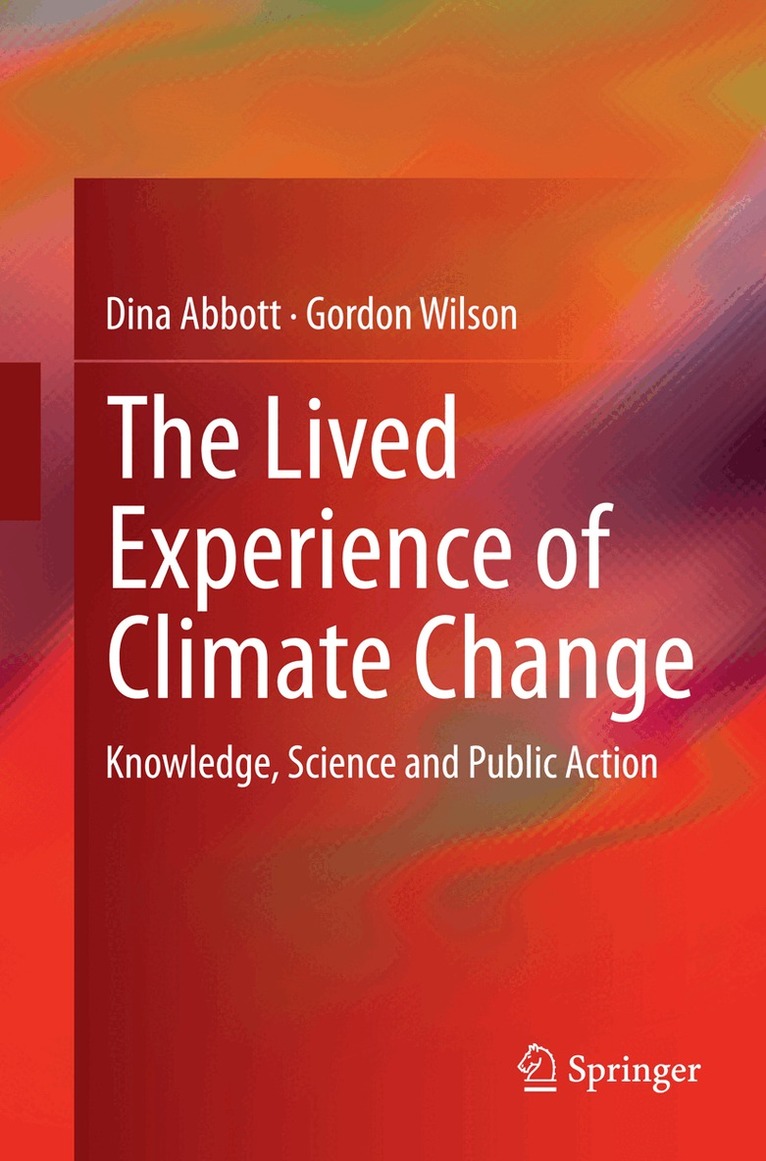
This book explores the idea that daily lived experiences of climate change are a crucial missing link in our knowledge that contrasts with scientific understandings of this global problem. It argues that both kinds of knowledge are limiting: the sciences by their disciplines and lived experiences by the boundaries of everyday lives. Therefore each group needs to engage the other in order to enrich and expand understanding of climate change and what to do about it.Complemented by a rich collection of examples and case studies, this book proposes a novel way of generating and analysing knowledge about climate change and how it may be used. The reader is introduced to new insights where the book:• Provides a framework that explains the variety of simultaneous, co-existing and often contradictory perspectives on climate change.• Reclaims everyday experiential knowledge as crucial for meeting global challenges such as climate change.• Overcomes the science-citizen dichotomy and leads to new ways of examining public engagement with science. Scientists are also human beings with lived experiences that filter their scientific findings into knowledge and actions.• Develops a ‘public action theory of knowledge’ as a tool for exploring how decisions on climate policy and intervention are reached and enacted.While scientists (physical and social) seek to explain climate change and its impacts, millions of people throughout the world experience it personally in their daily lives. The experience might be bad, as during extreme weather, engender hostility when governments attempt mitigation, and sometimes it is benign. This book seeks to understand the complex, often contradictory knowledge dynamics that inform the climate change debate, and is written clearly for a broad audience including lecturers, students, practitioners and activists, indeed anyone who wishes to gain further insight into this far-reachingissue.
974 kr
Skickas inom 10-15 vardagar
This book explores the idea that daily lived experiences of climate change are a crucial missing link in our knowledge that contrasts with scientific understandings of this global problem. It argues that both kinds of knowledge are limiting: the sciences by their disciplines and lived experiences by the boundaries of everyday lives. Therefore each group needs to engage the other in order to enrich and expand understanding of climate change and what to do about it.Complemented by a rich collection of examples and case studies, this book proposes a novel way of generating and analysing knowledge about climate change and how it may be used. The reader is introduced to new insights where the book:• Provides a framework that explains the variety of simultaneous, co-existing and often contradictory perspectives on climate change.• Reclaims everyday experiential knowledge as crucial for meeting global challenges such as climate change.• Overcomes the science-citizen dichotomy and leads to new ways of examining public engagement with science. Scientists are also human beings with lived experiences that filter their scientific findings into knowledge and actions.• Develops a ‘public action theory of knowledge’ as a tool for exploring how decisions on climate policy and intervention are reached and enacted.While scientists (physical and social) seek to explain climate change and its impacts, millions of people throughout the world experience it personally in their daily lives. The experience might be bad, as during extreme weather, engender hostility when governments attempt mitigation, and sometimes it is benign. This book seeks to understand the complex, often contradictory knowledge dynamics that inform the climate change debate, and is written clearly for a broad audience including lecturers, students, practitioners and activists, indeed anyone who wishes to gain further insight into this far-reachingissue.
763 kr
Tillfälligt slut
Henry of Ghent's Quodlibet XV, his last Quodlibet before his death, was composed sometime after the fall of Acre (May 10, 1291) and Nicolas IV's letter Illuminet super nos (sent on August 1, 1291), both of which are referred to in this Quodlibeta. This Quodlibet would have been prepared for distribution shortly after the public disputation was delivered, either in Advent of 1291 or Lent of 1292. The sixteen questions treat a range of issues, e.g. the immaculate conception, the omnipotence of God, the nature of an "instance", the absolute and ordained powers of the pope and the nature of a just war. The positions of Henry in Quodlibet XV were influential. For example, nearly a century after its composition, Thomas de Rossy refers to this text of Henry in his De conceptione Virginis Immaculatae. The text was reconstructed based upon manuscripts copied from a first Parisian university exemplar, manuscripts whose model was probably a second Parisian university exemplar, and a manuscript which was in the possession of Godfrey of Fontaines, whose model may have been a nearly completed version of what would ultimately be a source of the first Parisian exemplar.
646 kr
Skickas
Ancient and Medieval Philosophy-Series 2, No. 37The Stadsbibliotheek of Brugge houses a manuscript (ms. 510, f. 227ra-237vb) that holds a short logical text on the Syncategoremata. In this manuscript the text is ascribed to Henry of Ghent, who was a leading thinker of the second half of the thirteenth century. If Henry wrote the text, he had much more technical knowledge of logic and semantics than is often imagined. The text was influenced by the logical works of Peter of Spain.
1 057 kr
Tillfälligt slut
Henry of Ghent, the most influential philosopher/theologian of the last quarter of the 13th century at Paris, delivered his fourth Quodlibet during 1279. This Quodlibet was written at the beginning of what could be called the height of his career.In total there are 37 questions, which cover a wide range of topics, including theories in theology, metaphysics, epistemology, philosophical anthropology, ethics, and canon law. In these questions Henry presents his mature thought concerning the number of human substantial forms in which he counters the claims of the defenders of Thomas Aquinas, particularly those in Giles of Lessines’s De unitate formae, but also those found in Giles of Rome’s Contra Gradus. He is critical of Thomas Aquinas’s theories concerning human knowledge, the ‘more’ and the ‘less,’ and virtue. He also is critical of Bonaventure’s analysis of Augustine’s notion of rationes seminales.There are 33 known manuscripts which contain the text of Quodlibet IV, and the critical text is reconstructed based upon manuscripts known to have been in Henry’s school, as well as manuscripts copied from two successive university exemplars in Paris.
963 kr
Skickas inom 5-8 vardagar
Critical study of the ‘second part’ of Henry’s Summa devoted to the Persons of the Trinity Henry of Ghent’s Summa, art. 53-55, was composed shortly after Christmas of 1281, at the height of Henry’s teaching career in the Theology Faculty at the University in Paris. These questions, which begin the ‘second part’ of his Summa, are devoted to the Persons of the Trinity. They contain Henry’s philosophical analyses of the theoretical concepts person, relation, and universals. The text has been reconstructed based upon manuscripts copied from a first and second Parisian university exemplar. In the critical study that precedes the Latin text, the editors argue that the manuscript, Biblioteca VATICANA, Borghese 17, which contains the texts of these articles and which has, in the latter part of this manuscript, many of the features of an exemplar divided into pecia, could not have been the exemplar divided into pecia for these particular articles. The volume concludes with the typical tables. This publication is GPRC-labeled (Guaranteed Peer-Reviewed Content).
1 564 kr
Skickas inom 5-8 vardagar
The history of logic and its development during the medieval period. Radulphus Brito’s Quaestiones super Priora Analytica Aristotelis is a major work written in the early 1300s which treated Aristotle’s text devoted to the theory of the syllogism. Brito, perhaps one of the most influential medieval thinkers known as the Modistae, examines both categorical and hypothetical syllogisms. In his text, based on six known manuscripts which are complete or nearly complete, Brito was critical of many of the theories of his contemporary, Simon of Faversham. It should also be mentioned that Brito edited his work several times. There are at least two versions which indicate Brito returned to this material during his long career at the university in Paris. This volume is the first critical text edition of Brito’s Quaestiones super Priora Analytica Aristotelis and will therefore be of great interest to those studying the history of logic and its development during the medieval period.This publication is GPRC-labeled (Guaranteed Peer-Reviewed Content).
1 204 kr
Tillfälligt slut
Articles 56-59 of Henry of Ghent's Summa is devoted to the trinitarian properties. Henry was the most important Christian theological thinker in the last quarter of the 13th century and his works were influential not only in his lifetime, but also in the following century and into the Renaissance.Henry's Quaestiones ordinariae (Summa), articles 56-59 deal with the trinitarian properties and relations, topics of Henry's lectures at the university in Paris. In these articles, dated around 1286, Henry treats generation, a property unique to the Father, and being generated, a property unique to the Son.The university in Paris distributed articles 56-59 by means of two successive exemplars divided into peciae. Manuscripts copied from each have survived and the text of the critical edition has been established based upon the reconstructed texts of these two exemplars.