Greg Frost-Arnold – författare
Visar alla böcker från författaren Greg Frost-Arnold. Handla med fri frakt och snabb leverans.
8 produkter
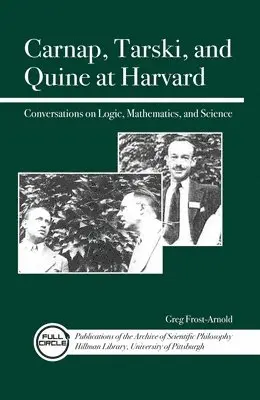
Carnap, Tarski, and Quine at Harvard
Conversations on Logic, Mathematics, and Science
Häftad, 2013
433 kr
Lägg i varukorg
During the academic year 1940-1941, several giants of analytic philosophy congregated at Harvard, holding regular private meetings, with Carnap, Tarski, and Quine. Carnap, Tarski, and Quine at Harvard allows the reader to act as a fly on the wall for their conversations. Carnap took detailed notes …
Rudolf Carnap: Studies in Semantics
The Collected Works of Rudolf Carnap, Volume 7
Av Greg Frost-Arnold, Steve Awodey
E-bok, 2024
1870 kr
Lägg i varukorg
This volume contains Carnap''s Studies in Semantics , a series of three interlocking books: Introduction to Semantics (1942), Formalization of Logic (1942), and Meaning and Necessity (1947). They were extremely influential in their time, especially the third, and shaped the direction of analytic …
Rudolf Carnap: Studies in Semantics
The Collected Works of Rudolf Carnap, Volume 7
Av Steve Awodey, Greg Frost-Arnold
Inbunden, 2024
1825 kr
Lägg i varukorg
This volume contains Carnap's Studies in Semantics, a series of three interlocking books: Introduction to Semantics (1942), Formalization of Logic (1942), and Meaning and Necessity (1947). They were extremely influential in their time, especially the third, and shaped the direction of analytic …
Rudolf Carnap: Studies in Semantics
The Collected Works of Rudolf Carnap, Volume 7
Av Greg Frost-Arnold, Steve Awodey
E-bok, 2024
1870 kr
Lägg i varukorg
This volume contains Carnap''s Studies in Semantics , a series of three interlocking books: Introduction to Semantics (1942), Formalization of Logic (1942), and Meaning and Necessity (1947). They were extremely influential in their time, especially the third, and shaped the direction of analytic …
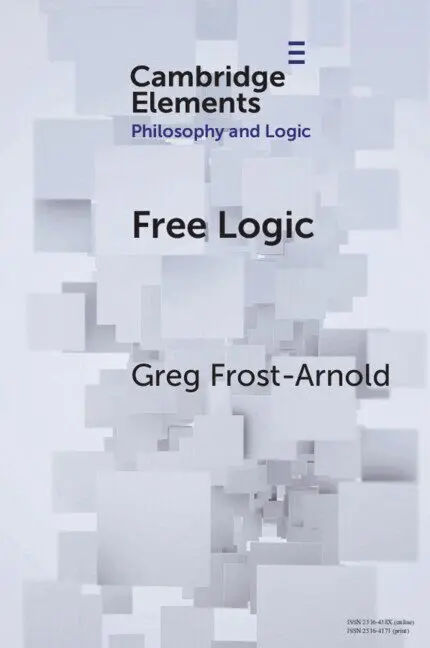
Free Logic
A Generalization
Häftad, 2025
308 kr
Lägg i varukorg
Classical logic assumes that names are univocal: every name refers to exactly one existing individual. This Principle of Univocality has two parts: an existence assumption and a uniqueness assumption. The existence assumption holds that every name refers to at least oneindividual, and the …
Free Logic
A Generalization
Inbunden, 2025
911 kr
Lägg i varukorg
Classical logic assumes that names are univocal: every name refers to exactly one existing individual. This Principle of Univocality has two parts: an existence assumption and a uniqueness assumption. The existence assumption holds that every name refers to at least oneindividual, and the …