Gregor Schoeler – författare
Visar alla böcker från författaren Gregor Schoeler. Handla med fri frakt och snabb leverans.
9 produkter
9 produkter
2 600 kr
Skickas inom 10-15 vardagar
Made up of a number of seminal articles that are translated for the first time in English, this prestigious book from Gregor Schoeler gives a reasoned, informed and comprehensive overflow of how the written and the spoken interacted, diverged and received cultural articulation among the Muslim societies of the first two centuries of the Hijra.
2 261 kr
Skickas inom 10-15 vardagar
This book considers the Arabic biographies of Prophet Muhammad, the earliest of which dates from two centuries after his life. These biographies, prized by Muslims, have been approached in the Western study of Islam from a range of positions. Some scholars reject them entirely, seeing in them products of the Muslim community’s idealisation of its history, while others accept them at face value, reasoning that, if not exact versions of events, the events could not have differed too much from their descriptions. The author revisits the debate and reconsiders several key incidents in the life of the Prophet. By compiling an extensive corpus of materials and comparing them closely, this book analyses the transmission and the contents of the accounts. It shows that by understanding clearly the interaction in early Islam between written and oral modes of transmission, and by the judicious sieving of the accounts, as well as the lines of transmission, we can sometimes reach back to that generation of Muslims who though not themselves witness to the events were younger contemporaries of those who were. Establishing a solid basis for the informed study of Muhammad’s biography and adding to the ongoing debate, this book will appeal to scholars of early Islam, history and theology.
935 kr
Skickas inom 10-15 vardagar
Made up of a number of seminal articles that are translated for the first time in English, this prestigious book from Gregor Schoeler gives a reasoned, informed and comprehensive overflow of how the written and the spoken interacted, diverged and received cultural articulation among the Muslim societies of the first two centuries of the Hijra.
688 kr
Skickas inom 10-15 vardagar
One of the most unusual books in classical Arabic literature, The Epistle of Forgiveness is the lengthy reply by the prolific Syrian poet and prose writer Abu l-'Ala' al-Ma'arri (d. 449/1057), to a letter written by an obscure grammarian, Ibn al-Qarih. With biting irony, The Epistle of Forgiveness mocks Ibn al-Qarih's hypocrisy and sycophancy by imagining he has died and arrived with some difficulty in Heaven, where he meets famous poets and philologists from the past. He also glimpses Hell, and converses with the Devil and various heretics. Al-Ma'arri—a maverick, a vegan, and often branded a heretic himself—seems to mock popular ideas about the Hereafter. This book, the first of two volumes, includes Ibn al-Qarih's initial letter to al-Ma'arri, as well as the first half of The Epistle of Forgiveness. This translation is the first complete translation in any language and retains the many digressions, difficult passages, and convoluted grammatical discussions of the original typically omitted in other translations. It is accompanied by a comprehensive introduction and detailed annotation. Replete with erudite commentary, amusing anecdotes, and sardonic wit, The Epistle of Forgiveness is an imaginative tour-de-force by one of the most pre-eminent figures in classical Arabic literature.A bilingual Arabic-English edition.
688 kr
Skickas inom 10-15 vardagar
One of the most unusual books in classical Arabic literature, The Epistle of Forgiveness is the lengthy reply by the prolific Syrian poet and prose writer, Abu l-'Ala' al-Ma'arri (d. 449/1057), to a letter by an obscure grammarian, Ibn al-Qarih. With biting irony, The Epistle of Forgiveness mocks Ibn al-Qarih's hypocrisy and sycophancy by imagining he has died and arrived with some difficulty in Heaven, where he meets famous poets and philologists from the past. He also glimpses Hell, and converses with the Devil and various heretics. Al-Ma'arri—a maverick, a vegan, and often branded a heretic himself—seems to mock popular ideas about the Hereafter. This second volume is a point-by-point reply to Ibn al-Qarih's letter using al-Ma'arri's characteristic mixture of erudition, irony, and admonition, enlivened with anecdotes and poems. Among other things, he writes about hypocrites; heretical poets, princes, rebels, and mystics; apostates; piety; superstition; the plight of men of letters; collaborative authorship; wine-drinking; old age; repentance; pre-Islamic pilgrimage customs; and money. This remarkable book is the first complete translation in any language, all the more impressive because of al-Ma'arri's highly ornate and difficult style, his use of rhymed prose, and numerous obscure words andexpressions.A bilingual Arabic-English edition.
731 kr
Skickas inom 10-15 vardagar
This book considers the Arabic biographies of Prophet Muhammad, the earliest of which dates from two centuries after his life. These biographies, prized by Muslims, have been approached in the Western study of Islam from a range of positions. Some scholars reject them entirely, seeing in them products of the Muslim community’s idealisation of its history, while others accept them at face value, reasoning that, if not exact versions of events, the events could not have differed too much from their descriptions. The author revisits the debate and reconsiders several key incidents in the life of the Prophet. By compiling an extensive corpus of materials and comparing them closely, this book analyses the transmission and the contents of the accounts. It shows that by understanding clearly the interaction in early Islam between written and oral modes of transmission, and by the judicious sieving of the accounts, as well as the lines of transmission, we can sometimes reach back to that generation of Muslims who though not themselves witness to the events were younger contemporaries of those who were. Establishing a solid basis for the informed study of Muhammad’s biography and adding to the ongoing debate, this book will appeal to scholars of early Islam, history and theology.
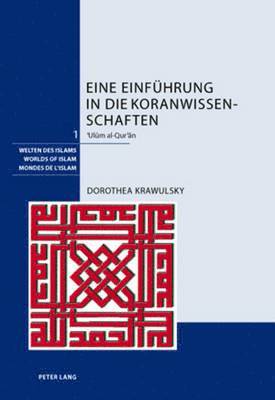
Del 1 - Welten Des Islams/Worlds of Islam/Mondes de L'Islam
Eine Einfuehrung in Die Koranwissenschaften
ʿulūm Al-Qurʾān
Inbunden, Tyska, 2006
690 kr
Tillfälligt slut
Del 14 - Studien Zur Geschichte Und Kultur Des Islamischen Orients
Charakter Und Authentie Der Muslimischen Überlieferung Über Das Leben Mohammeds
Inbunden, Tyska, 1996
1 493 kr
Skickas inom 5-8 vardagar
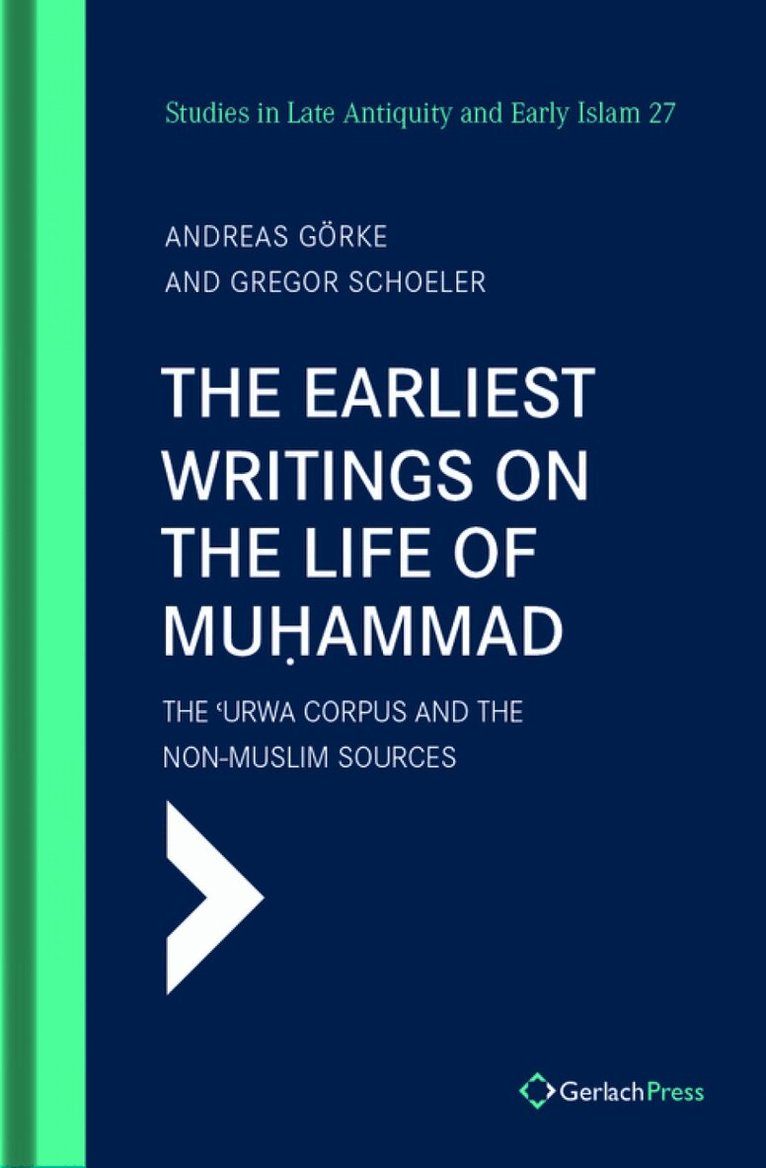
Del 27 - Studies in Late Antiquity and Early Islam
The Earliest Writings on the Life of Muḥammad
The ‘Urwa Corpus and the Non-Muslim Sources
Inbunden, Engelska, 2024
2 397 kr
Skickas inom 5-8 vardagar
The main part of this book consists of a compilation and evaluation of the corpus of traditions about the life of Muhammad attributed to the early scholar 'Urwa ibn al-Zubayr (c. 643-c. 712). 'Urwa was the nephew of the Prophet's wife 'A'isa, who was also his most important informant. The authenticity of a large part of these traditions is certain, since they were handed down independently from each other by two or more tradents of 'Urwa. They are thus the oldest authentic Muslim reports about the Prophet. The authors argue that 'Urwa's reports by and large correctly reflect the basic features of the historical events described. Somewhat older than 'Urwa's traditions about Muhammad is only a report in a non-Islamic Armenian source attributed to the chronicler Sebeos (wrote around 660). This and other external evidence partly agree with the Islamic sources, sometimes providing new perspectives on the life of the Prophet. But there are also contradictions. The authors can show that in such cases the 'Urwa transmission is preferable. The crux of the much-discussed so-called Hagarism hypothesis, which proposes an alternative narrative of the origins of Islam (Muhammad, after having established a community which comprised both Arabs and Jews, set off with these allies to conquer Palestine) is demonstrably based on a misreading of a Sebeos passage..