Guus Extra - Böcker
Visar alla böcker från författaren Guus Extra. Handla med fri frakt och snabb leverans.
13 produkter
13 produkter
1 479 kr
Tillfälligt slut
1 479 kr
Tillfälligt slut
Language Testing, Migration and Citizenship
Cross-National Perspectives on Integration Regimes
Häftad, Engelska, 2011
528 kr
Skickas inom 10-15 vardagar
What is required to achieve civic integration and citizenship in nation states across the world? Should language testing be a part of it? This book addresses the urgent need to develop a fuller conceptual and theoretical basis for language testing than is currently available, to enable widespread discussion of this theme and the concomitant linguistic and cultural requirements. The policy proposals for civic integration have so far been conducted almost entirely at a national level, and with little regard for the experiences of a countries with long traditions of migration, such as the USA, Canada, the UK or Australia. At the same time, EU enlargment and the ongoing rise in the rate of migration into and across Europe suggest that these issues will continue to grow in importance. This book raises the level of discussion to take account of international developments and to promote a more coherent and soundly based debate. It will appeal to researchers and academics working in sociolinguistics and language education, as well as those working on language policy.
Language Testing, Migration and Citizenship
Cross-National Perspectives on Integration Regimes
Inbunden, Engelska, 2009
2 485 kr
Skickas inom 10-15 vardagar
This is an in depth analysis of the linguistic issues surrounding civic integration and citizenship in nation states across the world. What is required to achieve civic integration and citizenship in nation states across the world? Should language testing be a part of it? This book addresses the urgent need to develop a fuller conceptual and theoretical basis for language testing than is currently available, to enable widespread discussion of this theme and the concomitant linguistic and cultural requirements. The policy proposals for civic integration have so far been conducted almost entirely at a national level, and with little regard for the experiences of countries with long traditions of migration, such as the USA, Canada, the UK or Australia. At the same time, EU enlargement and the ongoing rise in the rate of migration into and across Europe suggest that these issues will continue to grow in importance. This book raises the level of discussion to take account of international developments and to promote a more coherent and soundly based debate.It will appeal to researchers and academics working in sociolinguistics and language education, as well as those working on language policy. "The Advances in Sociolinguistics" series seeks to provide a snapshot of the current diversity of the field of sociolinguistics and the blurring of the boundaries between sociolinguistics and other domains of study concerned with the role of language in society.
Del 118 - Multilingual Matters
Other Languages of Europe
Demographic, Sociolinguistic and Educational Perspectives
Häftad, Engelska, 2001
419 kr
Skickas inom 5-8 vardagar
The book offers demographic, sociolinguistic, and educational perspectives on the status of both regional and immigrant languages in Europe and in a wider international context. From a cross-national point of view, empirical evidence on the status of these other languages of multicultural Europe is brought together in a combined frame of reference.
Del 130 - Multilingual Matters
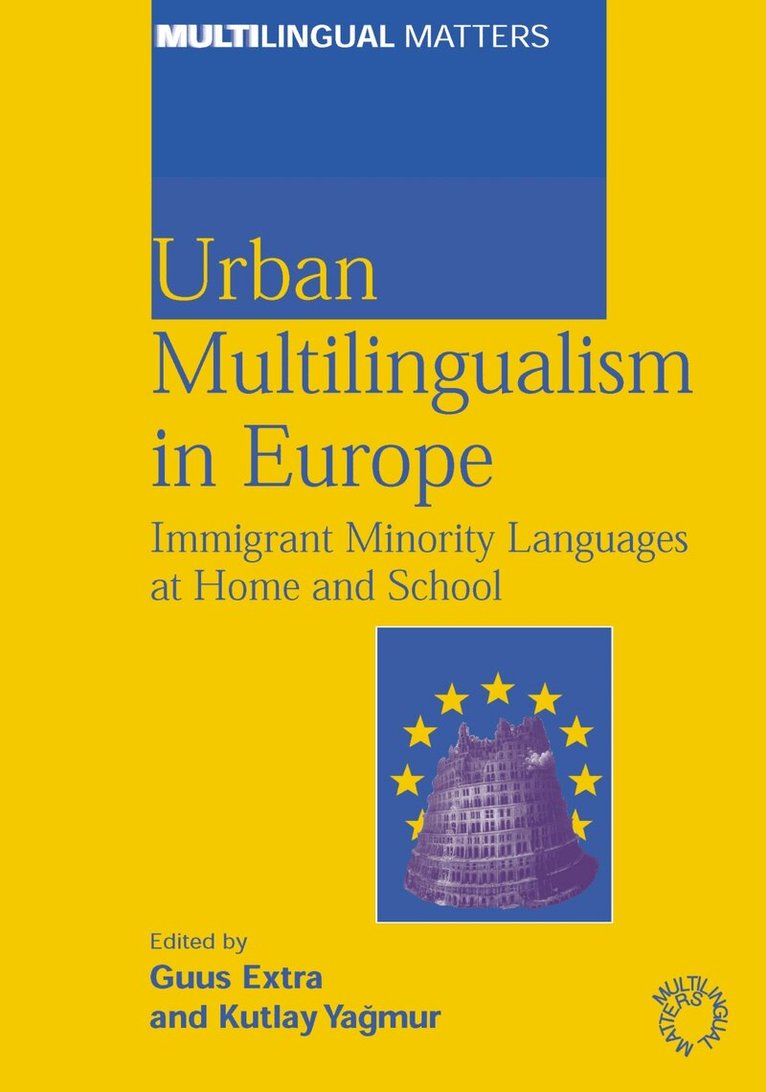
Urban Multilingualism in Europe
Immigrant Minority Languages at Home and School
Häftad, Engelska, 2004
362 kr
Tillfälligt slut
This book focuses on the increase of urban multilingualism in Europe as a consequence of processes of migration and minorisation. It offers multidisciplinary, crossnational and crosslinguistic perspectives on immigrant minority languages at home and in school in six multicultural cities across Europe. In each of these cities, Germanic or Romance languages have a dominant status in public life. This Multilingual Cities Project is based on large-scale empirical findings and has been carried out under the auspices of the European Cultural Foundation, in Amsterdam.Part I offers multidisciplinary background information on phenomenological, demographic, language rights and educational aspects of the status of immigrant minority communities and their languages in a variety of international contexts.Part II offers methodological considerations on the Multilingual Cities Project. In addition, it presents both national and local perspectives on multilingualism in each of the six cities under consideration. Each chapter provides information on the distribution and vitality of immigrant minority languages spoken at home and on the status of these languages in primary and secondary schools.Part III offers crossnational and crosslinguistic perspectives on the twenty most prominent languages that emerge from the study. The focus is again on the two major private and public domains in which language transmission may or may not occur: the home and the school, respectively. The book offers a challenging outlook on the educational management of language diversity in the increasingly multicultural and multilingual context of European nation-states.
1 842 kr
Tillfälligt slut
1 521 kr
Skickas inom 7-10 vardagar
No detailed description available for "Ethnic Minorities and Dutch as a Second Language".
2 206 kr
Skickas inom 5-8 vardagar
No detailed description available for "Bilingualism and Migration".
2 783 kr
Skickas inom 5-8 vardagar
Within the European context, linguistic diversity can be studied at the level of both official state languages and non-national languages. This comprehensive overview offers insightful crossnational and crosscontinental perspectives on non-national languages in terms of both regional and immigrant languages. The book focuses on mapping linguistic diversity in both the private and public domain. Methodological issues and empirical outcomes are explored for a variety of European and non-European countries and languages. The book consists of four parts. Part 1 provides an introduction to the subject, as well as an overview and discussion of migration statistics and language use. Part 2 deals with the mapping of regional languages in Europe, exemplified by case studies on Welsh, Basque, and Frisian. Part 3 focuses on immigrant languages in Europe and includes case studies from both national (Switzerland, Italy, France) and crossnational (Multilingual Cities Project) perspectives. Part 4 turns to mapping linguistic diversity abroad with case studies on Australia, South Africa, Turkey, and Japan.
462 kr
Skickas inom 5-8 vardagar
Within the European context, linguistic diversity can be studied at the level of both official state languages and non-national languages. This comprehensive overview offers insightful crossnational and crosscontinental perspectives on non-national languages in terms of both regional and immigrant languages. The book focuses on mapping linguistic diversity in both the private and public domain. Methodological issues and empirical outcomes are explored for a variety of European and non-European countries and languages. The book consists of four parts. Part 1 provides an introduction to the subject, as well as an overview and discussion of migration statistics and language use. Part 2 deals with the mapping of regional languages in Europe, exemplified by case studies on Welsh, Basque, and Frisian. Part 3 focuses on immigrant languages in Europe and includes case studies from both national (Switzerland, Italy, France) and crossnational (Multilingual Cities Project) perspectives. Part 4 turns to mapping linguistic diversity abroad with case studies on Australia, South Africa, Turkey, and Japan.
776 kr
Skickas inom 5-8 vardagar
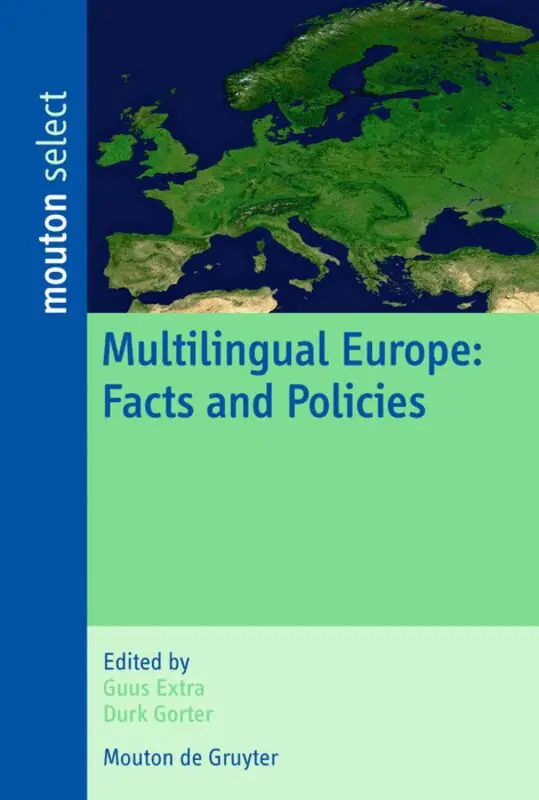
This book offers an inclusive perspective on the constellation of languages in Europe by taking into account official state languages, regional minority languages and immigrant minority languages. Although "celebrating linguistic diversity" is one of the key propositions in the European discourse on multilingualism and language policies, this device holds for these three types of languages in a decreasing order. All three types of languages, however, are constituent parts of a multilingual European identity and should be taken into account in any type of language policy. Both facts and policies on multilingualism and plurilingual education are addressed in case studies at the national and European level. The selection of case studies is based on a careful weighing of geographical spread of countries and languages across Europe on the one hand, and availability of established expert knowledge on the other. After an Introduction to the theme of the book (Guus Extra and Durk Gorter), Part I deals with official state languages with a focus on the spread of English as lingua franca across Europe (Juliane House), on French and France (Dennis Ager), on Polish in Poland and abroad (Justyna Lesniewśka), and on language constellations in the Baltic States (Gabrielle Hogan-Brun). Part II deals with regional minority languages with a focus on Catalan in Spain (Francesc Xavier Vila i Moreno), Frisian in the Netherlands (Durk Gorter et al.), Hungarian as a minority language in Central Europe (Susan Gal), and Saami in the Nordic countries (Mikael Svonni). Part III deals with immigrant minority languages in the United Kingdom (Viv Edwards), Sweden (Lilian Nygren-Junkin), Italy (Monica Barni and Carla Bagna) and Europe at large (Guus Extra and Kutlay Yağmur).
2 306 kr
Skickas inom 10-15 vardagar
This book focuses on the international and educational context of ethnic communities and their language varieties in the Netherlands. It presents major trends in Dutch research on community languages and cross-cultural evidence on reported vs observed use of community languages at Dutch schools.