Guy Burton - Böcker
Visar alla böcker från författaren Guy Burton. Handla med fri frakt och snabb leverans.
5 produkter
5 produkter
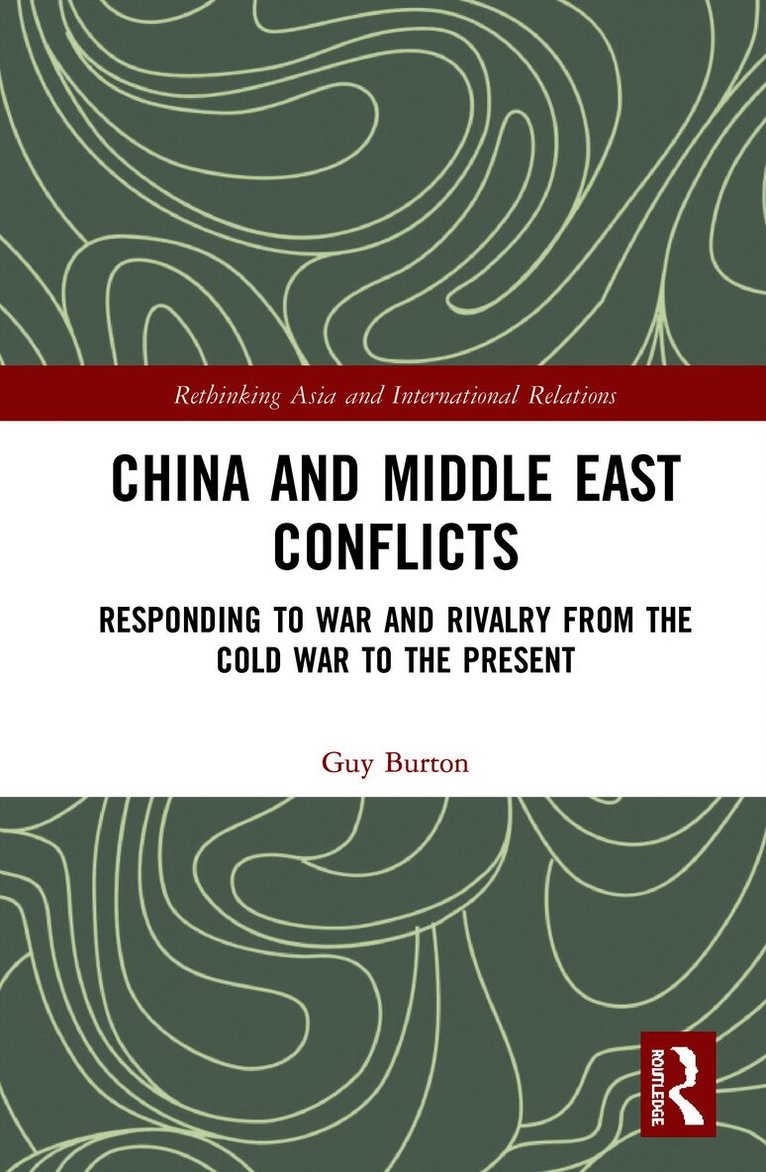
China and Middle East Conflicts
Responding to War and Rivalry from the Cold War to the Present
Inbunden, Engelska, 2020
2 166 kr
Skickas inom 10-15 vardagar
How do aspiring and established rising global powers respond to conflict? Using China, the book studies its response to wars and rivalries in the Middle East from the Cold War to the present.Since the People’s Republic was established in 1949, China has long been involved in the Middle East and its conflicts, from exploiting or avoiding them to their management, containment or resolution. Using a conflict and peace studies angle, Burton adopts a broad perspective on Chinese engagement by looking at its involvement in the region’s conflicts including Israel/Palestine, Iraq before and after 2003, Sudan and the Darfur crisis, the Iranian nuclear deal, the Gulf crisis and the wars in Syria, Libya and Yemen. The book reveals how a rising global and non-Western power handles the challenges associated with both violent and nonviolent conflict and the differences between limiting and reducing violence alongside other ways to eliminate the causes of conflict and grievance. Contributing to the wider discipline of International Relations and peace and conflict studies, this book will be of interest to students and scholars of peace and conflict studies, Chinese foreign policy and the politics and international relations of the Middle East.
China and Middle East Conflicts
Responding to War and Rivalry from the Cold War to the Present
Häftad, Engelska, 2022
634 kr
Skickas inom 10-15 vardagar
How do aspiring and established rising global powers respond to conflict? Using China, the book studies its response to wars and rivalries in the Middle East from the Cold War to the present.Since the People’s Republic was established in 1949, China has long been involved in the Middle East and its conflicts, from exploiting or avoiding them to their management, containment or resolution. Using a conflict and peace studies angle, Burton adopts a broad perspective on Chinese engagement by looking at its involvement in the region’s conflicts including Israel/Palestine, Iraq before and after 2003, Sudan and the Darfur crisis, the Iranian nuclear deal, the Gulf crisis and the wars in Syria, Libya and Yemen. The book reveals how a rising global and non-Western power handles the challenges associated with both violent and nonviolent conflict and the differences between limiting and reducing violence alongside other ways to eliminate the causes of conflict and grievance. Contributing to the wider discipline of International Relations and peace and conflict studies, this book will be of interest to students and scholars of peace and conflict studies, Chinese foreign policy and the politics and international relations of the Middle East.
557 kr
Skickas inom 10-15 vardagar
What is presidential leadership and why have some presidents been considered “great” – or rather “transformational” – while others are not? What are the drivers which distinguish these presidents from the rest?Presidential Leadership in the Americas since Independence answers these questions through a systematic study of leadership across the Americas over 200 years, from independence to the present day. Having surveyed who the most cited presidents are in the Americas, Guy Burton and Ted Goertzel examine the experience of presidents from across the western hemisphere: the US, Argentina, Brazil, Chile, Colombia, Mexico, Peru and Venezuela. They study the relationship between these men and women’s actions within the constraints they faced during four political periods: independence, national consolidation during the nineteenth century, state-building from the late nineteenth to mid twentieth centuries and neoliberalism since the 1970s-80s.The most “transformational” presidents are found to be those who are not only able to innovate and build new political consensuses at a time of crisis, but also consolidate them so that the reforms becoming lasting – and extending beyond an individual president’s own political (even biological) lifetime.
488 kr
Skickas inom 10-15 vardagar
What has been the role of rising powers in the Arab–Israeli conflict? What does this tell us about rising powers and conflict management as well as rising powers’ behavior in the world more generally? This book studies the way that five rising powers—Brazil, Russia, India, China and South Africa, the BRICS countries—have approached the conflict since it first became internationalized in 1947. Conflict management consists of different methods, from peacekeeping to mediation and the use of economic incentives and sanctions and (non)enforcement of international legal decisions. What distinguishes them is whether they are active or passive: active measures seek to transform a conflict and resolve it; passive measures seek to ameliorate its worst effects, but do not change their underlying causes. Since 1947 rising powers’ active or passive use of these methods has coincided with their rise and fall and rise again in the international system. Those rises and falls are tied to global changes, including the Cold War, the emergence of the Third World, economic and ideological retrenchment of the 1980s and 1990s and the shift from unipolarity to multipolarity after 2000.In summary, rising powers’ management of the Arab–Israeli conflict has shifted from active to more passive methods since 1947. Their actions have occurred alongside two key changes within the conflict. One is the shift from a primarily state-based conflict between Israel and the Arabs to one that is more ethnic and territorial in scope, between Israel and the Palestinians. The other the emergence of the Oslo framework which has frozen power imbalance between Israel and the Palestinians since 1993. By pursuing the Oslo process, rising powers have separated conflict management from developing ‘normal’ diplomatic and economic exchanges with Israel and the Palestinians. In adopting this more passive conflict management approach, rising powers are disregarding both emerging alternatives that may potentially transform the conflict’s dynamics (including involvement with civil society actors like the Boycott, Divestment and Sanctions movement) and undertaking more active efforts at conflict resolution—and presenting themselves as global powers.
Abraham Accords
National Security, Regional Order, and Popular Representation
Inbunden, Engelska, 2025
1 343 kr
Skickas inom 10-15 vardagar
The Abraham Accords: National Security, Regional Order, and Popular Representation is a pioneering effort in discussing and analyzing the background, motivations and implications surrounding the Abraham Accords. The authors argue for a nuanced conceptual toolkit to better break down complex strands of state, regional and international interaction, interest and concern. They point to regional dynamics being vital, especially to small states or states under attack, in terms of delivering on their security objectives and by building positions of influence. The Saudi case shows how the 2002 Arab Peace Initiative, perceived US policy failures, and imperatives of Vision 2030, have coalesced to differentiate its regional relations, including attempts at both “strategic autonomy” and “relational autonomy.” The degree of political consolidation, pluralism, and rentier stage are also found to be key indicators of past and future normalization trends with Israel, aspects which could have major bearings on domestic politics should the 2023 Gaza war continue or escalate further. This book includes a wealth of detail on the history and contemporary relations of Israel and Palestine and includes chapters covering all six of the Gulf Cooperation Council (GCC) member states, as well as Iran.