H. Davis – Författare
Visar alla böcker från författaren H. Davis. Handla med fri frakt och snabb leverans.
3 produkter
3 produkter
622 kr
Skickas inom 10-15 vardagar
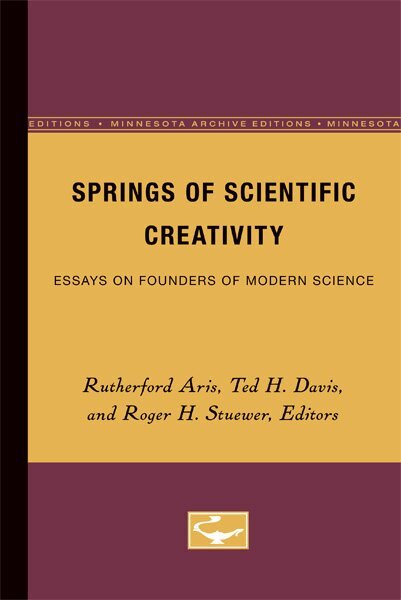
Springs of Scientific Creativity was first published in 1983.Mathematician Henri Poincaré was boarding a bus when he realized that the transformations of non-Euclidian geometry were just those he needed in his research on the theory of functions. He did not have to interrupt his conversation, still less to verify the equation in detail; his insight was complete at that point. Poincaré's insight into his own creativity -- his awareness that preliminary cogitation and the working of the subconscious had prepared his mind for an intuitive flash of recognition -- is just one of many possible analyses of scientific creativity, a subject as fascinating as it is elusive.The authors of this book have chosen to search for the springs of scientific creativity by examining the lives and work of a dozen innovative thinkers in the fields of mathematics, physics, and chemistry from the seventeenth down to the mid-twentieth century. First prepared for delivery in a lecture series held at the University of Minnesota, these essays delve into the social, psychological, and intellectual factors that fostered creativity in the lives of Galilei Galileo, Isaac Newton, J. P. Joule, James Cler Maxwell, Josiah Willard Gibbs, Lord Rayleigh, Elmer Sperry and Adrian Leverkühn, Walter Nernst, Albert Einstein, Erwin Schrödinger, Michael Polyani, and John von Neumann.The contributors are Thomas B. Settle, Richard S. Westfall, Donald S. L. Cardwell, C. W. F. Everitt, Martin J. Klein, John N. Howard, Thomas P. Hughes, Erwin N. Hiebert, Stanley Goldberg, Linda Wessels, William T. Scott, and Herman H. Goldstine.
1 094 kr
Skickas inom 10-15 vardagar
after heated and often bitter debates, SIEBENMANN'S opinion finally prevailed, i. e. , a contribution to cochlear lesions due to vibrations of the floor transmitted via bone conduction could not be demonstrated. For one thing, it was hard to see how appreciable amounts of energy could reach the ears in this manner, considering the attenuation that is bound to occur across each of the many joints along the pathway involved. In some older audiological surveys conducted in industry (e. g. , TEMKIN, 1933), groups of workmen were found who displayed signs of apical-turn lesions, i. e. , low-tone hearing losses for air and for bone. Such lesions could not be expected to results from exposure to air-borne sounds because of the low-frequency attenu ation of the middle ear. Although WITTMAACK'S explanation, which was frequently invoked in such reports, does no longer appear tenable, such apical-turn lesions could conceivably be caused by bone conduction components of high-intensity noise in the sense of BEKESY (1948). - As far as I am aware of, no newer studies have been conducted in this problem area, and the older experiments and/or surveys were done at times before signal parameters could be precisely controlled or measured. A detailed, critical review of the older studies on the potential contribution of bone-conducted energy to industrial hearing loss and its underlying pathology may be found in Werner (1940) who, incidently, favored SIEBENMANN'S point of VIew.
1 094 kr
Skickas inom 10-15 vardagar
When seen from an outsider's vantage point, the development of knowledge in the sensory sciences must appear massive and the result of some carefully followed master plan. In reality, it is the result of numerous relatively independent human endeavors shaped by application of the scientific method. The comprehensive construction of quantitative theories of sense organ function has occurred only recently -but at an explosive rate prefaced by centuries of expansion in the physical sciences. Predicated on this growth, the twentieth century may become known as the age of the biological sciences. With the exception of a modest number of intellectual giants, there were few contributors to the foundations of the sensory sciences before the dawn of this century. At least 90% of existing knowledge has been produced by scientists working in laboratories founded since 1920. If any single scientist and his laboratory may be identified with the growth in the sensory sciences, it is EDGAR DOUGLAS ADRIAN, First Baron of Cambridge and leader of the Physiological Laboratory at Cambridge University, England. Lord ADRIAN'S influence upon the sensory sciences was great, not only in terms of his contribution to knowledge itself but also through the influence which he exerted upon numerous young scientists who spent weeks or years at the Cambridge laboratory and who later returned to their homelands and colleagues with the seeds of vigorous research and quantitative inquiry firmly implanted.