Hadi Heidari - Böcker
Visar alla böcker från författaren Hadi Heidari. Handla med fri frakt och snabb leverans.
6 produkter
6 produkter
1 257 kr
Skickas inom 7-10 vardagar
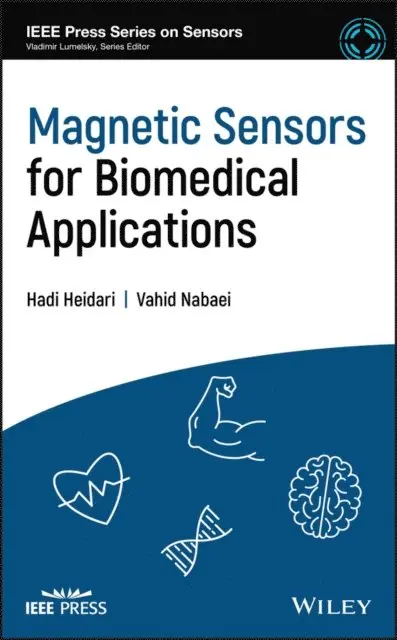
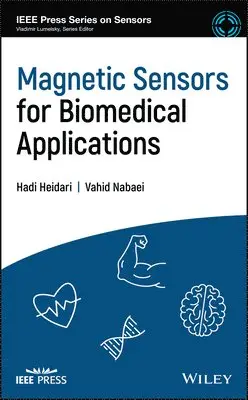
An important guide that reviews the basics of magnetic biosensor modeling and simulationMagnetic Sensors for Biomedical Applications offers a comprehensive review of magnetic biosensor modelling and simulation. The authors—noted experts on the topic—explore the model's strengths and weaknesses and discuss the competencies of different modelling software, including homemade and commercial (for example Multi-physics modelling software).The section on sensor materials examines promising materials whose properties have been used for sensing action and predicts future smart-materials that have the potential for sensing application. Next, the authors present classifications of sensors that are divided into different sub-types. They describe their working and highlight important applications that reveal the benefits and drawbacks of relevant designs. The book also contains information on the most recent developments in the field of each sensor type. This important book: Provides an even treatment of the major foundations of magnetic biosensorsPresents problem solution methods such as analytical and numericalExplains how solution methods complement each other, and offers information on their materials, design, computer aided modelling and simulation, optimization, and device fabricationDescribes modeling work challenges and solutionsWritten for students in electrical and electronics engineering, physics, chemistry, biomedical engineering, and biology, Magnetic Sensors for Biomedical Applications offers a guide to the principles of biomagnetic sensors, recent developments, and reveals the impact of sensor modelling and simulation on magnetic sensors.
1 338 kr
Skickas inom 7-10 vardagar
Provides an introduction to the topic of smart chemical sensors, along with an overview of the state of the art based on potential applicationsThis book presents a comprehensive overview of chemical sensors, ranging from the choice of material to sensor validation, modeling, simulation, and manufacturing. It discusses the process of data collection by intelligent techniques such as deep learning, multivariate analysis, and others. It also incorporates different types of smart chemical sensors and discusses each under a common set of sub-sections so that readers can fully understand the advantages and disadvantages of the relevant transducers—depending on the design, transduction mode, and final applications. Smart Sensors for Environmental and Medical Applications covers all major aspects of the field of smart chemical sensors, including working principle and related theory, sensor materials, classification of respective transducer type, relevant fabrication processes, methods for data analysis, and suitable applications. Chapters address field effect transistors technologies for biological and chemical sensors, mammalian cell–based electrochemical sensors for label-free monitoring of analytes, electronic tongues, chemical sensors based on metal oxides, metal oxide (MOX) gas sensor electronic interfaces, and more.Addressing the limitations and challenges in obtaining state-of-the-art smart biochemical sensors, this book: Balances the fundamentals of sensor design, fabrication, characterization, and analysis with advanced methodsCategorizes sensors into sub-types and describes their working, focusing on prominent applicationsDescribes instrumentation and IoT networking methods of chemical transducers that can be used for inexpensive, accurate detection in commercialized smart chemical sensorsCovers monitoring of food spoilage using polydiacetylene- and liposome-based sensors; smart and intelligent E-nose for sensitive and selective chemical sensing applications; odor sensing system; and microwave chemical sensorsSmart Sensors for Environmental and Medical Applications is an important book for senior-level undergraduate and graduate students learning about this high-performance technology and its many applications. It will also inform practitioners and researchers involved in the creation and use of smart sensors.
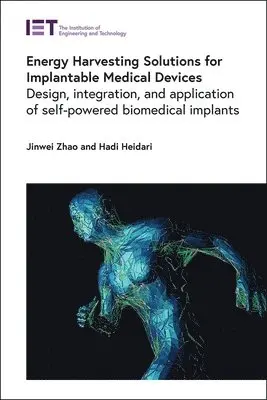
Energy Harvesting Solutions for Implantable Medical Devices
Design, integration, and application of self-powered biomedical implants
Inbunden, Engelska, 2025
1 611 kr
Skickas inom 3-6 vardagar
Implantable devices are becoming more prevalent in the monitoring and treatment of patients with chronic diseases such as heart failure, diabetes and cancer. Conventional implantable devices are battery-powered, but these batteries can suffer from a short lifespan, bulky size, or leakage hazards. Energy harvesting technologies are therefore emerging as an alternative to battery-powered devices.This book details the current availability of implantable devices with energy harvesting technologies used in modern therapy and treatment, and how to manage and control the quality and risk during design, manufacture, and validation. With chapters on kinetic energy, thermal energy, photovoltaic energy, biofuel energy, RF energy and wireless power transfer in implantable applications, the authors demonstrate how these technologies can harvest sufficient energy from the host human body which can be used to power implantable devices. Energy harvesting in different modern biomedical implantable applications is discussed and illustrated with examples which outline the benefits and drawbacks of energy harvesters used to power implantable devices.Energy Harvesting Solutions for Implantable Medical Devices: Design, integration, and application of self-powered biomedical implants provides a useful overview of these developing technologies for an audience of biomedical engineers, researchers, clinicians and advanced students.
1 196 kr
Skickas inom 7-10 vardagar
Discover ground-breaking advancements in wireless biomedical device technology with our comprehensive book, which delves into the latest innovations revolutionizing HealthcareChapter 1 introduces wireless power transfer (WPT) techniques, offering a solution to the frequent battery replacements required by cardiovascular implantable medical devices (cIMDs). Explore how WPT holds the promise of long-term functionality for these life-saving devices, ushering in an era of more efficient and convenient healthcare solutions.In Chapter 2, explore the world of energy harvesting for cardiovascular implants. From Triboelectric Nanogenerators (TENG) to Biofuel cells, discover how self-powering devices are reshaping the landscape of cardiovascular healthcare, reducing the need for battery replacements, and enhancing patient convenience.Chapter 3 unveils the potential of magnetoelectric composites in wireless power transfer for biomedical applications, while Chapter 4 sheds light on the competency of Triboelectric Nanogenerators in wireless device applications, offering a sustainable alternative to traditional batteries.Chapter 5 showcases the promise of photovoltaic energy scavenging for implantable medical devices, highlighting its potential to revolutionize healthcare with higher-power conversion efficiencies and smaller form factors.Explore the realm of ultrasound-based wireless powering technologies in Chapter 6, offering insights into the physics of acoustic powering and the design considerations for ultrasonically powered devices.Chapter 7 ventures into the realm of smart contact lenses, discussing their transformative potential in healthcare, augmented reality, and personalized computing.In Chapter 8, dive into the research gap for Single Input, Single-Output (SISO) state-of-the-art biomedical devices, exploring the challenges and opportunities in charge pump converters and multi-output converters.Finally, Chapter 9 explores power management integrated circuits for implantable devices, focusing on energy efficiency and optimal power usage to prolong device life and minimize power loss.With contributions from leading experts in the field, this book is an indispensable resource for researchers, engineers, and healthcare professionals alike, shaping the future of implantable medical devices and advancing patient care worldwide.
591 kr
Skickas inom 10-15 vardagar
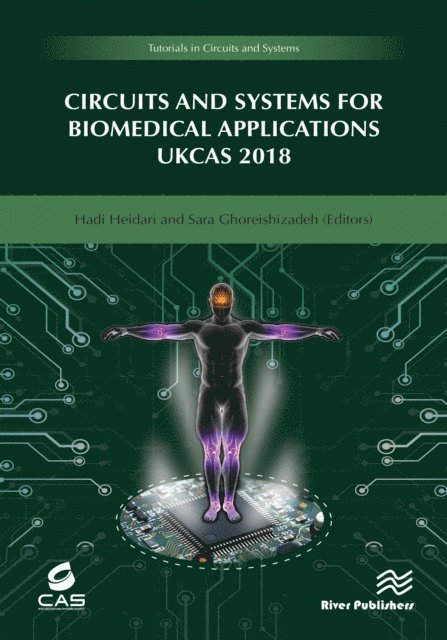
Circuits and Systems for Biomedical Applications-UKCAS 2018 covers several advanced topics in the area of Devices, Analog and Mixed-Signal Circuits and Systems for Biomedical Applications. The fundamental aspects of these topics are discussed, and state-of-the-art developments are presented. The book proceeds the 1st United Kingdom Circuits and Systems (UKCAS 2018) Workshop. It addresses multidisciplinary theme areas such as Biosensing, Memristors, next-generation medical diagnostics, neural-inspired circuits, neural implants, neuro-prostheses, prosthetic hand and neuro-rehabilitation. Having perceived the device and circuit assets for such technologies and knowing what challenges these present for the biomedical scientists and engineers, integrated circuits for addressable biosensing are reviewed in the first chapter. The Second Chapter is harnessing the power of the brain using metaloxide Memristors. The third chapter contains construction of an endoscopic capsule for the diagnostics of dysmotilities in the gastrointestinal track. The next three chapters are on neural interfaces: analogue building blocks of neural inspired circuits are described in the fourth chapter while chapter five focuses on circuits for bio-potential recording from the brain. Networked Integrated circuits and their use in creating advanced implantable stimulation systems will be discussed in chapter six. This topic will be completed by circuits and systems for control of Prosthetic Hands in seventh chapter and genetically enhanced brainimplants for neuro-rehabilitation in chapter eight.
1 705 kr
Skickas inom 5-8 vardagar
Circuits and Systems for Biomedical Applications-UKCAS 2018 covers several advanced topics in the area of Devices, Analog and Mixed-Signal Circuits and Systems for Biomedical Applications. The fundamental aspects of these topics are discussed, and state-of-the-art developments are presented. The book proceeds the 1st United Kingdom Circuits and Systems (UKCAS 2018) Workshop. It addresses multidisciplinary theme areas such as Biosensing, Memristors, next-generation medical diagnostics, neural-inspired circuits, neural implants, neuro-prostheses, prosthetic hand and neuro-rehabilitation. Having perceived the device and circuit assets for such technologies and knowing what challenges these present for the biomedical scientists and engineers, integrated circuits for addressable biosensing are reviewed in the first chapter. The Second Chapter is harnessing the power of the brain using metaloxide Memristors. The third chapter contains construction of an endoscopic capsule for the diagnostics of dysmotilities in the gastrointestinal track. The next three chapters are on neural interfaces: analogue building blocks of neural inspired circuits are described in the fourth chapter while chapter five focuses on circuits for bio-potential recording from the brain. Networked Integrated circuits and their use in creating advanced implantable stimulation systems will be discussed in chapter six. This topic will be completed by circuits and systems for control of Prosthetic Hands in seventh chapter and genetically enhanced brainimplants for neuro-rehabilitation in chapter eight.