• Fri frakt över 249 kr
  • •
  • Snabba leveranser
  • •
  • Billiga böcker
Kundservice

Du är på sajten för privatpersoner.

Företag, bibliotek eller offentlig verksamhet?

Du handlar på classic.bokus.com, där alla dina funktioner finns intakta.
Till classic.bokus.com
Bokus logotyp. Gå till startsidan.
  • Erbjudanden
  • Nyheter
  • Student
  • Topplistor
  • Barn & ungdom
  • Bokus Play
  • E-böcker
  • Pocketböcker
  • Spel & pussel

10% rabatt på allt med kod: NYSTART10 →

Sidfot

Mina sidor

    Hjälp

    • Kundservice
    • Vanliga frågor och svar
    • Frakt och leverans
    • Retur vid ångerrätt
    • Reklamera vara
    • Betalning
    • Köpvillkor
    • Allmänna villkor
    • Information om webbplatsens tillgänglighet

    Om Bokus

    • Om oss
    • Pressrum
    • För studenter
    • För företag
    • För bibliotek och offentlig verksamhet
    • För leverantörer
    • Hållbarhet

    Populärt

    • Aktuella erbjudanden
    • Presentkort
    • Studentlitteratur
    • Nya böcker
    • Topplistor
    • Signerade böcker
    • Engelska böcker

    Inspiration

    • Boktips
    • BookTok
    • Populära bokserier
    • Barnbokskaraktärer
    • Populära författare
    Logotyp för Bokus
    Följ oss på Facebook (extern länk)Följ oss på Instagram (extern länk)Följ oss på YouTube (extern länk)Följ oss på TikTok (extern länk)
    bokus @ CookiesAnpassa cookiesIntegritetspolicyKöpvillkor
    Till Citymail hemsida (extern länk)Till Budbee hemsida (extern länk)Till Postnord hemsida (extern länk)Till Schenker hemsida (extern länk)Till Early Bird hemsida (extern länk)Till Walleys hemsida (extern länk)
    1. Naturvetenskap och teknik
    2. Teknik och industri
    3. Elektronik och kommunikationer

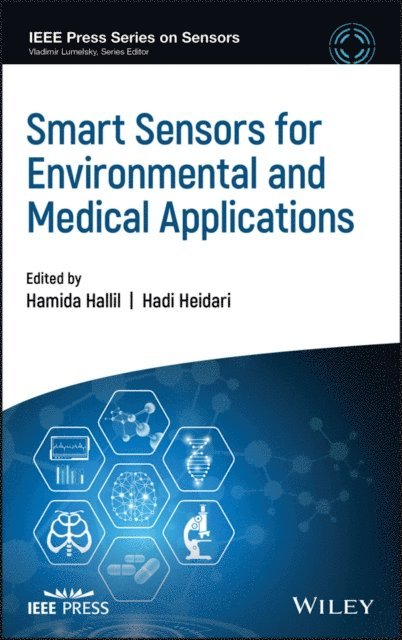
    Smart Sensors for Environmental and Medical Applications

    AvHamida Hallil,Hadi Heidari

    Inbunden, Engelska, 2020

    Del i serien IEEE Press Series on Sensors

    1 429 kr

    Beställningsvara. Skickas inom 5-8 vardagar. Fri frakt över 249 kr.

    Beskrivning

    Provides an introduction to the topic of smart chemical sensors, along with an overview of the state of the art based on potential applicationsThis book presents a comprehensive overview of chemical sensors, ranging from the choice of material to sensor validation, modeling, simulation, and manufacturing. It discusses the process of data collection by intelligent techniques such as deep learning, multivariate analysis, and others. It also incorporates different types of smart chemical sensors and discusses each under a common set of sub-sections so that readers can fully understand the advantages and disadvantages of the relevant transducers—depending on the design, transduction mode, and final applications. Smart Sensors for Environmental and Medical Applications covers all major aspects of the field of smart chemical sensors, including working principle and related theory, sensor materials, classification of respective transducer type, relevant fabrication processes, methods for data analysis, and suitable applications. Chapters address field effect transistors technologies for biological and chemical sensors, mammalian cell–based electrochemical sensors for label-free monitoring of analytes, electronic tongues, chemical sensors based on metal oxides, metal oxide (MOX) gas sensor electronic interfaces, and more.Addressing the limitations and challenges in obtaining state-of-the-art smart biochemical sensors, this book:  Balances the fundamentals of sensor design, fabrication, characterization, and analysis with advanced methodsCategorizes sensors into sub-types and describes their working, focusing on prominent applicationsDescribes instrumentation and IoT networking methods of chemical transducers that can be used for inexpensive, accurate detection in commercialized smart chemical sensorsCovers monitoring of food spoilage using polydiacetylene- and liposome-based sensors; smart and intelligent E-nose for sensitive and selective chemical sensing applications; odor sensing system; and microwave chemical sensorsSmart Sensors for Environmental and Medical Applications is an important book for senior-level undergraduate and graduate students learning about this high-performance technology and its many applications. It will also inform practitioners and researchers involved in the creation and use of smart sensors.

    Produktinformation

    • Utgivningsdatum:2020-06-05
    • Mått:10 x 10 x 10 mm
    • Vikt:454 g
    • Format:Inbunden
    • Språk:Engelska
    • Serie:IEEE Press Series on Sensors
    • Antal sidor:240
    • Förlag:John Wiley & Sons Inc
    • ISBN:9781119587347

    Utforska kategorier

    • Elektronik och kommunikationer inom Naturvetenskap och teknik

    Mer om författaren

    Hamida Hallil, PhD., is an Associate Professor in electrical engineering at the Bordeaux University and affiliated with the laboratory of Integration: from Material to Systems. Her current research interests include the design of innovative devices and sensors using electromagnetic and acoustic transduction modes. Since 2018, she is assigned as research scientist at CNRS International -NTU-Thales Research Alliance in Singapore and her work focuses on the development of 2D based acoustic devices and microwave sensors. She has co-authored over 60 peer-reviewed journal articles and conferences. She serves on the organizing or technical committees of several international conferences and French organisations. Hadi Heidari is an Assistant Professor (Lecturer) in Electronics and Nanoscale Engineering and lead of the Microelectronics Lab (meLAB) at the University of Glasgow, UK. His research focuses on microelectronics and sensors for wearable and implantable devices. He has authored over 140 articles in top-tier peer reviewed journals and in international conferences. He is an IEEE Senior Member, an Associate Editor for 4 Journals and the General Chair of IEEE ICECS 2020 Conference. He is member of the IEEE Circuits and Systems Society Board of Governors, and Member-at-Large in IEEE Sensors Council. He has grant portfolio of +£1 million funded by major research councils and funding organizations including European Commission, UK's EPSRC, Royal Society and Scottish Funding Council.

    Innehållsförteckning

    • List of Contributors xiPreface xiiiAbout the Editors xvii1 Introduction 1Hamida Hallil and Hadi Heidari1.1 Overview 11.2 Sensors: History and Terminology 21.2.1 Definitions and General Characteristics 31.2.2 Influence Quantities 51.3 Smart Sensors for Environmental and Medical Applications 61.4 Outline 8Reference 92 Field Effect Transistor Technologies for Biological and Chemical Sensors 11Anne-Claire Salaün, France Le Bihan, and Laurent Pichon2.1 Introduction 112.2 FET Gas Sensors 122.2.1 Materials 122.2.1.1 Inorganic Semiconductors 122.2.1.2 Semiconductor Polymers 122.2.1.3 Nanostructured Materials 132.2.2 FET as Gas Sensors 132.2.2.1 Pioneering FET Gas Sensors 132.2.2.2 OFET Gas Sensors 132.2.2.3 Nanowires-Based FET Gas Sensors 142.3 Ion-Sensitive Field Effect Transistors Based Devices 182.3.1 Classical ISFET 182.3.2 Other Technologies 192.3.2.1 EGFET: Extended Gate FET 202.3.2.2 SGFET: Suspended Gate FFETs 202.3.2.3 DGFET: Dual-Gate FETs 202.3.2.4 Water Gating FET or Electrolyte Gated FET 212.3.2.5 Other FETs 232.3.3 BioFETs 232.3.3.1 General Considerations 232.3.3.2 DNA BioFET 232.3.3.3 Protein BioFET 252.3.3.4 Cells 252.4 Nano-Field Effect Transistors 252.4.1 Fabrication of Nano-Devices 252.4.1.1 Silicon Nano-Devices 252.4.1.2 Carbon Nanotubes Nano-Devices 282.4.2 Detection of Biochemical Particles by Nanostructures-Based FET 282.4.2.1 SiNW pH Sensor 292.4.2.2 DNA Detection Using SiNW-Based Sensor 302.4.2.3 Protein Detection 322.4.2.4 Detection of Bacteria and Viruses 33References 343 Mammalian Cell-Based Electrochemical Sensor for Label-Free Monitoring of Analytes 43Md. Abdul Kafi, Mst. Khudishta Aktar, and Hadi Heidari3.1 Introduction 433.2 State-of-the-Art Cell Chip Design and Fabrication 453.3 Substrate Functionalization Strategies at the Cell–Electrode Interface 483.4 Electrochemical Characterization of Cellular Redox 493.5 Application of Cell-Based Sensor 513.6 Prospects and Challenges of Cell-Based Sensor 543.7 Conclusion 56References 564 Electronic Tongues 61Flavio M. Shimizu, Maria Luisa Braunger, Antonio Riul, Jr., and Osvaldo N. Oliveira, Jr.4.1 Introduction 614.2 General Applications of E-tongues 634.3 Bioelectronic Tongues (bETs) 654.4 New Design of Electrodes or Measurement Systems 664.5 Challenges and Outlook 73Acknowledgments 73References 745 Monitoring of Food Spoilage Using Polydiacetylene‐ and Liposome‐Based Sensors 81Max Weston, Federico Mazur, and Rona Chandrawati5.1 Introduction 815.2 Polydiacetylene for Visual Detection of Food Spoilage 825.2.1 Contaminant Detection 835.2.2 Freshness Indicators 855.2.3 Challenges, Trends, and Industrial Applicability in the Food Industry 875.3 Liposomes 885.3.1 Pathogen Detection 885.3.1.1 Escherichia coli 885.3.1.2 Salmonella spp. 905.3.1.3 Other Bacterium 905.3.1.4 Viruses, Pesticides, and Toxins 915.3.2 Stability of Liposome‐Based Sensors 935.3.3 Industrial Applicability of Liposomes 935.4 Conclusions 94References 946 Chemical Sensors Based on Metal Oxides 103K. S. Shalini Devi, Aadhav Anantharamakrishnan, Uma Maheswari Krishnan, and Jatinder Yakhmi6.1 Introduction 1036.2 Classes of MOx-Based Chemical Sensors 1046.3 Synthesis of MOx Structures 1046.4 Mechanism of Sensing by MOx 1056.5 Factors Influencing Sensing Performance 1066.6 Applications of MOx-Based Chemical Sensors 1096.6.1 MOx Sensors for Environmental Monitoring 1096.6.2 MOx Sensors in Clinical Diagnosis 1126.6.3 MOx Sensors in Pharmaceutical Analysis 1136.6.4 MOx-Based Sensors in Food Analysis 1166.6.5 MOx Sensors in Agriculture 1176.6.6 MOx Sensors for Hazard Analysis 1176.6.7 Flexible Sensors Based on MOx 1186.6.8 MOx-Based Lab-on-a-Chip Sensors 1186.7 Concluding Remarks 119Acknowledgment 119References 1207 Metal Oxide Gas Sensor Electronic Interfaces 129Zeinab Hijazi, Daniele D. Caviglia, and Maurizio Valle7.1 General Introduction 1297.1.1 Gas Sensing System 1297.1.2 Gas Sensing Technologies 1307.2 MOX Gas Sensors 1317.2.1 Principle of Operation 1317.2.2 Assessment of Available MOX-Based Gas Sensors 1327.3 System Requirements and Literature Review 1347.3.1 System Requirements 1347.3.2 Wide Range Resistance Interface Review 1367.4 Resistance to Time/Frequency Conversion Architecture 1377.4.1 Electronic Circuit Description 1377.4.2 Specifications for Each Building Block to Preserve High Linearity 1387.4.2.1 Resistance to Current Conversion (R-to-I) 1387.4.2.2 Switches 1417.4.2.3 Current to Voltage Conversion (I-to-V) 1417.4.2.4 Voltage to Time/Period (V-to-T) Conversion 1417.5 Power Consumption 1417.5.1 Power Consumption of MOX Gas Sensor 1417.5.2 Low Power Operating Mode 1427.5.3 Power Consumption at Circuit Level 1427.6 Conclusion 143References 1438 Smart and Intelligent E-nose for Sensitive and Selective Chemical Sensing Applications 149Saakshi Dhanekar8.1 Introduction 1498.1.1 The Human Olfactory System 1508.1.2 The Artificial Olfactory System 1508.1.2.1 Sensor Array 1518.1.2.2 Multivariate Data Analysis 1528.1.2.3 Pattern Recognition Methods 1538.2 What is an Electronic Nose? 1548.3 Applications of E-nose 1558.3.1 Key Applications of E-nose 1558.3.2 E-nose for Chemical Sensing 1558.4 Types of E-nose 1578.5 Examples of E-nose 1588.6 Improvements and Challenges 1658.7 Conclusion 165References 1669 Odor Sensing System 173Takamichi Nakamoto and Muis Muthadi9.1 Introduction 1739.2 Odor Biosensor 1749.3 Prediction of Odor Impression Using Deep Learning 1769.4 Establishment of Odor‐Source Localization Strategy Using Computational Fluid Dynamics 1819.4.1 Background of Odor‐Source Localization 1819.4.2 Sensor Model with Response Delay 1829.4.3 Simulation of Testing Environment Using CFD 1839.4.4 Simulation of Biologically Inspired Odor‐Source Localization 1859.4.4.1 Odor Plume Tracking Strategy 1859.4.4.2 Result 1869.4.5 Summary of Odor Source Localization Strategy 1879.5 Conclusion 188Acknowledgments 189References 18910 Microwave Chemical Sensors 193Hamida Hallil and Corinne Dejous10.1 Interests of Electromagnetic Transducer Gas Sensors at Microwave Frequencies 19310.2 Operating Principle 19310.2.1 Electromagnetic Transducers 19310.2.2 The Case of Microwave Transducers 19510.3 Theory of Microwave Transducers: Design, Methodology, and Approach 19610.4 Microwave Structure‐Based Chemical Sensor 20010.4.1 Manufacturing Techniques 20010.4.2 Chemical Microwave Sensors 20010.4.3 Wireless Interrogation Schemes 20410.5 Multivariate Data Analysis and Machine Learning for Targeted Species Identification 20710.6 Conclusion and Prospects 209Acknowledgments 210References 210Index 217