Hani Reda Farran - Böcker
Visar alla böcker från författaren Hani Reda Farran. Handla med fri frakt och snabb leverans.
4 produkter
4 produkter
538 kr
Skickas inom 10-15 vardagar
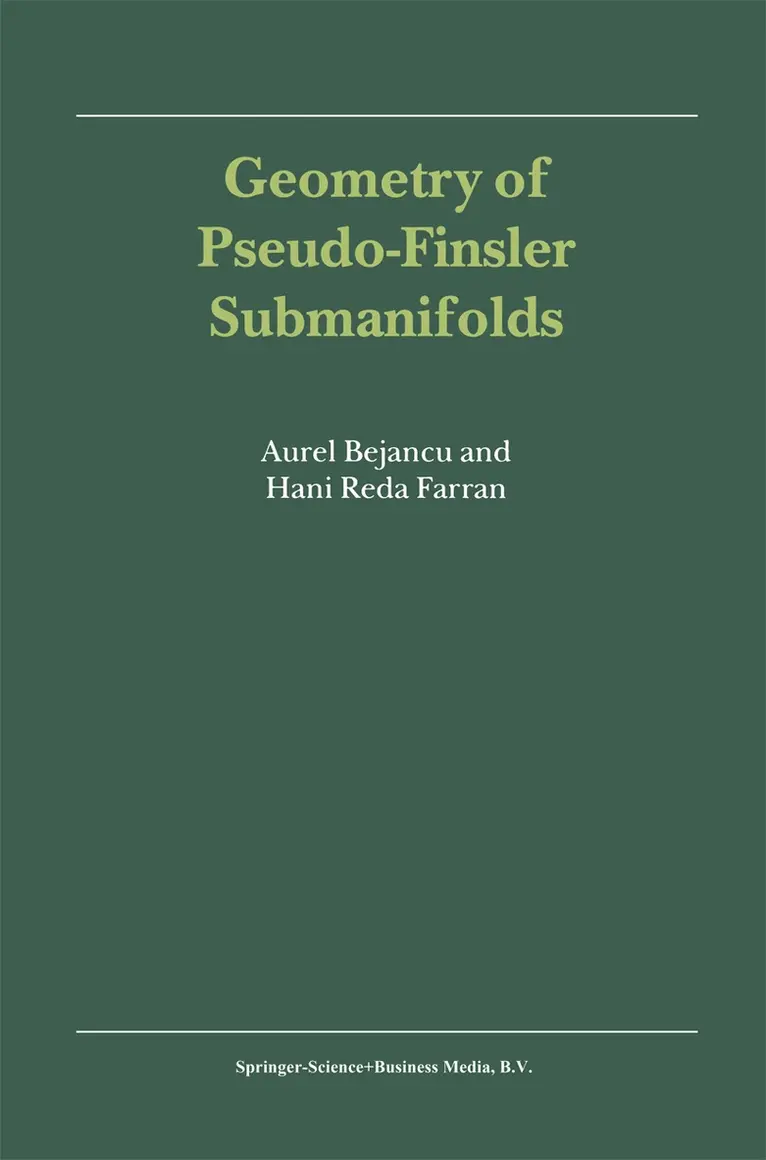
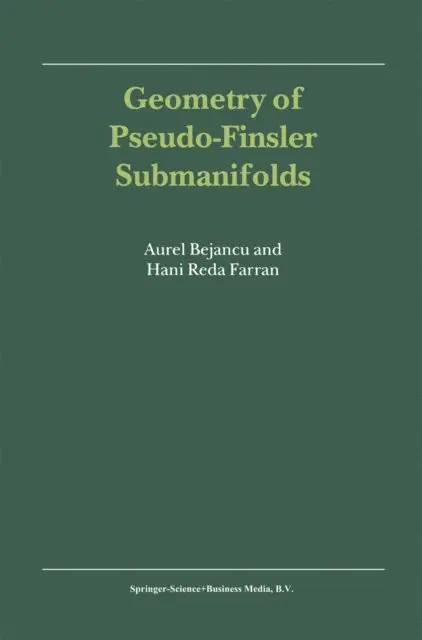
Finsler geometry is the most natural generalization of Riemannian geo- metry. It started in 1918 when P. Finsler [1] wrote his thesis on curves and surfaces in what he called generalized metric spaces. Studying the geometry of those spaces (which where named Finsler spaces or Finsler manifolds) became an area of active research. Many important results on the subject have been brought together in several monographs (cf. , H. Rund [3], G. Asanov [1], M. Matsumoto [6], A. Bejancu [8], P. L. Antonelli, R. S. Ingar- den and M. Matsumoto [1], M. Abate and G. Patrizio [1] and R. Miron [3]) . However, the present book is the first in the literature that is entirely de- voted to studying the geometry of submanifolds of a Finsler manifold. Our exposition is also different in many other respects. For example, we work on pseudo-Finsler manifolds where in general the Finsler metric is only non- degenerate (rather than on the particular case of Finsler manifolds where the metric is positive definite). This is absolutely necessary for physical and biological applications of the subject.Secondly, we combine in our study both the classical coordinate approach and the modern coordinate-free ap- proach. Thirdly, our pseudo-Finsler manifolds F = (M, M', F*) are such that the geometric objects under study are defined on an open submani- fold M' of the tangent bundle T M, where M' need not be equal to the entire TMo = TM\O(M).
1 069 kr
Skickas inom 10-15 vardagar
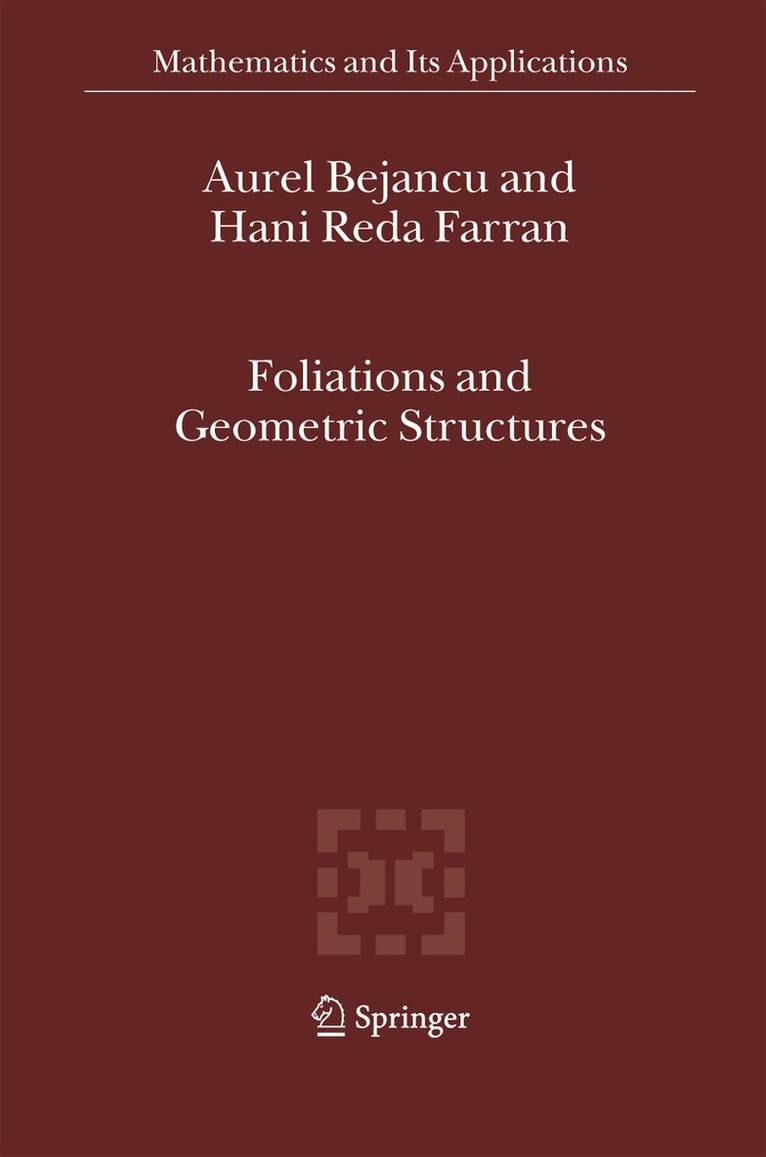
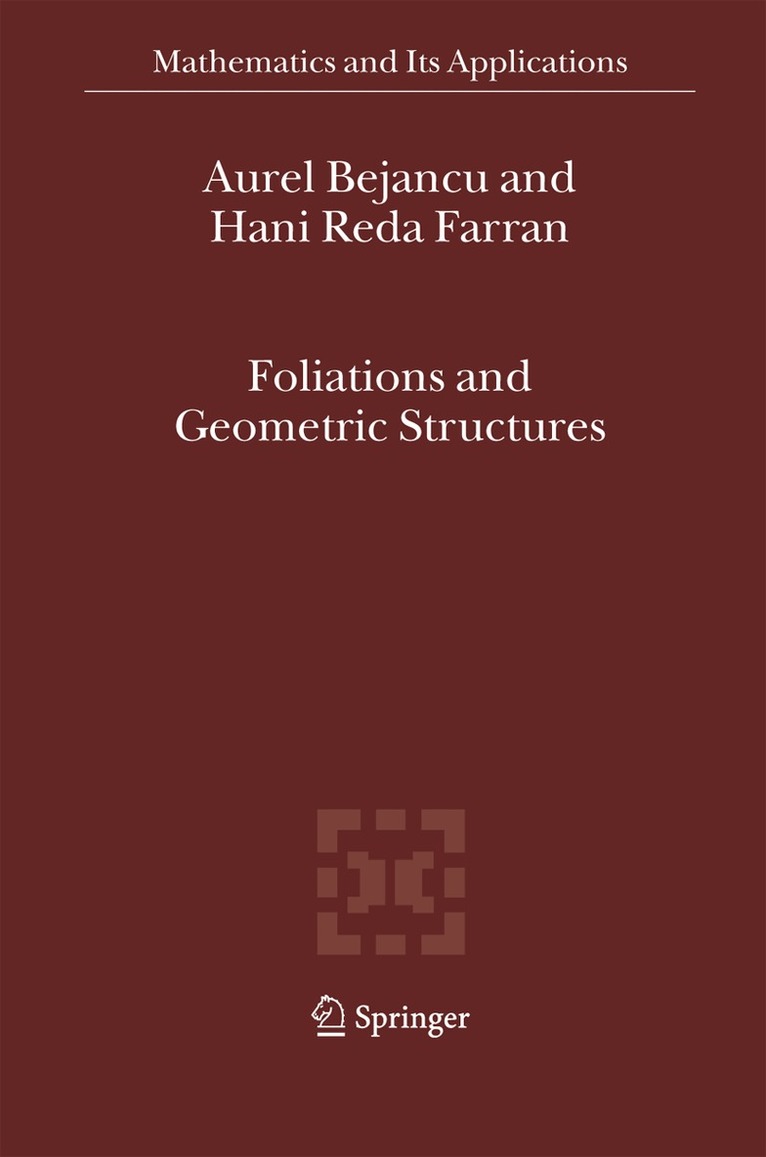
The theory of foliations of manifolds was created in the forties of the last century by Ch. Ehresmann and G. Reeb [ER44]. Since then, the subject has enjoyed a rapid development and thousands of papers investigating foliations have appeared. A list of papers and preprints on foliations up to 1995 can be found in Tondeur [Ton97]. Due to the great interest of topologists and geometers in this rapidly ev- ving theory, many books on foliations have also been published one after the other. We mention, for example, the books written by: I. Tamura [Tam76], G. Hector and U. Hirsch [HH83], B. Reinhart [Rei83], C. Camacho and A.L. Neto [CN85], H. Kitahara [Kit86], P. Molino [Mol88], Ph. Tondeur [Ton88], [Ton97], V. Rovenskii [Rov98], A. Candel and L. Conlon [CC03]. Also, the survey written by H.B. Lawson, Jr. [Law74] had a great impact on the de- lopment of the theory of foliations. So it is natural to ask: why write yet another book on foliations? The answerisverysimple.Ourareasofinterestandinvestigationaredi?erent.The main theme of this book is to investigate the interrelations between foliations of a manifold on one hand, and the many geometric structures that the ma- foldmayadmitontheotherhand.Amongthesestructureswemention:a?ne, Riemannian, semi-Riemannian, Finsler, symplectic, and contact structures.
538 kr
Skickas inom 10-15 vardagar
Finsler geometry is the most natural generalization of Riemannian geo- metry. It started in 1918 when P. Finsler [1] wrote his thesis on curves and surfaces in what he called generalized metric spaces. Studying the geometry of those spaces (which where named Finsler spaces or Finsler manifolds) became an area of active research. Many important results on the subject have been brought together in several monographs (cf. , H. Rund [3], G. Asanov [1], M. Matsumoto [6], A. Bejancu [8], P. L. Antonelli, R. S. Ingar- den and M. Matsumoto [1], M. Abate and G. Patrizio [1] and R. Miron [3]) . However, the present book is the first in the literature that is entirely de- voted to studying the geometry of submanifolds of a Finsler manifold. Our exposition is also different in many other respects. For example, we work on pseudo-Finsler manifolds where in general the Finsler metric is only non- degenerate (rather than on the particular case of Finsler manifolds where the metric is positive definite). This is absolutely necessary for physical and biological applications of the subject.Secondly, we combine in our study both the classical coordinate approach and the modern coordinate-free ap- proach. Thirdly, our pseudo-Finsler manifolds F = (M, M', F*) are such that the geometric objects under study are defined on an open submani- fold M' of the tangent bundle T M, where M' need not be equal to the entire TMo = TM\O(M).
1 069 kr
Skickas inom 10-15 vardagar
The theory of foliations of manifolds was created in the forties of the last century by Ch. Ehresmann and G. Reeb [ER44]. Since then, the subject has enjoyed a rapid development and thousands of papers investigating foliations have appeared. A list of papers and preprints on foliations up to 1995 can be found in Tondeur [Ton97]. Due to the great interest of topologists and geometers in this rapidly ev- ving theory, many books on foliations have also been published one after the other. We mention, for example, the books written by: I. Tamura [Tam76], G. Hector and U. Hirsch [HH83], B. Reinhart [Rei83], C. Camacho and A.L. Neto [CN85], H. Kitahara [Kit86], P. Molino [Mol88], Ph. Tondeur [Ton88], [Ton97], V. Rovenskii [Rov98], A. Candel and L. Conlon [CC03]. Also, the survey written by H.B. Lawson, Jr. [Law74] had a great impact on the de- lopment of the theory of foliations. So it is natural to ask: why write yet another book on foliations? The answerisverysimple.Ourareasofinterestandinvestigationaredi?erent.The main theme of this book is to investigate the interrelations between foliations of a manifold on one hand, and the many geometric structures that the ma- foldmayadmitontheotherhand.Amongthesestructureswemention:a?ne, Riemannian, semi-Riemannian, Finsler, symplectic, and contact structures.