Haoyu Niu – författare
Visar alla böcker från författaren Haoyu Niu. Handla med fri frakt och snabb leverans.
6 produkter
6 produkter
Inbunden, Engelska, 2022
1 523 kr
Skickas inom 10-15 vardagar
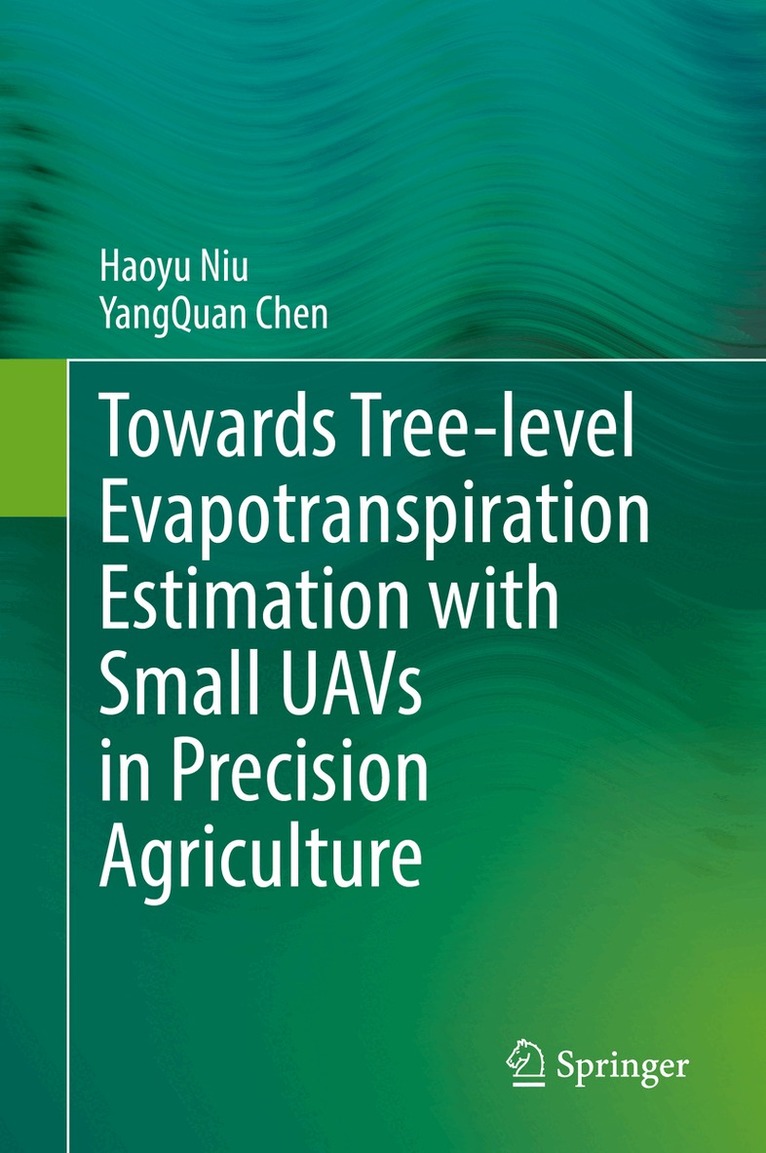
Estimating evapotranspiration (ET) has been one of the most critical research areas in agriculture because of water scarcity, the growing population, and climate change. The accurate estimation and mapping of ET are necessary for crop water management. Traditionally, researchers use water balance, soil moisture, weighing lysimeters, or an energy balance approach, such as Bowen ratio or eddy covariance towers to estimate ET. However, these ET methods are point-specific or area-weighted measurements and cannot be extended to a large scale. On the other hand, while remote sensing is able to provide spatially distributed measurements, the spatial resolution of multispectral satellite images is often not enough for crops with clumped canopy structures, such as trees and vines. Unmanned aerial vehicles (UAVs) can mitigate these spatial and temporal limitations. Lightweight cameras and sensors can be mounted on the UAVs and take high-resolution images. Unlike satellite imagery, the spatial resolution of the UAV images can be at the centimeter-level. UAVs can also fly on-demand, which provides high temporal imagery. This book examines the different UAV-based approaches of ET estimation. Models and algorithms, such as mapping evapotranspiration at high resolution with internalized calibration (METRIC), the two-source energy balance (TSEB) model, and machine learning (ML) are discussed. It also covers the challenges and opportunities for UAVs in ET estimation, with the final chapters devoted to new ET estimation methods and their potential applications for future research.
E-bok
Engelska, 20221 825 kr
Läs direkt efter köp
Estimating evapotranspiration (ET) has been one of the most critical research areas in agriculture because of water scarcity, the growing population, and climate change. The accurate estimation and mapping of ET are necessary for crop water management. Traditionally, researchers use water balance, soil moisture, weighing lysimeters, or an energy balance approach, such as Bowen ratio or eddy covariance towers to estimate ET. However, these ET methods are point-specific or area-weighted measurements and cannot be extended to a large scale. On the other hand, while remote sensing is able to provide spatially distributed measurements, the spatial resolution of multispectral satellite images is often not enough for crops with clumped canopy structures, such as trees and vines. Unmanned aerial vehicles (UAVs) can mitigate these spatial and temporal limitations. Lightweight cameras and sensors can be mounted on the UAVs and take high-resolution images. Unlike satellite imagery, the spatial resolution of the UAV images can be at the centimeter-level. UAVs can also fly on-demand, which provides high temporal imagery. This book examines the different UAV-based approaches of ET estimation. Models and algorithms, such as mapping evapotranspiration at high resolution with internalized calibration (METRIC), the two-source energy balance (TSEB) model, and machine learning (ML) are discussed. It also covers the challenges and opportunities for UAVs in ET estimation, with the final chapters devoted to new ET estimation methods and their potential applications for future research.
Häftad, Engelska, 2023
1 523 kr
Skickas inom 10-15 vardagar
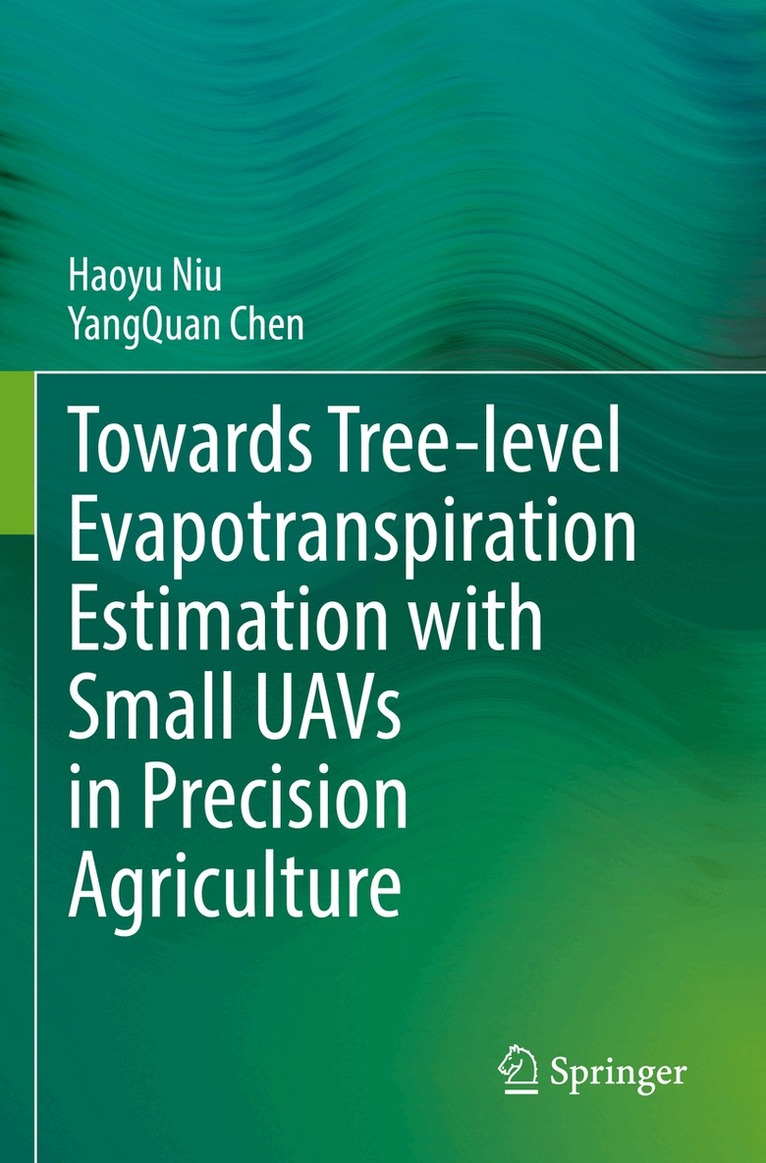
Estimating evapotranspiration (ET) has been one of the most critical research areas in agriculture because of water scarcity, the growing population, and climate change. The accurate estimation and mapping of ET are necessary for crop water management. Traditionally, researchers use water balance, soil moisture, weighing lysimeters, or an energy balance approach, such as Bowen ratio or eddy covariance towers to estimate ET. However, these ET methods are point-specific or area-weighted measurements and cannot be extended to a large scale. On the other hand, while remote sensing is able to provide spatially distributed measurements, the spatial resolution of multispectral satellite images is often not enough for crops with clumped canopy structures, such as trees and vines. Unmanned aerial vehicles (UAVs) can mitigate these spatial and temporal limitations. Lightweight cameras and sensors can be mounted on the UAVs and take high-resolution images. Unlike satellite imagery, the spatial resolution of the UAV images can be at the centimeter-level. UAVs can also fly on-demand, which provides high temporal imagery. This book examines the different UAV-based approaches of ET estimation. Models and algorithms, such as mapping evapotranspiration at high resolution with internalized calibration (METRIC), the two-source energy balance (TSEB) model, and machine learning (ML) are discussed. It also covers the challenges and opportunities for UAVs in ET estimation, with the final chapters devoted to new ET estimation methods and their potential applications for future research.
Inbunden, Engelska, 2024
1 618 kr
Skickas inom 5-8 vardagar
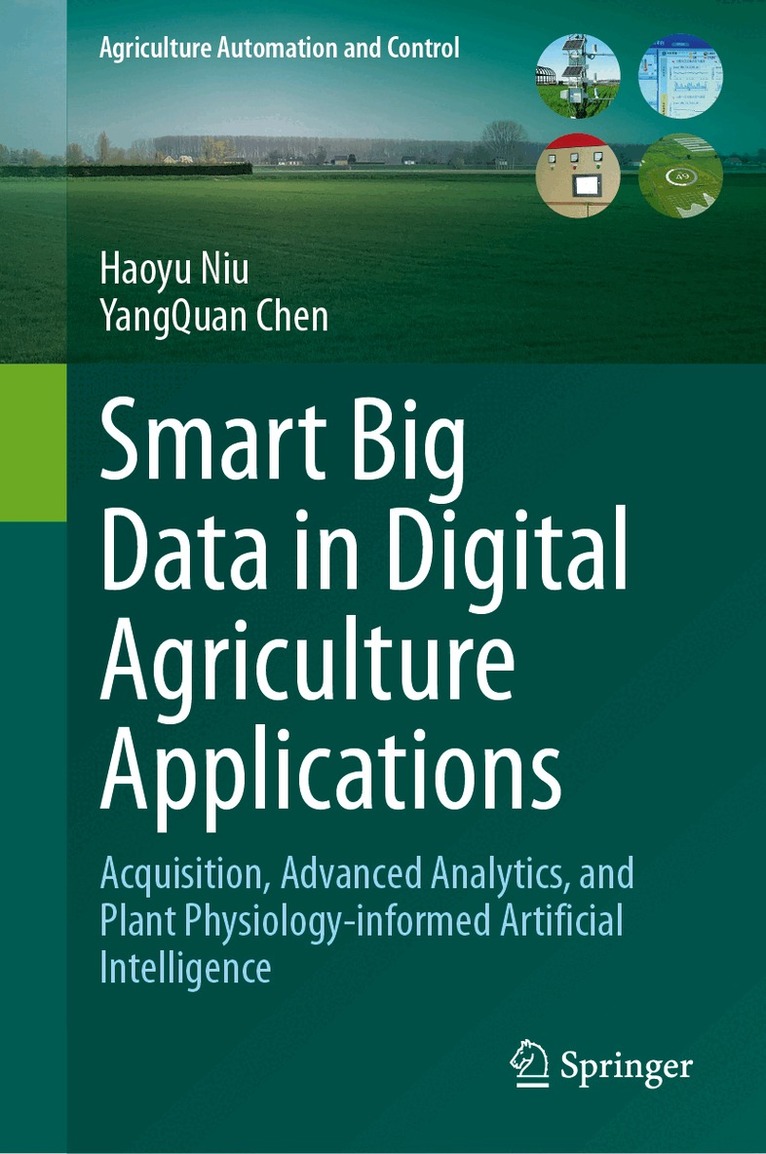
In the dynamic realm of digital agriculture, the integration of big data acquisition platforms has sparked both curiosity and enthusiasm among researchers and agricultural practitioners. This book embarks on a journey to explore the intersection of artificial intelligence and agriculture, focusing on small-unmanned aerial vehicles (UAVs), unmanned ground vehicles (UGVs), edge-AI sensors and the profound impact they have on digital agriculture, particularly in the context of heterogeneous crops, such as walnuts, pomegranates, cotton, etc. For example, lightweight sensors mounted on UAVs, including multispectral and thermal infrared cameras, serve as invaluable tools for capturing high-resolution images. Their enhanced temporal and spatial resolutions, coupled with cost effectiveness and near-real-time data acquisition, position UAVs as an optimal platform for mapping and monitoring crop variability in vast expanses. This combination of data acquisition platforms and advanced analytics generates substantial datasets, necessitating a deep understanding of fractional-order thinking, which is imperative due to the inherent “complexity” and consequent variability within the agricultural process. Much optimism is vested in the field of artificial intelligence, such as machine learning (ML) and computer vision (CV), where the efficient utilization of big data to make it “smart” is of paramount importance in agricultural research. Central to this learning process lies the intricate relationship between plant physiology and optimization methods. The key to the learning process is the plant physiology and optimization method. Crafting an efficient optimization method raises three pivotal questions: 1.) What represents the best approach to optimization? 2.) How can we achieve a more optimal optimization? 3.) Is it possible to demand “more optimal machine learning,” exemplified by deep learning, while minimizing the need for extensive labeled data for digital agriculture? This book details the foundations of the plant physiology-informed machine learning (PPIML) and the principle of tail matching (POTM) framework. It is the 9th title of the "Agriculture Automation and Control" book series published by Springer.
E-bok
Engelska, 20241 995 kr
Läs direkt efter köp
In the dynamic realm of digital agriculture, the integration of big data acquisition platforms has sparked both curiosity and enthusiasm among researchers and agricultural practitioners. This book embarks on a journey to explore the intersection of artificial intelligence and agriculture, focusing on small-unmanned aerial vehicles (UAVs), unmanned ground vehicles (UGVs), edge-AI sensors and the profound impact they have on digital agriculture, particularly in the context of heterogeneous crops, such as walnuts, pomegranates, cotton, etc. For example, lightweight sensors mounted on UAVs, including multispectral and thermal infrared cameras, serve as invaluable tools for capturing high-resolution images. Their enhanced temporal and spatial resolutions, coupled with cost effectiveness and near-real-time data acquisition, position UAVs as an optimal platform for mapping and monitoring crop variability in vast expanses. This combination of data acquisition platforms and advanced analytics generates substantial datasets, necessitating a deep understanding of fractional-order thinking, which is imperative due to the inherent “complexity” and consequent variability within the agricultural process. Much optimism is vested in the field of artificial intelligence, such as machine learning (ML) and computer vision (CV), where the efficient utilization of big data to make it “smart” is of paramount importance in agricultural research. Central to this learning process lies the intricate relationship between plant physiology and optimization methods. The key to the learning process is the plant physiology and optimization method. Crafting an efficient optimization method raises three pivotal questions: 1.) What represents the best approach to optimization? 2.) How can we achieve a more optimal optimization? 3.) Is it possible to demand “more optimal machine learning,” exemplified by deep learning, while minimizing the need for extensive labeled data for digital agriculture? This book details the foundations of the plant physiology-informed machine learning (PPIML) and the principle of tail matching (POTM) framework. It is the 9th title of the "Agriculture Automation and Control" book series published by Springer.
Häftad, Engelska, 2025
1 631 kr
Skickas inom 10-15 vardagar
In the dynamic realm of digital agriculture, the integration of big data acquisition platforms has sparked both curiosity and enthusiasm among researchers and agricultural practitioners. This book embarks on a journey to explore the intersection of artificial intelligence and agriculture, focusing on small-unmanned aerial vehicles (UAVs), unmanned ground vehicles (UGVs), edge-AI sensors and the profound impact they have on digital agriculture, particularly in the context of heterogeneous crops, such as walnuts, pomegranates, cotton, etc. For example, lightweight sensors mounted on UAVs, including multispectral and thermal infrared cameras, serve as invaluable tools for capturing high-resolution images. Their enhanced temporal and spatial resolutions, coupled with cost effectiveness and near-real-time data acquisition, position UAVs as an optimal platform for mapping and monitoring crop variability in vast expanses. This combination of data acquisition platforms and advanced analytics generates substantial datasets, necessitating a deep understanding of fractional-order thinking, which is imperative due to the inherent “complexity” and consequent variability within the agricultural process. Much optimism is vested in the field of artificial intelligence, such as machine learning (ML) and computer vision (CV), where the efficient utilization of big data to make it “smart” is of paramount importance in agricultural research. Central to this learning process lies the intricate relationship between plant physiology and optimization methods. The key to the learning process is the plant physiology and optimization method. Crafting an efficient optimization method raises three pivotal questions: 1.) What represents the best approach to optimization? 2.) How can we achieve a more optimal optimization? 3.) Is it possible to demand “more optimal machine learning,” exemplified by deep learning, while minimizing the need for extensive labeled data for digital agriculture? This book details the foundations of the plant physiology-informed machine learning (PPIML) and the principle of tail matching (POTM) framework. It is the 9th title of the "Agriculture Automation and Control" book series published by Springer.