Henry C. Lucas - Böcker
Visar alla böcker från författaren Henry C. Lucas. Handla med fri frakt och snabb leverans.
4 produkter
4 produkter
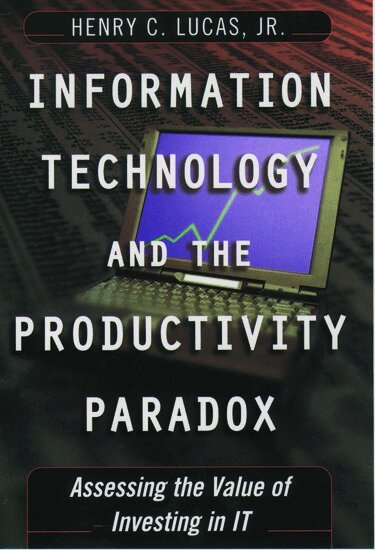
Information Technology and the Productivity Paradox
Assessing the Value of Investing in IT
Inbunden, Engelska, 1999
398 kr
Skickas inom 5-8 vardagar
From networks to databases, email to voicemail, the amount of capital being invested in information technology each year is staggering. By 1996, U.S. firms were spending more than $500 billion annually on software, networks and staff. The recently merged Bank of America and NationsBank have an initial IT budget of 4 billion dollars. As firms like this push rapidly into the business world of the 21st century, the question has remained: how do firms measure returns from these substantial investments in information technology?Henry C. Lucas effectively answers this question by providing a creative and reliable framework for measuring the competitive advantages and profits gained through investments in state-of-the-art information systems. There is value in information technology, and it is possible to show returns, Lucas argues--unfortunately this value just doesn't always show up clearly on the bottom line of a ledger. In five expertly presented sections, he spells out exactly what businesses can expect from their information technology investments--some investments create a measurable value, some do not, but all are important nonetheless. Through a precise mix of frameworks and models, such as an Investment Opportunities Matrix, and punctuated with real examples from successful firms, this is the first book to allow executives to see exactly how their information technology investment can be expected to return value, thereby maximizing their advantages in an age of global competitiveness.Indeed, firms who manage their information systems most efficiently are best suited to succeed in a rapidly evolving marketplace. With so much at stake, Information Technology is certain to be the essential guide for firms determined to compete and flourish in the highly competitive economy of the next century.
613 kr
Skickas inom 5-8 vardagar
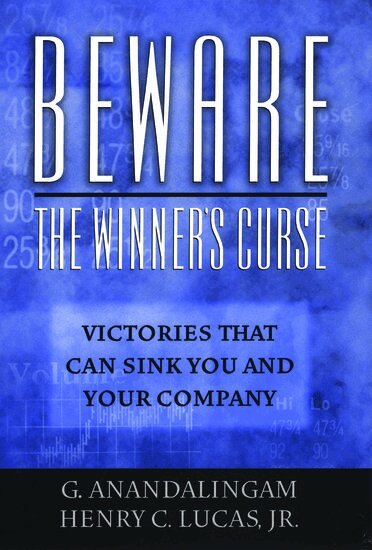
In the roaring 1990s, many companies seemed to claim great victories-acquiring another company, obtaining state-of-the art technology, or hiring a potential CEO savior-only to find that they had made a great mistake. The term "Winner's Curse" was coined by economists to explain an effect commonly observed in auctions. In such situations, since the winning bidder is usually the most optimistic about the value of the item being auctioned, there is a verygood chance that the bid will be more (sometimes much more) than the item is worth. So a company that overvalues a good or service, or bids higher than its value has the potential of experiencing this Winner'sCurse. In this book, G. Anandalingam and Henry C. Lucas, Jr. expand the model of the Winner's Curse to explain how companies like Tyco, MCI-WorldCom and Bank One overpaid for acquisitions, and how shareholders suffered as a result. They elucidate the disasters that happened during the rush to acquire new technologies and illuminate the reasons that companies that were seemingly pioneers in the dot-com era fell by the wayside. Beginning by exploring the psychological, personal andmarket factors that can encourage a decision maker to overvalue an asset and experience the Winner's Curse, the book goes on to examine several case studies, including the disastrous wireless spectrumauctions that have devastated the telecommunications industry, and the dot-com bust. It concludes by discussing ways to avoid the Winner's Curse, calling for major changes in the behavior of CEOs and members of boars of directors, as well as the use of powerful techniques for analyzing decisions, including a systems approach to decision making, scenario analysis and game theory.
836 kr
Skickas inom 3-6 vardagar
2 519 kr
Skickas inom 5-8 vardagar
Take an active role in managing technology! From new business models to new types of business, information technology has become a key driver of business and an essential component of corporate strategy. But simply acquiring technology is not enough; organizations must manage IT effectively to gain the competitive advantage. Henry Lucasa s Information Technology: Strategic Decision Making for Managers focuses on the key knowledge and skills you need to take an active role in managing technology and obtain the maximum benefits from investing in IT. Offering streamlined, up--to--date coverage, the text is ideally suited for MBA students or anyone who wants to learn more about how to gain the competitive advantage by successfully managing IT. Features aeo Focuses on managerial issues: This text explores the many real technology issues confronting todaya s managers, such as what to do with legacy systems, when to outsource, and how to choose a source of processing and services. aeo Shows how to evaluate IT investments: Two full chapters cover the value of information technology and how to evaluate IT project proposals using both net present value and real options approaches. aeo Balances technical and managerial coverage: This balance helps you understand how diverse companies have developed their IT architectures and environments.aeo Explains the various applications of technology: Concrete examples illustrate major IT applications, such as ecommerce, ERP, CRM, decision and intelligent systems, and knowledge management.