Henry Horng-Shing Lu – författare
3 583 kr
Skickas inom 10-15 vardagar
492 kr
Skickas inom 5-8 vardagar
633 kr
Läs direkt efter köp
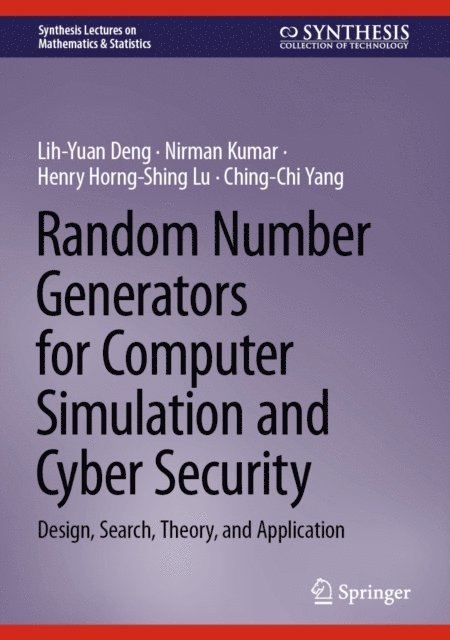
This book discusses the theory and practice of random number generators that are useful for computer simulation and computer security applications. Random numbers are ubiquitous in computation. They are used in randomized algorithms to perform sampling or choose randomly initialized parameters or perform Markov Chain Monte Carlo (MCMC). They are also used in computer security applications for various purposes such as cryptographic nuances or in authenticators. In practice, the random numbers used by any of these applications are from a pseudo-random sequence. These pseudo-random sequences are generated by RNGs (random number generators). This book discusses the theory underlying such RNGs, which are used by all programmers. However, few try to understand the theory behind them. This topic is an active area of research, particularly when the generators are used for cryptographic applications. The authors introduce readers to RNGs, how they are judged for quality, the mathematical and statistical theory behind them, as well as provide details on how these can be implemented in any programming language. The book discusses non-linear transformations that use classical linear generators for cryptographic applications and how to optimize to make such generators more efficient. In addition, the book provides up-to-date research on RNGs including a modern class of efficient RNGs and shows how to search for new RNGs with good quality and how to parallelize these RNGs.
495 kr
Skickas inom 10-15 vardagar
2 797 kr
Skickas inom 10-15 vardagar
3 351 kr
Läs direkt efter köp
3 583 kr
Skickas inom 10-15 vardagar
4 267 kr
Läs direkt efter köp
2 925 kr
Läs direkt efter köp
2 178 kr
Skickas inom 5-8 vardagar
2 174 kr
Skickas inom 10-15 vardagar
2 822 kr
Läs direkt efter köp
Now in its second edition, this handbook collects authoritative contributions on modern methods and tools in statistical bioinformatics with a focus on the interface between computational statistics and cutting-edge developments in computational biology. The three parts of the book cover statistical methods for single-cell analysis, network analysis, and systems biology, with contributions by leading experts addressing key topics in probabilistic and statistical modeling and the analysis of massive data sets generated by modern biotechnology. This handbook will serve as a useful reference source for students, researchers and practitioners in statistics, computer science and biological and biomedical research, who are interested in the latest developments in computational statistics as applied to computational biology.
667 kr
Skickas inom 5-8 vardagar