Bernhard Schölkopf - Böcker
Visar alla böcker från författaren Bernhard Schölkopf. Handla med fri frakt och snabb leverans.
13 produkter
13 produkter
548 kr
Skickas
130 kr
Tillfälligt slut
116 kr
Tillfälligt slut
416 kr
Tillfälligt slut
760 kr
Skickas inom 3-6 vardagar
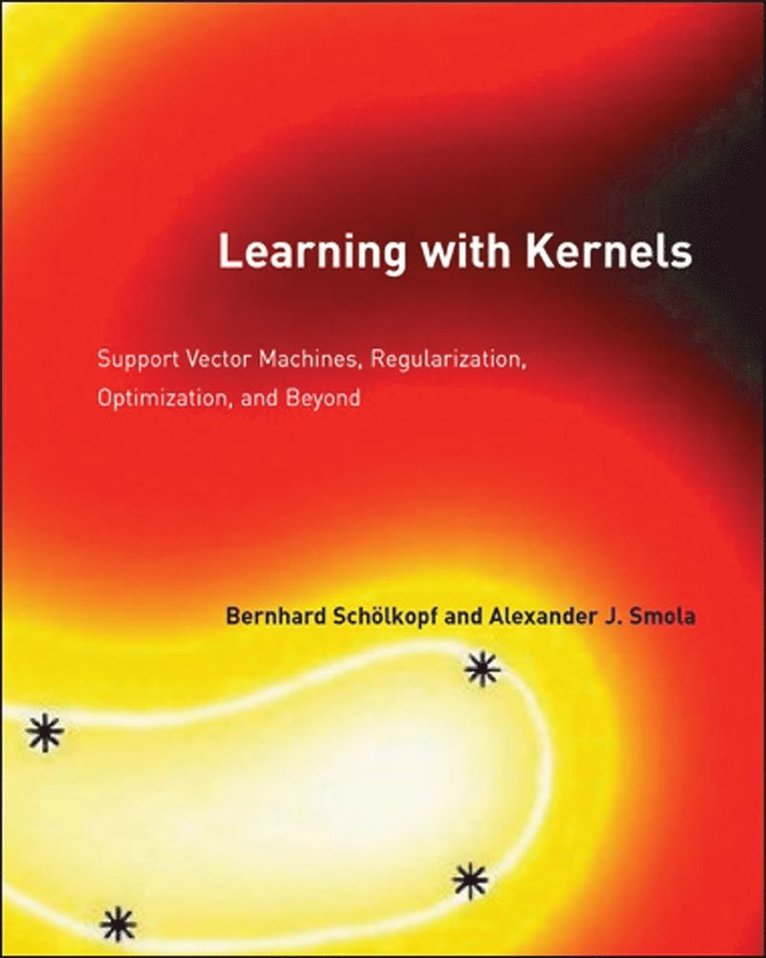
Learning with Kernels
Support Vector Machines, Regularization, Optimization, and Beyond
Häftad, Engelska, 2018
1 287 kr
Skickas inom 5-8 vardagar
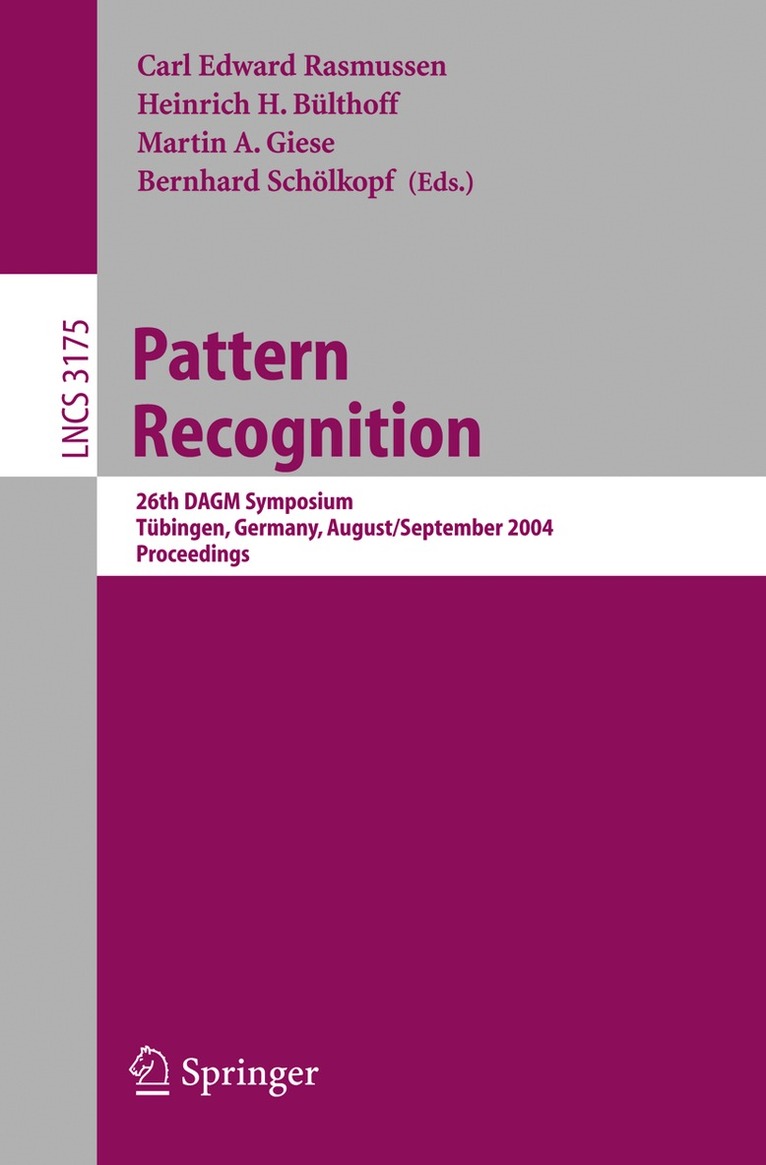
Pattern Recognition
26th DAGM Symposium, August 30 - September 1, 2004, Proceedings
Häftad, Engelska, 2004
556 kr
Skickas inom 10-15 vardagar
We are delighted to present the proceedings of DAGM 2004, and wish to - press our gratitude to the many people whose e?orts made the success of the conference possible. We received 146 contributions of which we were able to - cept 22 as oral presentations and 48 as posters. Each paper received 3 reviews, upon which decisions were based. We are grateful for the dedicated work of the 38 members of the program committee and the numerous referees. The careful review process led to the exciting program which we are able to present in this volume. Among the highlights of the meeting were the talks of our four invited spe- ers, renowned experts in areas spanning learning in theory, in vision and in robotics: - William T. Freeman, Arti?cial Intelligence Laboratory, MIT: Sharing F- tures for Multi-class Object Detection - PietroPerona,Caltech:TowardsUnsupervisedLearningofObjectCategories - StefanSchaal,DepartmentofComputerScience,UniversityofSouthernC- ifornia: Real-Time Statistical Learning for Humanoid Robotics - Vladimir Vapnik, NEC Research Institute: Empirical Inference WearegratefulforeconomicsupportfromHondaResearchInstituteEurope, ABW GmbH, Transtec AG, DaimlerChrysler, and Stemmer Imaging GmbH, which enabled us to ?nance best paper prizes and a limited number of travel grants. Many thanks to our local support Sabrina Nielebock and Dagmar Maier, who dealt with the unimaginably diverse range of practical tasks involved in planning a DAGM symposium. Thanks to Richard van de Stadt for providing excellent software and support for handling the reviewing process. A special thanks goes to Jeremy Hill, who wrote and maintained the conference website.
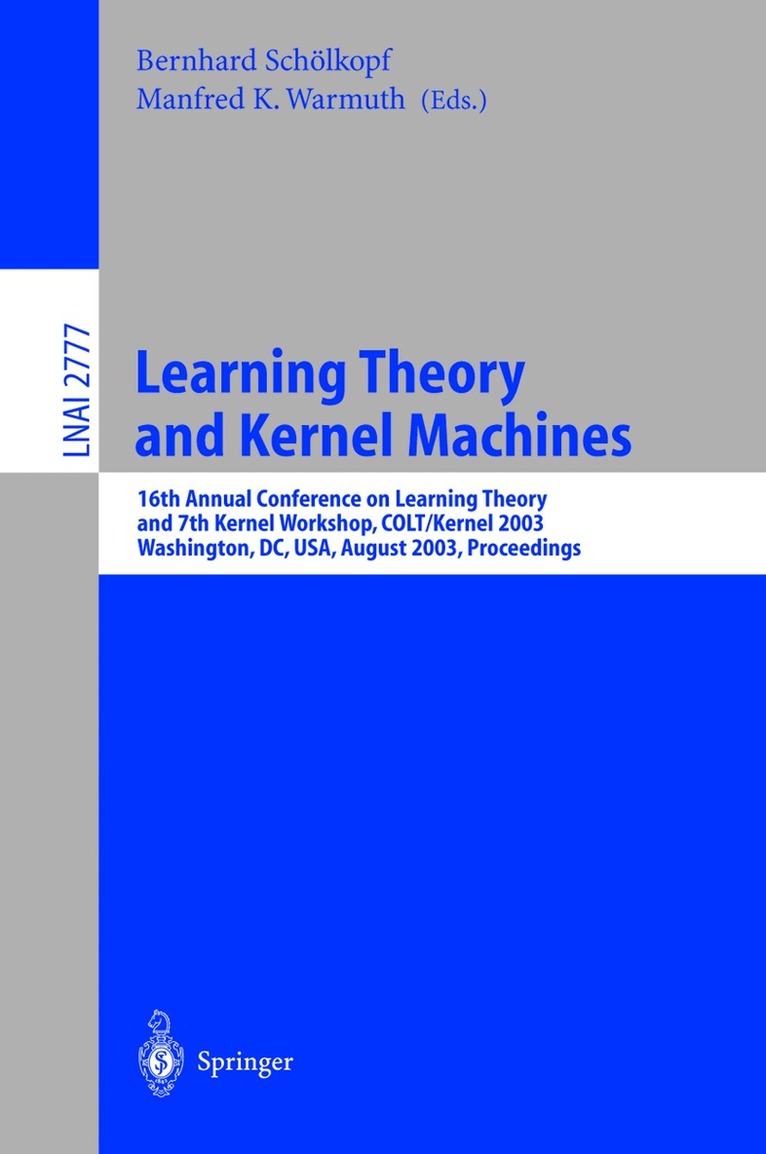
Learning Theory and Kernel Machines
16th Annual Conference on Computational Learning Theory and 7th Kernel Workshop, COLT/Kernel 2003, Washington, DC, USA, August 24-27, 2003, Proceedings
Häftad, Engelska, 2003
1 105 kr
Skickas inom 10-15 vardagar
This volume contains papers presented at the joint 16th Annual Conference on Learning Theory (COLT) and the 7th Annual Workshop on Kernel Machines, heldinWashington,DC,USA,duringAugust24-27,2003.COLT,whichrecently merged with EuroCOLT, has traditionally been a meeting place for learning theorists. We hope that COLT will bene?t from the collocation with the annual workshoponkernelmachines,formerlyheldasaNIPSpostconferenceworkshop. The technical program contained 47 papers selected from 92 submissions. All 47paperswerepresentedasposters;22ofthepaperswereadditionallypresented astalks.Therewerealsotwotargetareaswithinvitedcontributions.Incompu- tional game theory,atutorialentitled"LearningTopicsinGame-TheoreticDe- sionMaking"wasgivenbyMichaelLittman,andaninvitedpaperon"AGeneral Class of No-Regret Learning Algorithms and Game-Theoretic Equilibria" was contributed by Amy Greenwald. In natural language processing, a tutorial on "Machine Learning Methods in Natural Language Processing" was presented by Michael Collins, followed by two invited talks, "Learning from Uncertain Data" by Mehryar Mohri and "Learning and Parsing Stochastic Uni?cation- Based Grammars" by Mark Johnson.In addition to the accepted papers and invited presentations, we solicited short open problems that were reviewed and included in the proceedings. We hope that reviewed open problems might become a new tradition for COLT. Our goal was to select simple signature problems whose solutions are likely to inspire further research. For some of the problems the authors o?ered monetary rewards. Yoav Freund acted as the open problem area chair. The open problems were presented as posters at the conference.
2 118 kr
Skickas inom 10-15 vardagar
Numerous fascinating breakthroughs in biotechnology have generated large volumes and diverse types of high throughput data that demand the development of efficient and appropriate tools in computational statistics integrated with biological knowledge and computational algorithms.
556 kr
Skickas inom 10-15 vardagar
This book honours the outstanding contributions of Vladimir Vapnik, a rare example of a scientist for whom the following statements hold true simultaneously: his work led to the inception of a new field of research, the theory of statistical learning and empirical inference; he has lived to see the field blossom; and he is still as active as ever. He started analyzing learning algorithms in the 1960s and he invented the first version of the generalized portrait algorithm. He later developed one of the most successful methods in machine learning, the support vector machine (SVM) – more than just an algorithm, this was a new approach to learning problems, pioneering the use of functional analysis and convex optimization in machine learning. Part I of this book contains three chapters describing and witnessing some of Vladimir Vapnik's contributions to science. In the first chapter, Léon Bottou discusses the seminal paper published in 1968 by Vapnik and Chervonenkis that lay the foundations of statistical learning theory, and the second chapter is an English-language translation of that original paper. In the third chapter, Alexey Chervonenkis presents a first-hand account of the early history of SVMs and valuable insights into the first steps in the development of the SVM in the framework of the generalised portrait method. The remaining chapters, by leading scientists in domains such as statistics, theoretical computer science, and mathematics, address substantial topics in the theory and practice of statistical learning theory, including SVMs and other kernel-based methods, boosting, PAC-Bayesian theory, online and transductive learning, loss functions, learnable function classes, notions of complexity for function classes, multitask learning, and hypothesis selection.These contributions include historical and context notes, short surveys, and comments on future research directions. This book will be of interest to researchers, engineers, and graduate students engaged with all aspects of statistical learning.
540 kr
Skickas inom 10-15 vardagar
This book honours the outstanding contributions of Vladimir Vapnik, a rare example of a scientist for whom the following statements hold true simultaneously: his work led to the inception of a new field of research, the theory of statistical learning and empirical inference; he has lived to see the field blossom; and he is still as active as ever. He started analyzing learning algorithms in the 1960s and he invented the first version of the generalized portrait algorithm. He later developed one of the most successful methods in machine learning, the support vector machine (SVM) – more than just an algorithm, this was a new approach to learning problems, pioneering the use of functional analysis and convex optimization in machine learning. Part I of this book contains three chapters describing and witnessing some of Vladimir Vapnik's contributions to science. In the first chapter, Léon Bottou discusses the seminal paper published in 1968 by Vapnik and Chervonenkis that lay the foundations of statistical learning theory, and the second chapter is an English-language translation of that original paper. In the third chapter, Alexey Chervonenkis presents a first-hand account of the early history of SVMs and valuable insights into the first steps in the development of the SVM in the framework of the generalised portrait method. The remaining chapters, by leading scientists in domains such as statistics, theoretical computer science, and mathematics, address substantial topics in the theory and practice of statistical learning theory, including SVMs and other kernel-based methods, boosting, PAC-Bayesian theory, online and transductive learning, loss functions, learnable function classes, notions of complexity for function classes, multitask learning, and hypothesis selection.These contributions include historical and context notes, short surveys, and comments on future research directions. This book will be of interest to researchers, engineers, and graduate students engaged with all aspects of statistical learning.
2 118 kr
Skickas inom 10-15 vardagar
Now in its second edition, this handbook collects authoritative contributions on modern methods and tools in statistical bioinformatics with a focus on the interface between computational statistics and cutting-edge developments in computational biology.
653 kr
Skickas inom 5-8 vardagar