Henry Rosemont Jr. - Böcker
Visar alla böcker från författaren Henry Rosemont Jr.. Handla med fri frakt och snabb leverans.
5 produkter
5 produkter
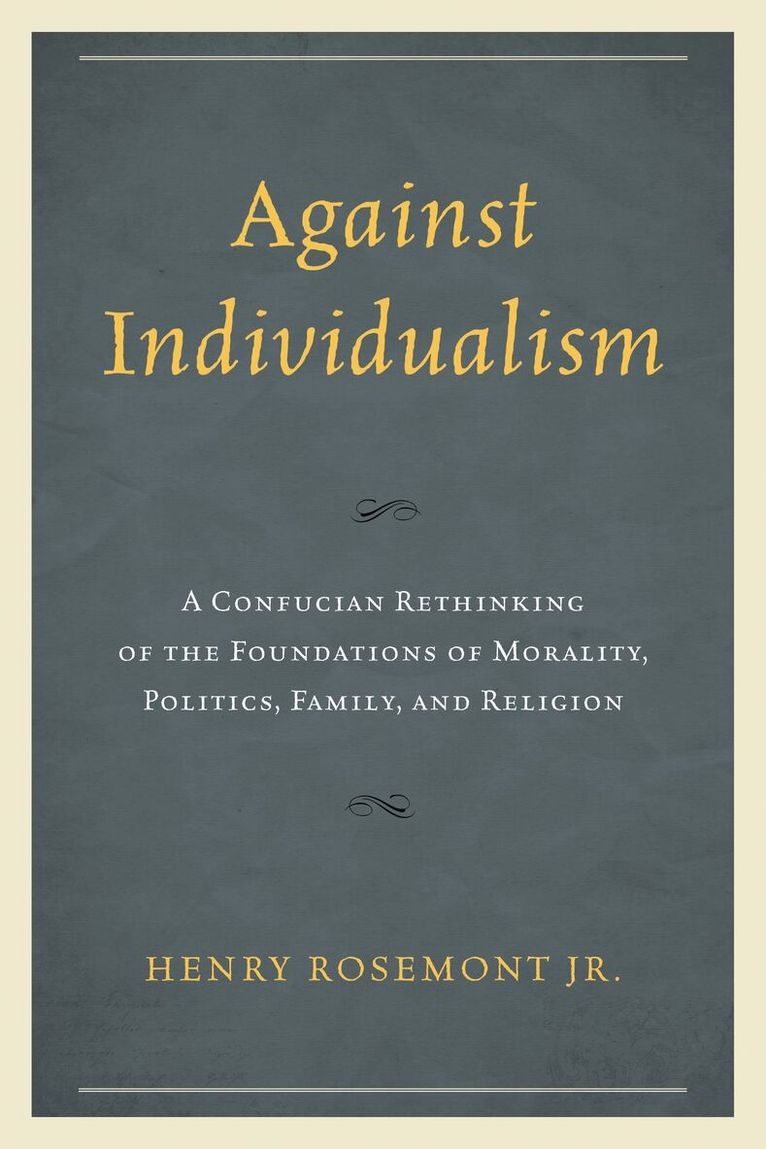
Against Individualism
A Confucian Rethinking of the Foundations of Morality, Politics, Family, and Religion
Inbunden, Engelska, 2015
1 343 kr
Skickas inom 10-15 vardagar
The first part of Against Individualism: A Confucian Rethinking of the Foundations of Morality, Politics, Family, and Religion is devoted to showing how and why the vision of human beings as free, independent and autonomous individuals is and always was a mirage that has served liberatory functions in the past, but has now become pernicious for even thinking clearly about, much less achieving social and economic justice, maintaining democracy, or addressing the manifold environmental and other problems facing the world today. In the second and larger part of the book Rosemont proffers a different vision of being human gleaned from the texts of classical Confucianism, namely, that we are first and foremost interrelated and thus interdependent persons whose uniqueness lies in the multiplicity of roles we each live throughout our lives. This leads to an ethics based on those mutual roles in sharp contrast to individualist moralities, but which nevertheless reflect the facts of our everyday lives very well. The book concludes by exploring briefly a number of implications of this vision for thinking differently about politics, family life, justice, and the development of a human-centered authentic religiousness. This book will be of value to all students and scholars of philosophy, political theory, and Religious, Chinese, and Family Studies, as well as everyone interested in the intersection of morality with their everyday and public lives.
Against Individualism
A Confucian Rethinking of the Foundations of Morality, Politics, Family, and Religion
Häftad, Engelska, 2016
675 kr
Skickas inom 10-15 vardagar
The first part of Against Individualism: A Confucian Rethinking of the Foundations of Morality, Politics, Family, and Religion is devoted to showing how and why the vision of human beings as free, independent and autonomous individuals is and always was a mirage that has served liberatory functions in the past, but has now become pernicious for even thinking clearly about, much less achieving social and economic justice, maintaining democracy, or addressing the manifold environmental and other problems facing the world today. In the second and larger part of the book Rosemont proffers a different vision of being human gleaned from the texts of classical Confucianism, namely, that we are first and foremost interrelated and thus interdependent persons whose uniqueness lies in the multiplicity of roles we each live throughout our lives. This leads to an ethics based on those mutual roles in sharp contrast to individualist moralities, but which nevertheless reflect the facts of our everyday lives very well. The book concludes by exploring briefly a number of implications of this vision for thinking differently about politics, family life, justice, and the development of a human-centered authentic religiousness. This book will be of value to all students and scholars of philosophy, political theory, and Religious, Chinese, and Family Studies, as well as everyone interested in the intersection of morality with their everyday and public lives.
140 kr
Skickas inom 10-15 vardagar
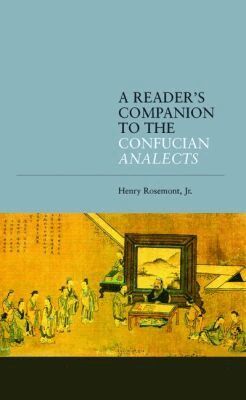
In this little book, Confucian scholar and philosopher Henry Rosemont, Jr. has summarized forty years of experience studying, translating, and teaching the Analects. For essential cross-referencing of textual passages in differing translations, Rosemont provides tables of variant spellings of Chinese terms, a finding list for students named in the text, a concordance of key philosophical and religious terms, and an annotated bibliography to guide the reader's further studies and reflections on the text. Distributed for Henry Rosemont, Jr.
402 kr
Tillfälligt slut
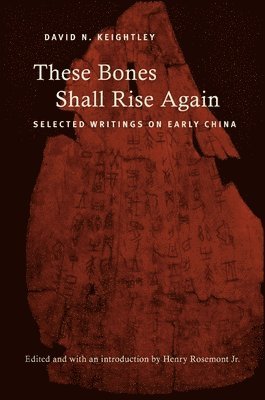
David N. Keightley's seminal essays on the origins of Chinese society are brought together in one volume.These Bones Shall Rise Again, brings together in one volume many of David N. Keightley's seminal essays on the origins of early Chinese civilization. Written over a period of three decades and accessible to the non-specialist, these essays provide a wealth of information and insights on the Shang dynasty, traditionally dated 1766–1122 or 1056 BCE. Of all the eras of Chinese history, the Shang has been a particularly elusive one, long considered more myth than reality. A historian with a keen appreciation for anthropology and archaeology, Keightley has given us many descriptions of Shang life. Best known for his analysis of oracle bones, he has looked beyond the bones themselves and expanded his historical vision to ponder the lives of those who used them. What did the Shang diviner think he was doing? The temerity to ask such questions and the insights they have provided have been provocative and, at times, controversial. Equally intriguing have been Keightley's assertions that many of the distinctive features of Chinese civilization were already in evidence during the Shang, 3000 years ago. In this collection, readers will find not only an essential reference but also the best kind of thought-provoking scholarship.
1 057 kr
Tillfälligt slut
David N. Keightley's seminal essays on the origins of Chinese society are brought together in one volume.These Bones Shall Rise Again, brings together in one volume many of David N. Keightley's seminal essays on the origins of early Chinese civilization. Written over a period of three decades and accessible to the non-specialist, these essays provide a wealth of information and insights on the Shang dynasty, traditionally dated 1766–1122 or 1056 BCE. Of all the eras of Chinese history, the Shang has been a particularly elusive one, long considered more myth than reality. A historian with a keen appreciation for anthropology and archaeology, Keightley has given us many descriptions of Shang life. Best known for his analysis of oracle bones, he has looked beyond the bones themselves and expanded his historical vision to ponder the lives of those who used them. What did the Shang diviner think he was doing? The temerity to ask such questions and the insights they have provided have been provocative and, at times, controversial. Equally intriguing have been Keightley's assertions that many of the distinctive features of Chinese civilization were already in evidence during the Shang, 3000 years ago. In this collection, readers will find not only an essential reference but also the best kind of thought-provoking scholarship.