Hessel Wijkstra – författare
Visar alla böcker från författaren Hessel Wijkstra. Handla med fri frakt och snabb leverans.
5 produkter
5 produkter
Häftad, Engelska, 2014
1 234 kr
Skickas inom 10-15 vardagar
Thepastdecadehasseendramaticadvances inurologyandimaging. Thesechangesareevident in improvements in laparoscopic surgery as well as in the emergence of multidetector CT, with multiplanar reformatting and FDG-PET-CT as routine imaging methods. The new minimally invasive procedures often require more exacting imaging as the surgeon does not have the same visual ?eld of view as was possible with open procedures. Thus, it is appropriate now to p- vide an update on imaging advances for the bene?t of urologists and radiologists alike. The increasing number of innovative imaging approaches to urologic tumors including CT, MRI, PET, SPECT, and endoscopic imaging can be perplexing and lead to over- and underesti- tions of the capabilities of modern imaging on the part of those who interpret them and those who use the information they provide for patient management. There is a growing “exp- tations gap” between what is expected and what is possible that needs to be closed. While previous books have focused on the more common urologic tumors such as bladder, prostate, andkidneycancer,nonehasattemptedacomprehensivereviewofthestateoftheartofimaging in most of the tumors involved in urologic oncology. Imaging in Urologic Oncology addresses these challenges. In the modern imaging department it is easy to forget how useful conventional plain rad- graphy can be in urologic diagnosis. Much of our current understanding of urologic disease is based on the “classic appearance” on intravenous urograms, cystograms, or retrograde pye- grams. Therefore, conventional imaging provides the ?rst “layer” in our understanding of u- logic tumors. The next layer is cross-sectional imaging.
Inbunden, Engelska, 2009
1 680 kr
Skickas inom 10-15 vardagar
Thepastdecadehasseendramaticadvances inurologyandimaging. Thesechangesareevident in improvements in laparoscopic surgery as well as in the emergence of multidetector CT, with multiplanar reformatting and FDG-PET-CT as routine imaging methods. The new minimally invasive procedures often require more exacting imaging as the surgeon does not have the same visual ?eld of view as was possible with open procedures. Thus, it is appropriate now to p- vide an update on imaging advances for the bene?t of urologists and radiologists alike. The increasing number of innovative imaging approaches to urologic tumors including CT, MRI, PET, SPECT, and endoscopic imaging can be perplexing and lead to over- and underesti- tions of the capabilities of modern imaging on the part of those who interpret them and those who use the information they provide for patient management. There is a growing “exp- tations gap” between what is expected and what is possible that needs to be closed. While previous books have focused on the more common urologic tumors such as bladder, prostate, andkidneycancer,nonehasattemptedacomprehensivereviewofthestateoftheartofimaging in most of the tumors involved in urologic oncology. Imaging in Urologic Oncology addresses these challenges. In the modern imaging department it is easy to forget how useful conventional plain rad- graphy can be in urologic diagnosis. Much of our current understanding of urologic disease is based on the “classic appearance” on intravenous urograms, cystograms, or retrograde pye- grams. Therefore, conventional imaging provides the ?rst “layer” in our understanding of u- logic tumors. The next layer is cross-sectional imaging.
E-bok
PDF, Engelska, 20081 565 kr
Läs direkt efter köp
Thepastdecadehasseendramaticadvances inurologyandimaging. Thesechangesareevident in improvements in laparoscopic surgery as well as in the emergence of multidetector CT, with multiplanar reformatting and FDG-PET-CT as routine imaging methods. The new minimally invasive procedures often require more exacting imaging as the surgeon does not have the same visual ?eld of view as was possible with open procedures. Thus, it is appropriate now to p- vide an update on imaging advances for the bene?t of urologists and radiologists alike. The increasing number of innovative imaging approaches to urologic tumors including CT, MRI, PET, SPECT, and endoscopic imaging can be perplexing and lead to over- and underesti- tions of the capabilities of modern imaging on the part of those who interpret them and those who use the information they provide for patient management. There is a growing “exp- tations gap” between what is expected and what is possible that needs to be closed. While previous books have focused on the more common urologic tumors such as bladder, prostate, andkidneycancer,nonehasattemptedacomprehensivereviewofthestateoftheartofimaging in most of the tumors involved in urologic oncology. Imaging in Urologic Oncology addresses these challenges. In the modern imaging department it is easy to forget how useful conventional plain rad- graphy can be in urologic diagnosis. Much of our current understanding of urologic disease is based on the “classic appearance” on intravenous urograms, cystograms, or retrograde pye- grams. Therefore, conventional imaging provides the ?rst “layer” in our understanding of u- logic tumors. The next layer is cross-sectional imaging.
Häftad, Engelska, 2018
565 kr
Skickas inom 10-15 vardagar
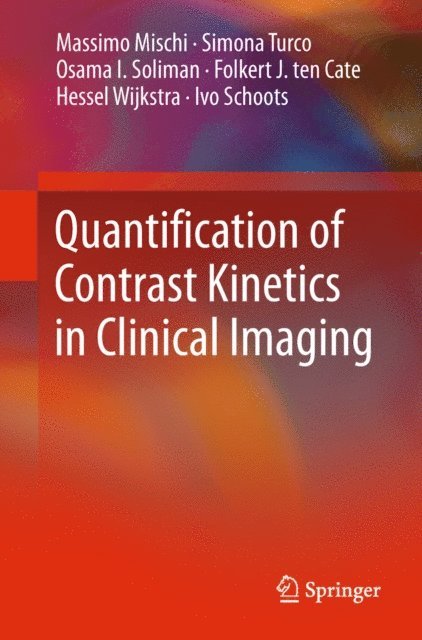
This book provides a comprehensive survey of the pharmacokinetic models used for the quantitative interpretation of contrast-enhanced imaging. It discusses all the available imaging technologies and the problems related to the calibration of the imaging system and accuracy of the estimated physiological parameters. Enhancing imaging modalities using contrast agents has opened up new opportunities for going beyond morphological information and enabling minimally invasive assessment of tissue and organ functionality down to the molecular level. In combination with mathematical modeling of the contrast agent kinetics, contrast- enhanced imaging has the potential to provide clinically valuable additional information by estimating quantitative physiological parameters. The book presents the broad spectrum of diagnostic possibilities provided by quantitative contrast-enhanced imaging, with a particular focus on cardiology and oncology, as well as novel developments in the area of quantitative molecular imaging along with their potential clinical applications. Given the variety of available techniques, the choice of the appropriate imaging modality and the most suitable pharmacokinetic model is often challenging. As such, the book provides a valuable technical guide for researchers, clinical scientists, and experts in the field who wish to better understand and properly apply tracer-kinetic modeling for quantitative contrast-enhanced imaging.
E-bok
Engelska, 2018708 kr
Läs direkt efter köp
This book provides a comprehensive survey of the pharmacokinetic models used for the quantitative interpretation of contrast-enhanced imaging. It discusses all the available imaging technologies and the problems related to the calibration of the imaging system and accuracy of the estimated physiological parameters. Enhancing imaging modalities using contrast agents has opened up new opportunities for going beyond morphological information and enabling minimally invasive assessment of tissue and organ functionality down to the molecular level. In combination with mathematical modeling of the contrast agent kinetics, contrast- enhanced imaging has the potential to provide clinically valuable additional information by estimating quantitative physiological parameters. The book presents the broad spectrum of diagnostic possibilities provided by quantitative contrast-enhanced imaging, with a particular focus on cardiology and oncology, as well as novel developments in the area of quantitative molecular imaging along with their potential clinical applications. Given the variety of available techniques, the choice of the appropriate imaging modality and the most suitable pharmacokinetic model is often challenging. As such, the book provides a valuable technical guide for researchers, clinical scientists, and experts in the field who wish to better understand and properly apply tracer-kinetic modeling for quantitative contrast-enhanced imaging.