H.J. Peters - Böcker
Visar alla böcker från författaren H.J. Peters. Handla med fri frakt och snabb leverans.
4 produkter
4 produkter
1 064 kr
Skickas inom 10-15 vardagar
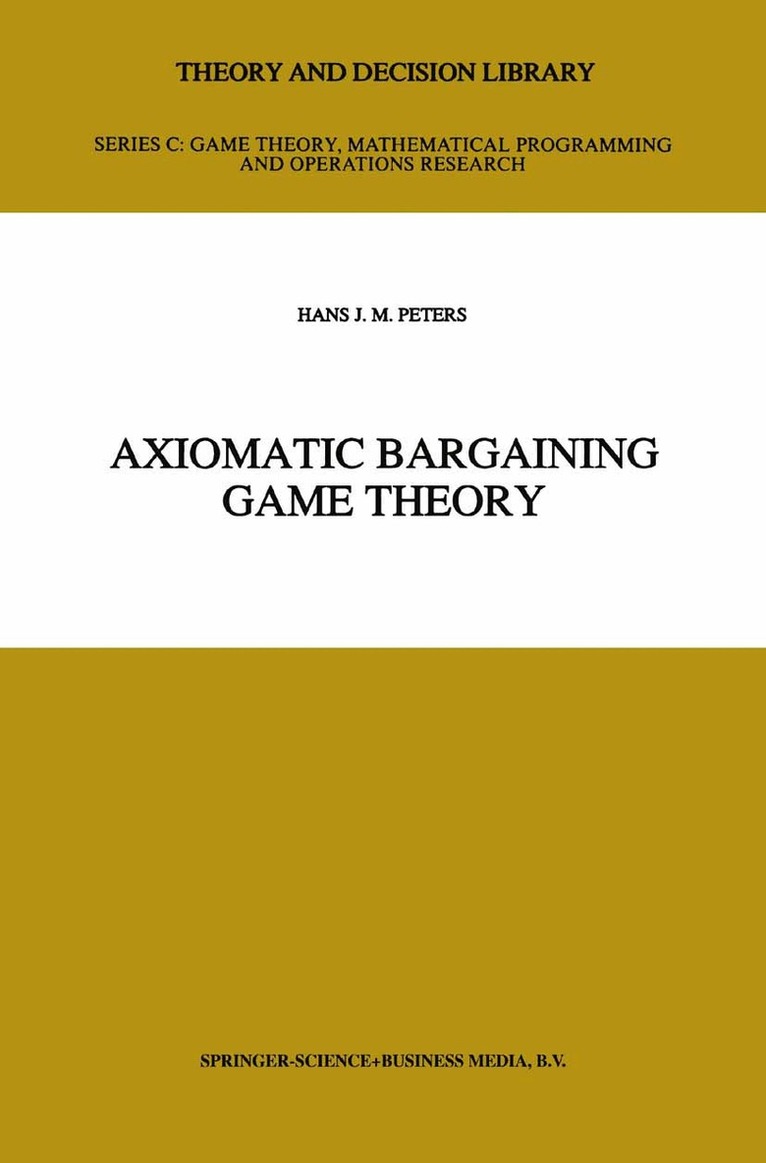
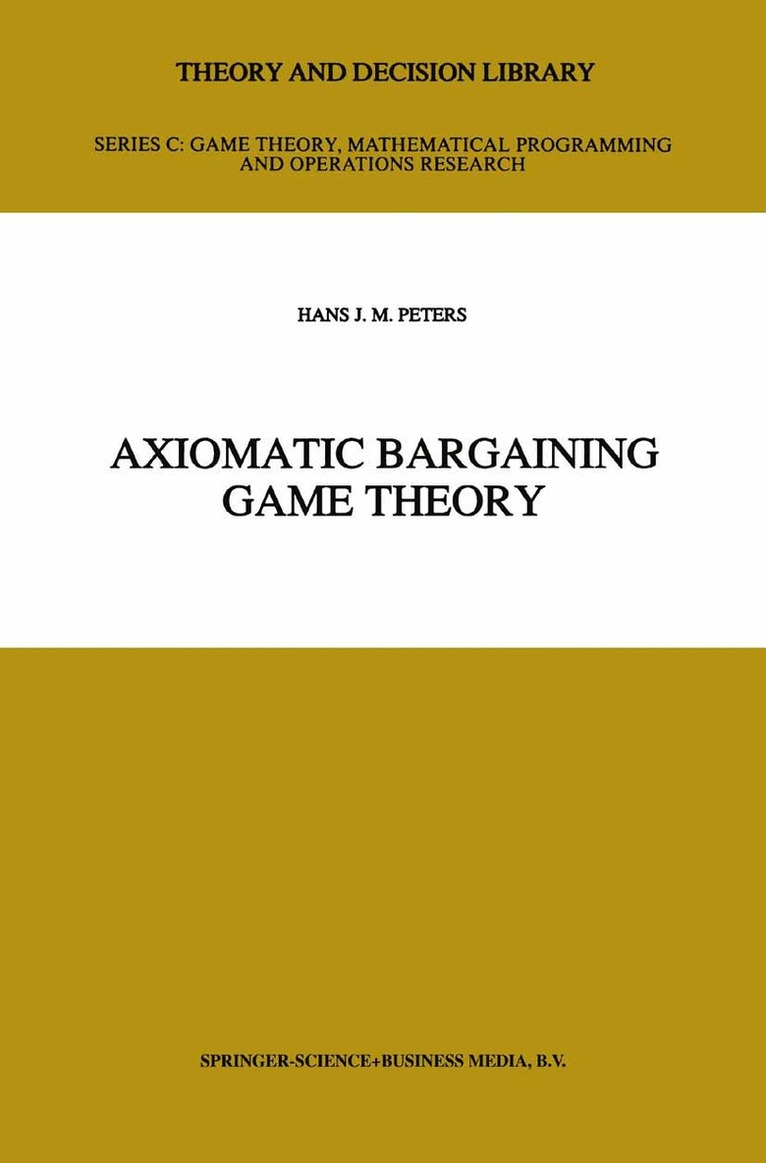
Many social or economic conflict situations can be modelled by specifying the alternatives on which the involved parties may agree, and a special alternative which summarizes what happens in the event that no agreement is reached. Such a model is called a bargaining game, and a prescription assigning an alternative to each bargaining game is called a bargaining solution. In the co-operative game-theoretical approach, bargaining solutions are mathematically characterized by desirable properties, usually called axioms. In the nonco-operative approach, solutions are derived as equilibria of strategic models describing an underlying bargaining procedure. "Axiomatic Bargaining Theory" provides the reader with a survey of co-operative, axiomatic models of bargaining, starting with Nash's seminal paper, "The Bargaining Problem". It presents an overview of the main results in this area during the past four decades and also provides a chapter on nonco-operative models of bargaining, particularly on those models leading to bargaining solutions that also result from the axiomatic approach.The main existing axiomatizations of solutions for coalitional bargaining games are included, as well as an auxiliary chapter on the relevant demands from utility theory.
Del 31 - Theory and Decision Library C
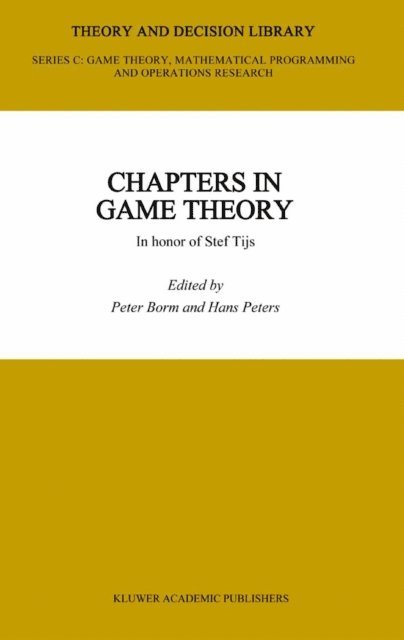
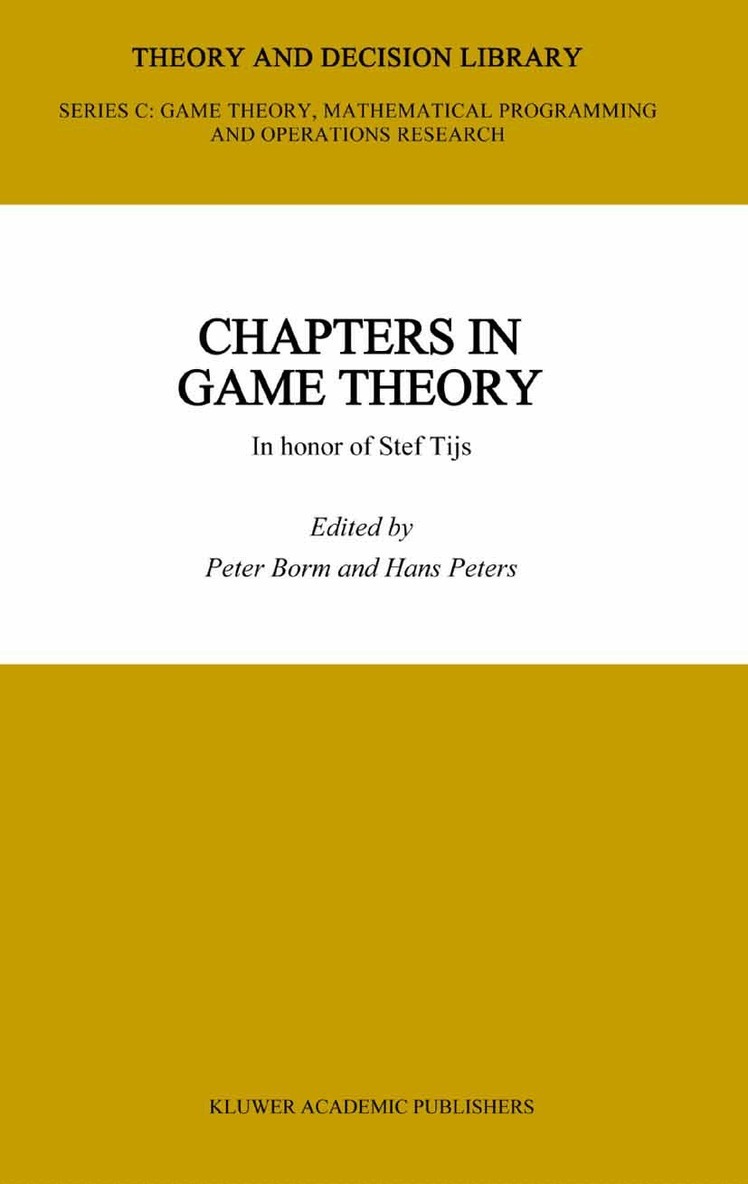
Chapters in Game Theory
In honor of Stef Tijs
Inbunden, Engelska, 2002
1 593 kr
Skickas inom 10-15 vardagar
"Chapters in Game Theory" was written to mark the occasion of the 65th birthday of Stef Tijs, who is regarded by many as the "godfather" of game theory in the Netherlands. The contributors all are indebted to Stef Tijs, as former PhD students or otherwise. The text contains 14 chapters on a wide range of subjects. Some of these can be considered surveys while other chapters present new results: most contributions can be positioned somewhere in between these categories. The topics covered include: co-operative stochastic games; nonco-operative stochastic games; sequencing games; games arising from linear (semi-) infinite programming problems; network formation, costs and potential games; potentials and consistency in transferable utility games; the nucleolus and equilibrium prices; population uncertainty and equilibrium selection; cost sharing; centrality in social networks; extreme points of the core; equilibrium sets of bimatrix games; game theory and the market; and transfer procedures for nontransferable utility games.
1 640 kr
Skickas inom 10-15 vardagar
Chapters in Game Theory has been written on the occasion of the 65th birthday of Stef Tijs, who can be regarded as the godfather of game theory in the Netherlands. The contributors all are indebted to Stef Tijs, as former Ph.D. students or otherwise. The book contains fourteen chapters on a wide range of subjects. Some of these can be considered surveys while other chapters present new results: most contributions can be positioned somewhere in between these categories. The topics covered include: cooperative stochastic games; noncooperative stochastic games; sequencing games; games arising form linear (semi-) infinite programming problems; network formation, costs and potential games; potentials and consistency in transferable utility games; the nucleolus and equilibrium prices; population uncertainty and equilibrium selection; cost sharing; centrality in social networks; extreme points of the core; equilibrium sets of bimatrix games; game theory and the market; and transfer procedures for nontransferable utility games. Both editors did their Ph.D with Stef Tijs, while he was affiliated with the mathematics department of the University of Nijmegen.
1 096 kr
Skickas inom 10-15 vardagar
Many social or economic conflict situations can be modeled by specifying the alternatives on which the involved parties may agree, and a special alternative which summarizes what happens in the event that no agreement is reached. Such a model is called a bargaining game, and a prescription assigning an alternative to each bargaining game is called a bargaining solution. In the cooperative game-theoretical approach, bargaining solutions are mathematically characterized by desirable properties, usually called axioms. In the noncooperative approach, solutions are derived as equilibria of strategic models describing an underlying bargaining procedure. Axiomatic Bargaining Game Theory provides the reader with an up-to-date survey of cooperative, axiomatic models of bargaining, starting with Nash's seminal paper, The Bargaining Problem. It presents an overview of the main results in this area during the past four decades. Axiomatic Bargaining Game Theory provides a chapter on noncooperative models of bargaining, in particular on those models leading to bargaining solutions that also result from the axiomatic approach.The main existing axiomatizations of solutions for coalitional bargaining games are included, as well as an auxiliary chapter on the relevant demands from utility theory.