Holley Moyes - Böcker
Visar alla böcker från författaren Holley Moyes. Handla med fri frakt och snabb leverans.
4 produkter
4 produkter
2 639 kr
Skickas inom 5-8 vardagar
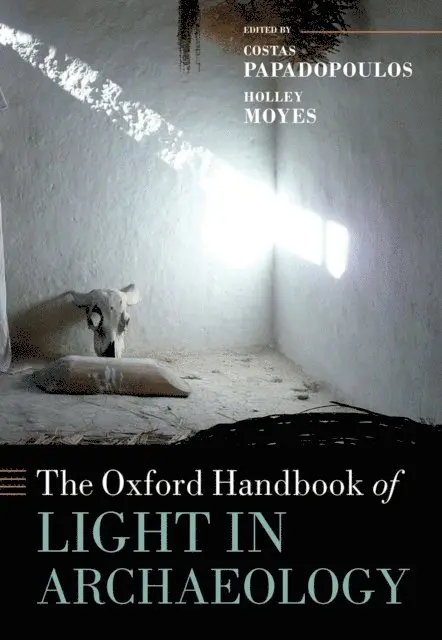
Light has a fundamental role to play in our perception of the world. Natural or artificial lightscapes orchestrate uses and experiences of space and, in turn, influence how people construct and negotiate their identities, form social relationships, and attribute meaning to (im)material practices. Archaeological practice seeks to analyse the material culture of past societies by examining the interaction between people, things, and spaces. As light is a crucial factor that mediates these relationships, understanding its principles and addressing illumination's impact on sensory experience and perception should be a fundamental pursuit in archaeology. However, in archaeological reasoning, studies of lightscapes have remained largely neglected and understudied. This volume provides a comprehensive and accessible consideration of light in archaeology and beyond by including dedicated and fully illustrated chapters covering diverse aspects of illumination in different spatial and temporal contexts, from prehistory to the present. Written by leading international scholars, it interrogates the qualities and affordances of light in different contexts and (im)material environments, explores its manipulation, and problematises its elusive properties. The result is a synthesis of invaluable insights into sensory experience and perception, demonstrating illumination's vital impact on social, cultural, and artistic contexts.
1 240 kr
Tillfälligt slut
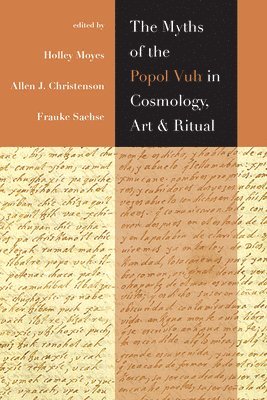
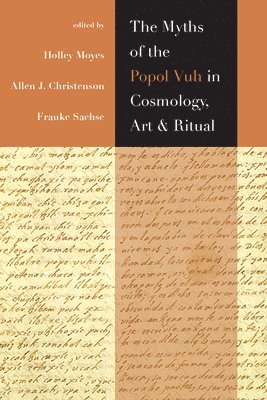
This volume offers an integrated and comparative approach to the Popol Vuh, analyzing its myths to elucidate the ancient Maya past while using multiple lines of evidence to shed light on the text. Combining interpretations of the myths with analyses of archaeological, iconographic, epigraphic, ethnohistoric, ethnographic, and literary resources, the work demonstrates how Popol Vuh mythologies contribute to the analysis and interpretation of the ancient Maya past. The chapters are grouped into four sections. The first section interprets the Highland Maya worldview through examination of the text, analyzing interdependence between deities and human beings as well as the textual and cosmological coherence of the Popol Vuh as a source. The second section analyzes the Precolumbian Maya archaeological record as it relates to the myths of the Popol Vuh, providing new interpretations of the use of space, architecture, burials, artifacts, and human remains found in Classic Maya caves. The third explores ancient Maya iconographic motifs, including those found in Classic Maya ceramic art; the nature of predatory birds; and the Hero Twins’ deeds in the Popol Vuh. The final chapters address mythological continuities and change, reexamining past methodological approaches using the Popol Vuh as a resource for the interpretation of Classic Maya iconography and ancient Maya religion and mythology, connecting the myths of the Popol Vuh to iconography from Preclassic Izapa, and demonstrating how narratives from the Popol Vuh can illuminate mythologies from other parts of Mesoamerica. The Myths of the Popol Vuh in Cosmology, Art, and Ritual is the first volume to bring together multiple perspectives and original interpretations of the Popol Vuh myths. It will be of interest not only to Mesoamericanists but also to art historians, archaeologists, ethnohistorians, iconographers, linguists, anthropologists, and scholars working in ritual studies, the history of religion, historic and Precolumbian literature and historic linguistics. Contributors: Jaime J. Awe, Karen Bassie-Sweet, Oswaldo Chinchilla Mazariegos, Michael D. Coe, Iyaxel Cojtí Ren, Héctor Escobedo, Thomas H. Guderjan, Julia Guernsey, Christophe Helmke, Nicholas A. Hopkins, Barbara MacLeod, Jesper Nielsen, Colin Snider, Karl A. Taube
441 kr
Tillfälligt slut
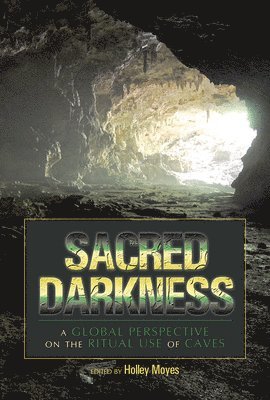
Caves have been used in various ways across human society, but despite the persistence within popular culture of the iconic caveman, deep caves were never used primarily as habitation sites for early humans. Rather, in both ancient and contemporary contexts, caves have served primarily as ritual spaces. In Sacred Darkness, contributors use archaeological evidence as well as ethnographic studies of modern ritual practices to envision the cave as place of spiritual and ideological power that emerges as a potent venue for ritual practice.Covering the ritual use of caves in Europe, Asia, Australia, Africa, Mesoamerica, and the US Southwest and Eastern woodlands, this book brings together case studies by prominent scholars whose research spans from the Paleolithic period to the present day. These contributions demonstrate that cave sites are as fruitful as surface contexts in promoting the understanding of both ancient and modern religious beliefs and practices.This state-of-the-art survey of ritual cave use will be one of the most valuable resources for understanding the role of caves in studies of religion, sacred landscape, or cosmology and a must-read for any archaeologist interested in caves.
507 kr
Skickas inom 5-8 vardagar
This volume offers an integrated and comparative approach to the Popol Vuh, analyzing its myths to elucidate the ancient Maya past while using multiple lines of evidence to shed light on the text. Combining interpretations of the myths with analyses of archaeological, iconographic, epigraphic, ethnohistoric, ethnographic, and literary resources, the work demonstrates how Popol Vuh mythologies contribute to the analysis and interpretation of the ancient Maya past. The chapters are grouped into four sections. The first section interprets the Highland Maya worldview through examination of the text, analyzing interdependence between deities and human beings as well as the textual and cosmological coherence of the Popol Vuh as a source. The second section analyzes the Precolumbian Maya archaeological record as it relates to the myths of the Popol Vuh, providing new interpretations of the use of space, architecture, burials, artifacts, and human remains found in Classic Maya caves. The third explores ancient Maya iconographic motifs, including those found in Classic Maya ceramic art; the nature of predatory birds; and the Hero Twins’ deeds in the Popol Vuh. The final chapters address mythological continuities and change, reexamining past methodological approaches using the Popol Vuh as a resource for the interpretation of Classic Maya iconography and ancient Maya religion and mythology, connecting the myths of the Popol Vuh to iconography from Preclassic Izapa, and demonstrating how narratives from the Popol Vuh can illuminate mythologies from other parts of Mesoamerica. The Myths of the Popol Vuh in Cosmology, Art, and Ritual is the first volume to bring together multiple perspectives and original interpretations of the Popol Vuh myths. It will be of interest not only to Mesoamericanists but also to art historians, archaeologists, ethnohistorians, iconographers, linguists, anthropologists, and scholars working in ritual studies, the history of religion, historic and Precolumbian literature and historic linguistics. Contributors: Jaime J. Awe, Karen Bassie-Sweet, Oswaldo Chinchilla Mazariegos, Michael D. Coe, Iyaxel Cojtí Ren, Héctor Escobedo, Thomas H. Guderjan, Julia Guernsey, Christophe Helmke, Nicholas A. Hopkins, Barbara MacLeod, Jesper Nielsen, Colin Snider, Karl A. Taube