
Hugh Dalziel Duncan – författare
Visar alla böcker från författaren Hugh Dalziel Duncan. Handla med fri frakt och snabb leverans.
3 produkter
3 produkter
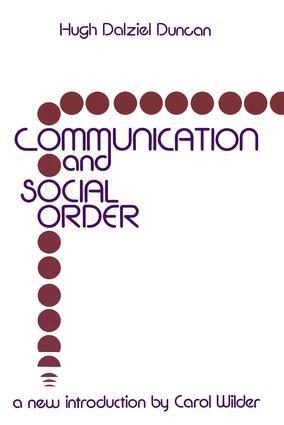
Häftad, Engelska, 1984
675 kr
Skickas inom 10-15 vardagar
In this highly influential study of art forms as models for a theory of communications, Hugh Dalziel Duncan demonstrates that without understanding of the role of symbols in society, social scientists cannot hope to develop adequate models for social analysis. He reviews critically major contributions to communication theory during the past century: Freud's analysis of dream symbolism, Simmel's concept of sociability, James' insights into religious experience, and Dewey's relating of art to experience.
Inbunden, Engelska, 2017
2 151 kr
Skickas inom 10-15 vardagar
In this highly influential study of art forms as models for a theory of communications, Hugh Dalziel Duncan demonstrates that without understanding of the role of symbols in society, social scientists cannot hope to develop adequate models for social analysis. He reviews critically major contributions to communication theory during the past century: Freud's analysis of dream symbolism, Simmel's concept of sociability, James' insights into religious experience, and Dewey's relating of art to experience.
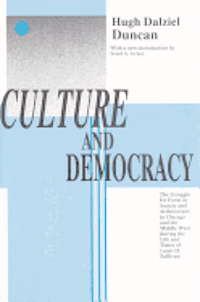
Häftad, Engelska, 1989
481 kr
Tillfälligt slut
This work by the late and great sociologist Hugh Dalziel Duncan, paints the great panorama of the Middle West, where egalitarianism is the most cherished value, and money is the most important vehicle of life. How art finds a place in this society is shown in the specific struggle between the architects, businessmen, unionists, and educators of Chicago. Into such specifics Duncan reveals the place of supposedly abstract theories developed by John Dewey, George Herbert Mead, Thorstein Veblen, and above all, Louis H. Sullivan, whose school of architecture presents both a new form of physical design and a new order of society. The rise, seeming defeat, and final triumph of Sullivan's principles of order in architecture are related to his social and aesthetic theories of form in society. In democratic society, all individuals must be capable of art, just as all individuals share in art as experience. Sullivan's description of the development within the individual of the idea of architecture is treated as an allegory of such development in the spirit of democratic values. His life is offered as a parable of the problem facing American artists as they attempt to root art in democratic culture. In Sullivan's words: "The critical study of architecture becomes not merely the direct study of art, but in extenso, a study of the social conditions producing it. The study of a newly shaping type of civilization. By this light, the study of architecture becomes naturally and logically a branch of social science. . . ." Duncan's exceptional volume, written with grace and clarity, registers the achievements of this Chicago School, showing how culture and democracy reached a special moment of consensus with the money-based economy of our time.