Hugh McDonnell - Böcker
Visar alla böcker från författaren Hugh McDonnell. Handla med fri frakt och snabb leverans.
3 produkter
3 produkter
733 kr
Kommande
The End of Violence focuses on General Jacques Pâris de Bollardière, who transformed from a rising star in the French army into a stalwart of nonviolence. In 1957, de Bollardière abruptly left his command in Algeria out of a refusal to countenance torture, publicly denouncing this paradigmatic war of European decolonization. In doing so, he jettisoned a glittering career forged in the Free French forces and Resistance maquis in the Second World War, and in France's colonial war in Indochina (1945–1954). Hugh McDonnell offers an innovative contribution with previously unexplored source material that reveals worldviews informing early twentieth-century provincial aristocratic family life, novel insights into Second World War dynamics, ethical problems of the Free French movement, and the messy and lethal world of the Ardennes maquis. He provides a complex analysis of revolutionary warfare as the guiding ethos of the French army in its colonial wars in Indochina and Algeria, the retrospective debates in the 1970s about torture in Algeria, and the wider, highly politicized public sphere in late Cold War France. The End of Violence contextualizes de Bollardière's public interventions to examine the contentious French debates about Western military alliances and commitment to nuclear weaponry. Thus, de Bollardière's story, while unique, sheds light on vital wider historical questions, both in France and beyond: ideas and practices of violence and nonviolence, forms of socialization and possibilities for dissent in the military, and the achievements and limitations of the nonviolence movement.
2 144 kr
Skickas inom 7-10 vardagar
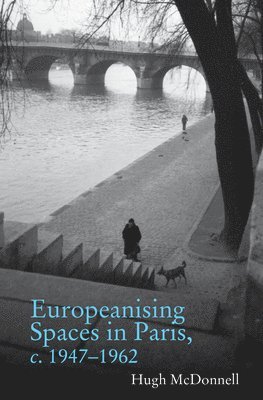
In the wake of the Second World War, ideas of Europe abounded. What did Europe mean as a concept, and what did it mean to be European? Europeanising Spaces in Paris, c. 1947-1962 makes the case that Paris was both a leading and distinctive forum for the expression of these ideas in the post-war period. It examines spaces in the French capital in which ideas about Europe were formulated, articulated, exchanged, circulated, and contested during this post-war period, roughly between the escalation of the Cold War and the end of France's war of decolonisation in Algeria.Such processes of making sense of Europe are elucidated in urban, political and cultural spaces in the French capital. Specifically, the Parisian café, home and street are each examined in terms of how they were implicated in ideas about Europe. Then, the Paris-based Mouvement socialiste des états unis d'Europe (The Socialist Movement for the United States of Europe) and the far-right wing Fédération des étudiants nationalistes (The Federation of Nationalist Students) are examined as examples of political movements that mobilised around – very different – concepts of Europe. The final section on cultural Europeanising spaces draws attention to the specificities of the Europeanism of exiles from Franco's Spain in Paris; the work of the great scholar of the Arab world, Jacques Berque, in the context of his understanding of the Mediterranean world and his understanding of faith; and finally, the work of the legendary photographer, Henri Cartier-Bresson, by looking at the capacities and limitations of the photographic medium for the representation of Europe, and how these corresponded with Cartier-Bresson’s political, social, and aesthetic commitments.
583 kr
Skickas inom 7-10 vardagar
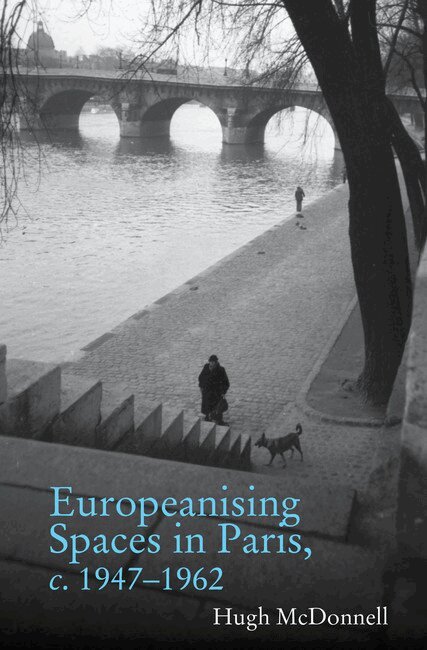
In the wake of the Second World War, ideas of Europe abounded. What did Europe mean as a concept, and what did it mean to be European? Europeanising Spaces in Paris, c. 1947-1962 makes the case that Paris was both a leading and distinctive forum for the expression of these ideas in the post-war period. It examines spaces in the French capital in which ideas about Europe were formulated, articulated, exchanged, circulated, and contested during this post-war period, roughly between the escalation of the Cold War and the end of France's war of decolonisation in Algeria.Such processes of making sense of Europe are elucidated in urban, political and cultural spaces in the French capital. Specifically, the Parisian café, home and street are each examined in terms of how they were implicated in ideas about Europe. Then, the Paris-based Mouvement socialiste des états unis d'Europe (The Socialist Movement for the United States of Europe) and the far-right wing Fédération des étudiants nationalistes (The Federation of Nationalist Students) are examined as examples of political movements that mobilised around – very different – concepts of Europe. The final section on cultural Europeanising spaces draws attention to the specificities of the Europeanism of exiles from Franco's Spain in Paris; the work of the great scholar of the Arab world, Jacques Berque, in the context of his understanding of the Mediterranean world and his understanding of faith; and finally, the work of the legendary photographer, Henri Cartier-Bresson, by looking at the capacities and limitations of the photographic medium for the representation of Europe, and how these corresponded with Cartier-Bresson’s political, social, and aesthetic commitments.