Hyun Bang Shin – författare
Visar alla böcker från författaren Hyun Bang Shin. Handla med fri frakt och snabb leverans.
11 produkter
11 produkter
1 784 kr
Skickas inom 10-15 vardagar
A detailed examination of the “Korean development model” from its urban dimension, evaluating its sociopolitical contexts and implications for international development cooperation.There is an increasing tendency to use the development experience of Asian countries as a reference point for other countries in the Global South. Korea’s condensed urbanization and industrialization, accompanied by the expansion of new cities and industrial complexes across the country, have become one such model, even if the fruits of such development may not have been equitably shared across geographies and generations. The chapters in this book critically reassess the Korean urban development experience from regional policy to new town development, demonstrating how these policy experiences were deeply rooted in Korea’s socioeconomic environment and discussing what can be learned from them when applying them in other developmental contexts.This book will be of great interest to scholars and researchers in the field of urban studies and developmental studies in general, and in Korea’s (urban) development experience in particular.Chapters 1, 2, 4, and 12 of this book are freely available as downloadable Open Access PDFs at http://www.taylorfrancis.com under a Creative Commons Attribution-Non Commercial-No Derivatives (CC-BY-NC-ND) 4.0 license.
622 kr
Skickas inom 10-15 vardagar
A detailed examination of the “Korean development model” from its urban dimension, evaluating its sociopolitical contexts and implications for international development cooperation.There is an increasing tendency to use the development experience of Asian countries as a reference point for other countries in the Global South. Korea’s condensed urbanization and industrialization, accompanied by the expansion of new cities and industrial complexes across the country, have become one such model, even if the fruits of such development may not have been equitably shared across geographies and generations. The chapters in this book critically reassess the Korean urban development experience from regional policy to new town development, demonstrating how these policy experiences were deeply rooted in Korea’s socioeconomic environment and discussing what can be learned from them when applying them in other developmental contexts.This book will be of great interest to scholars and researchers in the field of urban studies and developmental studies in general, and in Korea’s (urban) development experience in particular.Chapters 1, 2, 4, and 12 of this book are freely available as downloadable Open Access PDFs at http://www.taylorfrancis.com under a Creative Commons Attribution-Non Commercial-No Derivatives (CC-BY-NC-ND) 4.0 license.
692 kr
Skickas inom 5-8 vardagar
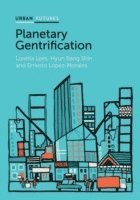
This is the first book in Polity's new 'Urban Futures' series.At the beginning of the twenty-first century, proclamations rang out that gentrification had gone global. But what do we mean by 'gentrification' today? How can we compare 'gentrification' in New York and London with that in Shanghai, Johannesburg, Mumbai and Rio de Janeiro? This book argues that gentrification is one of the most significant and socially unjust processes affecting cities worldwide today, and one that demands renewed critical assessment.Drawing on the 'new' comparative urbanism and writings on planetary urbanization, the authors undertake a much-needed transurban analysis underpinned by a critical political economy approach. Looking beyond the usual gentrification suspects in Europe and North America to non-Western cases, from slum gentrification to mega-displacement, they show that gentrification has unfolded at a planetary scale, but it has not assumed a North to South or West to East trajectory the story is much more complex than that. Rich with empirical detail, yet wide-ranging, Planetary Gentrification unhinges, unsettles and provincializes Western notions of urban development. It will be invaluable to students and scholars interested in the future of cities and the production of a truly global urban studies, and equally importantly to all those committed to social justice in cities.
258 kr
Skickas inom 5-8 vardagar
This is the first book in Polity's new 'Urban Futures' series.At the beginning of the twenty-first century, proclamations rang out that gentrification had gone global. But what do we mean by 'gentrification' today? How can we compare 'gentrification' in New York and London with that in Shanghai, Johannesburg, Mumbai and Rio de Janeiro? This book argues that gentrification is one of the most significant and socially unjust processes affecting cities worldwide today, and one that demands renewed critical assessment.Drawing on the 'new' comparative urbanism and writings on planetary urbanization, the authors undertake a much-needed transurban analysis underpinned by a critical political economy approach. Looking beyond the usual gentrification suspects in Europe and North America to non-Western cases, from slum gentrification to mega-displacement, they show that gentrification has unfolded at a planetary scale, but it has not assumed a North to South or West to East trajectory the story is much more complex than that. Rich with empirical detail, yet wide-ranging, Planetary Gentrification unhinges, unsettles and provincializes Western notions of urban development. It will be invaluable to students and scholars interested in the future of cities and the production of a truly global urban studies, and equally importantly to all those committed to social justice in cities.
Urbanising Dynamics of Global China
Speculation, Articulation, and Translation in Global Capitalism
Inbunden, Engelska, 2025
2 129 kr
Skickas inom 10-15 vardagar
The book focuses on the urban dimension of "global China", especially regarding the impacts of its urbanising dynamics on the (re)imaginings and manifestations of global urban futures. It situates China’s urban question in contemporary global change, and vice versa, by understanding the rise of global China as an urban process that weaves together compressed spaces, variegated times and trans- scalar power dynamics in the making of global capitalism.The overseas expansion of China’s economic influence has long been foregrounded in media reports and policy debates, especially with the rise of the Belt and Road Initiative that has turned China into one of the key investors in the global South. The term global China has been widely adopted to depict the geopolitical dimension of this immense flow of capital. This edited volume explores the urban manifestation of global China at different scales and involving diverse actors, discussing the ways in which the urban has been reconfigured by China’s global expansion and uncovering the differentiated modes of speculative and spectacular urban production at present. Observing from Ghana, India, Malaysia and China, chapters in this book collectively make theoretical, methodological and empirical contributions to recognise the dynamics of speculation, articulation and translation in global capitalism, where China plays an increasingly significant role.Three main themes have guided the book’s interrogation of what global China implies. These include: (a) transplanting models and urbanism; (b) multi- scalar construction of temporality; and (c) situating the urban China model in global capitalism.These aspects mark the core of the book’s endeavour to extend the critique of our changing urban conditions at present. This book was originally published as a special issue of Urban Geography.
962 kr
Skickas inom 10-15 vardagar
Considering Asian cities ranging from Taipei, Hong Kong and Bangkok to Hanoi, Nanjing and Seoul, this collection discusses the socio-political processes of how neoliberalization entwines with local political economies and legacies of ‘developmental’ or ‘socialist’ statism to produce urban contestations centered on housing.
Political Economy of Megaprojects in Asia
State Power, Land Control, Financial Flows, and Dispossession
Inbunden, Engelska, 2025
2 129 kr
Skickas inom 10-15 vardagar
This book offers a comprehensive analysis of how the developmental goals of Asian states are reflected in large-scale projects and how various actors both realize and challenge these goals. The rise of Asian economies has spurred the proliferation of megaprojects through large-scale resource mobilization, necessitating varying degrees of state intervention. Despite neoliberal pressures, these projects remain linked to national developmental aspirations, driven by domestic, transnational, or combined pro-growth interests, and serve multiple political purposes.The book advances the argument that megaprojects embody the dynamics of multiscalar strategic relations that determine the process and outcome of urbanization. These projects create iconic landmarks, new towns, central business districts, and infrastructure, showcasing intertwined political and economic interests. By examining contemporary megaprojects in China, South Korea, Taiwan, India, Malaysia, and Turkey, the contributing authors reveal the complexity of urbanizing forces and their multiscalar nature in shaping the built environment and shed light on the intricate interplay of state strategies, economic needs, and sociopolitical forces that influence urban landscapes.This interdisciplinary work provides a nuanced understanding of the political economy underpinning Asian urbanization and contributes to ongoing debates on urban development, state–society relations, and the production of space in the context of globalization.Chapter 1 of this book is freely available as a downloadable Open Access PDF at http://www.taylorfrancis.com under a Creative Commons Attribution-Non Commercial-No Derivatives (CC BY-NC-ND) 4.0 license.
Political Economy of Megaprojects in Asia
State Power, Land Control, Financial Flows, and Dispossession
Häftad, Engelska, 2025
582 kr
Skickas inom 10-15 vardagar
This book offers a comprehensive analysis of how the developmental goals of Asian states are reflected in large-scale projects and how various actors both realize and challenge these goals. The rise of Asian economies has spurred the proliferation of megaprojects through large-scale resource mobilization, necessitating varying degrees of state intervention. Despite neoliberal pressures, these projects remain linked to national developmental aspirations, driven by domestic, transnational, or combined pro-growth interests, and serve multiple political purposes.The book advances the argument that megaprojects embody the dynamics of multiscalar strategic relations that determine the process and outcome of urbanization. These projects create iconic landmarks, new towns, central business districts, and infrastructure, showcasing intertwined political and economic interests. By examining contemporary megaprojects in China, South Korea, Taiwan, India, Malaysia, and Turkey, the contributing authors reveal the complexity of urbanizing forces and their multiscalar nature in shaping the built environment and shed light on the intricate interplay of state strategies, economic needs, and sociopolitical forces that influence urban landscapes.This interdisciplinary work provides a nuanced understanding of the political economy underpinning Asian urbanization and contributes to ongoing debates on urban development, state–society relations, and the production of space in the context of globalization.Chapter 1 of this book is freely available as a downloadable Open Access PDF at http://www.taylorfrancis.com under a Creative Commons Attribution-Non Commercial-No Derivatives (CC BY-NC-ND) 4.0 license.
1 348 kr
Skickas inom 5-8 vardagar
Under contemporary capitalism the extraction of value from the built environment has escalated, working in tandem with other urban processes to lay the foundations for the exploitative processes of gentrification world-wide. Global gentrifications: Uneven development and displacement critically assesses and tests the meaning and significance of gentrification in places outside the ‘usual suspects’ of the Global North. Informed by a rich array of case studies from cities in Asia, Latin America, Africa, Southern Europe, and beyond, the book (re)discovers the important generalities and geographical specificities associated with the uneven process of gentrification globally. It highlights intensifying global struggles over urban space and underlines gentrification as a growing and important battleground in the contemporary world.The book will be of value to students and academics, policy makers, planners and community organisations.
485 kr
Skickas inom 5-8 vardagar
Under contemporary capitalism the extraction of value from the built environment has escalated, working in tandem with other urban processes to lay the foundations for the exploitative processes of gentrification world-wide. Global gentrifications: Uneven development and displacement critically assesses and tests the meaning and significance of gentrification in places outside the ‘usual suspects’ of the Global North. Informed by a rich array of case studies from cities in Asia, Latin America, Africa, Southern Europe, and beyond, the book (re)discovers the important generalities and geographical specificities associated with the uneven process of gentrification globally. It highlights intensifying global struggles over urban space and underlines gentrification as a growing and important battleground in the contemporary world.The book will be of value to students and academics, policy makers, planners and community organisations.
257 kr
Skickas inom 5-8 vardagar
COVID-19 has presented huge challenges to governments, businesses, civil societies, and people from all walks of life, but its impact has been highly variegated, affecting society in multiple negative ways, with uneven geographical and socioeconomic patterns. The crisis revealed existing contradictions and inequalities in society, compelling us to question what it means to return to “normal” and what insights can be gleaned from Southeast Asia for thinking about a post-pandemic world. In this regard, this edited volume collects the informed views of an ensemble of social scientists – area studies, development studies, and legal scholars; anthropologists, architects, economists, geographers, planners, sociologists, and urbanists; representing academic institutions, activist and charitable organisations, policy and research institutes, and areas of professional practice – who recognise the necessity of critical commentary and engaged scholarship. These contributions represent a wide-ranging set of views, collectively producing a compilation of reflections on the following three themes in particular: (1) Urbanisation, digital infrastructures, economies, and the environment; (2) Migrants, (im)mobilities, and borders; and (3) Collective action, communities, and mutual action. Overall, this edited volume first aims to speak from a situated position in relevant debates to challenge knowledge about the pandemic that has assigned selective and inequitable visibility to issues, people, or places, or which through its inferential or interpretive capacity has worked to set social expectations or assign validity to certain interventions with a bearing on the pandemic’s course and the future it has foretold. Second, it aims to advance or renew understandings of social challenges, risks, or inequities that were already in place, and which, without further or better action, are to be features of our “post-pandemic world” as well. This volume also contributes to the ongoing efforts to de-centre and decolonise knowledge production. It endeavours to help secure a place within these debates for a region that was among the first outside of East Asia to be forced to contend with COVID-19 in a substantial way and which has evinced a marked and instructive diversity and dynamism in its fortunes.