I. Bernard Cohen - Böcker
Visar alla böcker från författaren I. Bernard Cohen. Handla med fri frakt och snabb leverans.
8 produkter
8 produkter
250 kr
Tillfälligt slut
161 kr
Skickas inom 7-10 vardagar
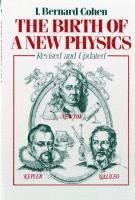
These are notions so basic to our view of life that we take them for granted. But in the seventeenth century they were revolutionary, heretical, even dangerous to the men who formed them. Culture, religion, and science had intertwined over the centuries to create a world view based on a stationary earth. Indeed, if the earth moved, would not birds be blown off the trees and would not an object thrown straight up come down far away?Then came the Renaissance and with it Copernicus, Galileo, Kepler, Huygens, and Newton: giants who courageously remade the world into an earth which actually moves 100,000 feet a second while revolving 1,000 miles an hour around an object 93,000,000 miles away. And yet birds perch unruffled and an apple will fall straight down.All of this we think we know. But how well do we know it? In the twenty-five years since its first publication, The Birth of a New Physics has become a classic in the history of science. Here expanded by more than one-third and fully updated, it not only offers us the best account of the greatest scientific revolution but also tells us how we can know we live in a dynamic universe.
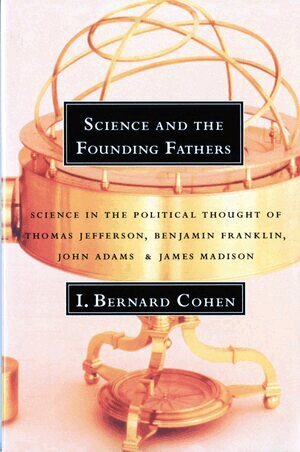
Science and the Founding Fathers
Science in the Political Thought of Thomas Jefferson, Benjamin Franklin, John Adams, and James Madison
Häftad, Engelska, 1997
318 kr
Skickas inom 5-8 vardagar
Thomas Jefferson was the only president who could read and understand Newton's Principia. Benjamin Franklin is credited with establishing the science of electricity. John Adams had the finest education in science that the new country could provide, including "Pnewmaticks, Hydrostaticks, Mechanicks, Staticks, Opticks." James Madison, chief architect of the Constitution, peppered his Federalist Papers with references to physics, chemistry, and the life sciences.For these men science was an integral part of life—including political life. This is the story of their scientific education and of how they employed that knowledge in shaping the political issues of the day, incorporating scientific reasoning into the Constitution.
245 kr
Skickas inom 5-8 vardagar
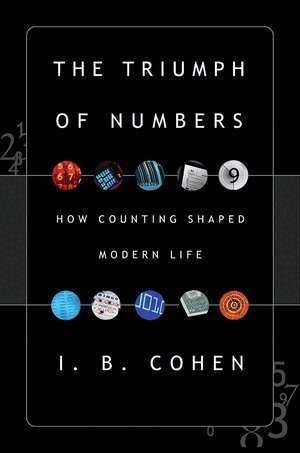
The great historian of science I. B. Cohen explores how numbers have come to assume a leading role in science, in the operations and structure of government, in marketing, and in many other aspects of daily life. Consulting and collecting numbers has been a feature of human affairs since antiquity—taxes, head counts for military service—but not until the Scientific Revolution in the twelfth century did social numbers such as births, deaths, and marriages begin to be analyzed. Cohen shines a new light on familiar figures such as Thomas Jefferson, Benjamin Franklin, and Charles Dickens; and he reveals Florence Nightingale to be a passionate statistician. Cohen has left us with an engaging and accessible history of numbers, an appreciation of the essential nature of statistics.
315 kr
Tillfälligt slut
460 kr
Skickas inom 7-10 vardagar
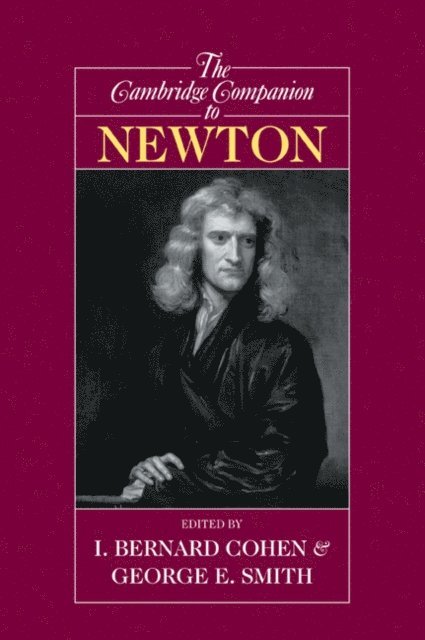
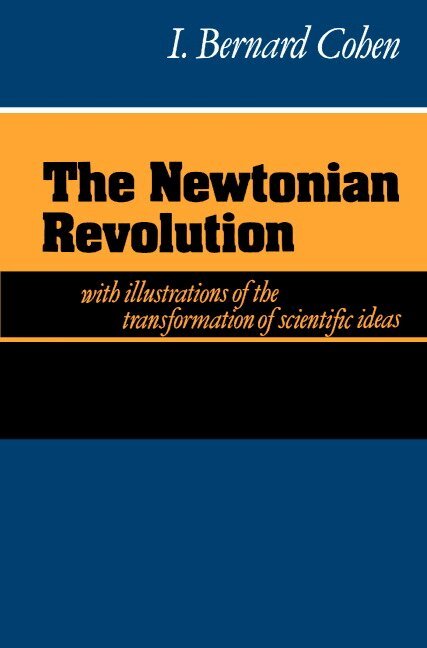
This volume presents Professor Cohen's original interpretation of the revolution that marked the beginnings of modern science and set Newtonian science as the model for the highest level of achievement in other branches of science. It shows that Newton developed a special kind of relation between abstract mathematical constructs and the physical systems that we observe in the world around us by means of experiment and critical observation. The heart of the radical Newtonian style is the construction on the mind of a mathematical system that has some features in common with the physical world; this system s then modified when the deductions and conclusions drawn from it are tested against the physical universe. Using this system Newton was able to make his revolutionary innovations in celestial mechanics and, ultimately, create a new physics of central forces and the law of universal gravitation. Building on his analysis of Newton's methodology, Professor Cohen explores the fine structure of revolutionary change and scientific creativity in general. This is done by developing the concept of scientific change as a series of transformations of ecxisting ideas. It is shown that such transformation is characteristic of many aspects of the sciences and that the concept of scientific change by transformation suggests a new way of examining the very nature of scientific creativity.
399 kr
Skickas inom 10-15 vardagar
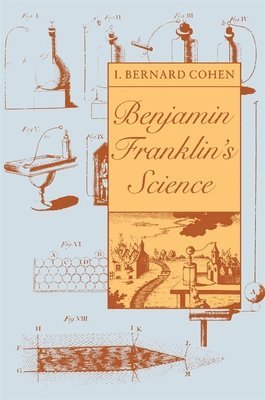
Benjamin Franklin is well known to most of us, yet his fundamental and wide-ranging contributions to science are still not adequately understood. Until now he has usually been incorrectly regarded as a practical inventor and tinkerer rather than a scientific thinker. He was elected to membership in the elite Royal Society because his experiments and original theory of electricity had made a science of that new subject. His popular fame came from his two lightning experiments—the sentry-box experiment and the later and more famous experiment of the kite—which confirmed his theoretical speculations about the identity of electricity and provided a basis for the practical invention of the lightning rod. Franklin advanced the eighteenth-century understanding of all phenomena of electricity and provided a model for experimental science in general.I. Bernard Cohen, an eminent historian of science and the principal elucidator of Franklin’s scientific work, examines his activities in fields ranging from heat to astronomy. He provides masterful accounts of the theoretical background of Franklin’s science (especially his study of Newton), the experiments he performed, and their influence throughout Europe as well as the United States. Cohen emphasizes that Franklin’s political and diplomatic career cannot be understood apart from his scientific activities, which established his reputation and brought him into contact with leaders of British and European society. A supplement by Samuel J. Edgerton considers Franklin’s attempts to improve the design of heating stoves, another practical application that arose from theoretical interests.This volume will be valuable to all readers wanting to learn more about Franklin and to gain a deeper appreciation of the development of science in America.
386 kr
Skickas inom 10-15 vardagar
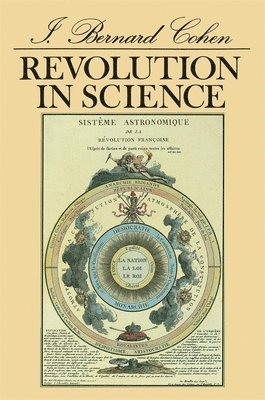
Only a scholar as rich in learning as I. Bernard Cohen could do justice to a theme so subtle and yet so grand. Spanning five centuries and virtually all of scientific endeavor, Revolution in Science traces the nuances that differentiate both scientific revolutions and human perceptions of them, weaving threads of detail from physics, mathematics, behaviorism, Freud, atomic physics, and even plate tectonics and molecular biology, into the larger fabric of intellectual history.How did “revolution,” a term from the physical sciences, meaning a turning again and implying permanence and recurrence—the cyclical succession of the seasons, the “revolutions” of the planets in their orbits—become transformed into an expression for radical change in political and socioeconomic affairs, then become appropriated once again to the sciences?How have political revolutions—French, American, Bolshevik—and such intellectual forces as Darwinism further modified the concept, from revolution in science as a dramatic break with the past to the idea that science progresses by the slow accumulation of knowledge? And what does each transformation in each historical period tell us about the deep conceptual changes in our image of the scientist and scientific activity?Cohen’s exploration seeks to uncover nothing less than the nature of all scientific revolutions, the stages by which they occur, their time scale, specific criteria for determining whether or not there has been a revolution, and the creative factors in producing a revolutionary new idea. His book is a probing analysis of the history of an idea and one of the most impressive surveys of the history of science ever undertaken.