Ian Kenyon - Böcker
Visar alla böcker från författaren Ian Kenyon. Handla med fri frakt och snabb leverans.
4 produkter
4 produkter
804 kr
Skickas inom 7-10 vardagar
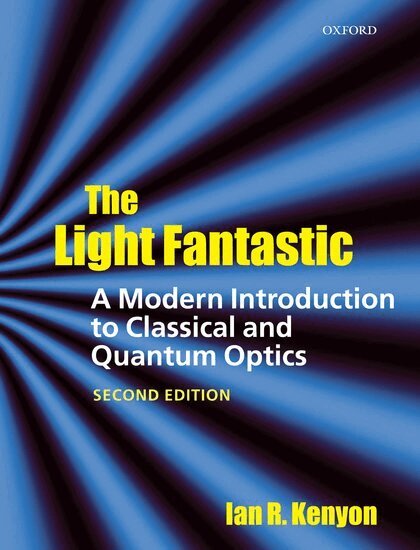
A thorough introduction to modern classical and quantum optics, appropriate for advanced undergraduates or beginning graduates. The emphasis is on building an understanding in straightforward steps. Digital cameras, LCD screens, laser welding, and the optical fibre-based internet illustrate the penetration of optics in twenty-first century life: many such modern applications are presented from first principles. Self-contained themes covered in the book include: - Paraxial ray optics for devices including matrix methods and aberrations.- Interference, coherence and interferometry. - Diffraction, spectrometry and Gaussian optics. - Fourier optics, holography and information processing. - Astronomical telescopes, adaptive optics and aperture synthesis. - Maxwell's theory; scattering, absorption and dispersion in bulk materials; multilayer filters. - Quantum phenomena, wave-particle duality and the uncertainty principle. - Schroedinger's analysis of spectra, photon properties. - Laser principles; He:Ne to MQW lasers and applications. - Detectors: photodiodes, CCDs, PMs and image intensifiers; response, noise and linearity. - Fibre optics: single mode fibre analysis; the modern data highway; fibre sensors. - Photon-atom interactions, optical cooling and optical clocks. - Second quantization, photon correlations, SPDC, entanglement.This thoroughly revised and updated edition includes new coverage of photonic crystals and Bloch waves, as well as quantum dots and microcavities.
2 098 kr
Skickas inom 7-10 vardagar
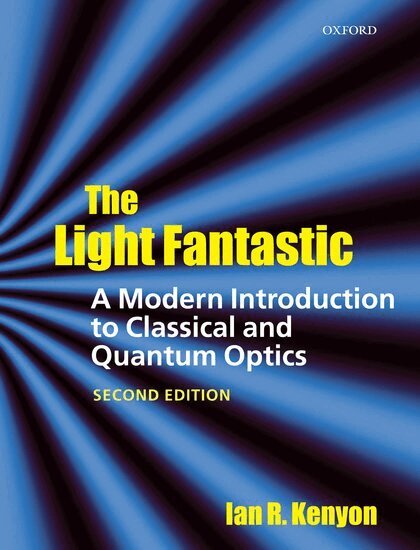
A thorough introduction to modern classical and quantum optics, appropriate for advanced undergraduates or beginning graduates. The emphasis is on building an understanding in straightforward steps. Digital cameras, LCD screens, laser welding, and the optical fibre-based internet illustrate the penetration of optics in twenty-first century life: many such modern applications are presented from first principles. Self-contained themes covered in the book include: - Paraxial ray optics for devices including matrix methods and aberrations.- Interference, coherence and interferometry. - Diffraction, spectrometry and Gaussian optics. - Fourier optics, holography and information processing. - Astronomical telescopes, adaptive optics and aperture synthesis. - Maxwell's theory; scattering, absorption and dispersion in bulk materials; multilayer filters. - Quantum phenomena, wave-particle duality and the uncertainty principle. - Schroedinger's analysis of spectra, photon properties. - Laser principles; He:Ne to MQW lasers and applications. - Detectors: photodiodes, CCDs, PMs and image intensifiers; response, noise and linearity. - Fibre optics: single mode fibre analysis; the modern data highway; fibre sensors. - Photon-atom interactions, optical cooling and optical clocks. - Second quantization, photon correlations, SPDC, entanglement.This thoroughly revised and updated edition includes new coverage of photonic crystals and Bloch waves, as well as quantum dots and microcavities.
1 033 kr
Skickas inom 3-6 vardagar
528 kr
Skickas inom 10-15 vardagar
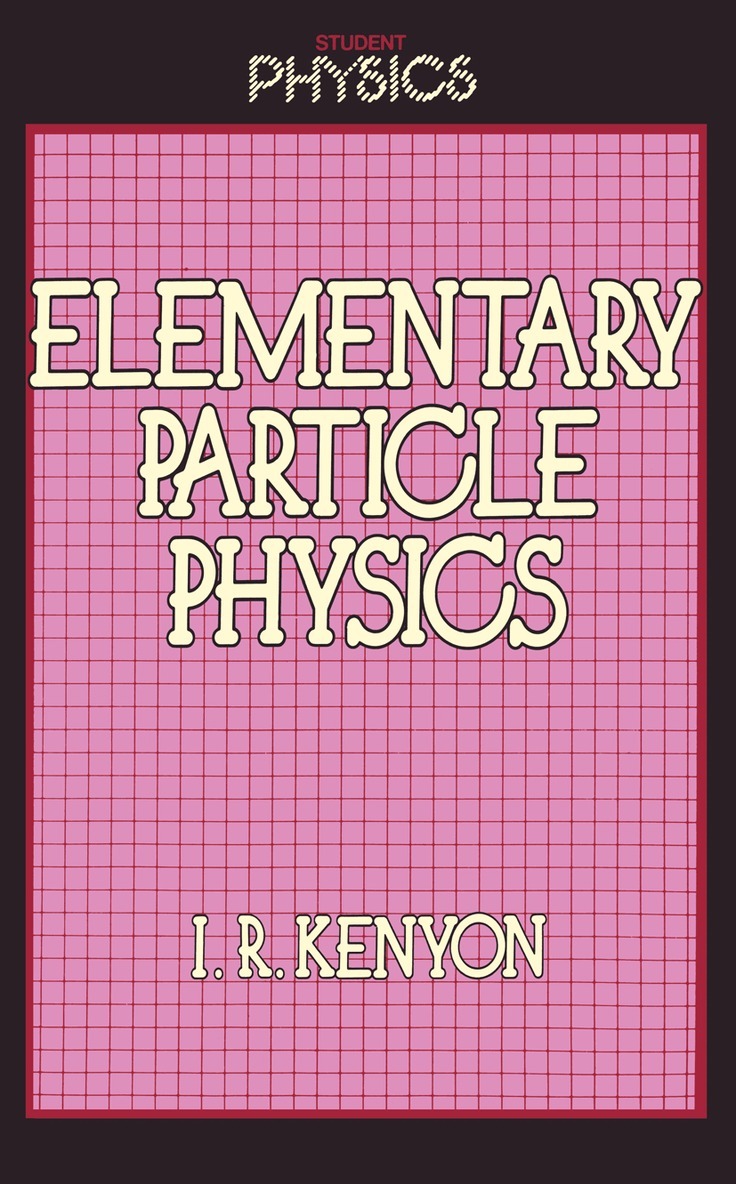
This book is intended for the use of final-year undergraduates and first-year postgraduates. The aim has been to concentrate on the 'Standard Model' and the gauge symmetries because these form the core of the subject. Leptons, quarks and forces are introduced at the beginning of the book, with a minimum of detail; then follow the experimental techniques. After this introduction the gauge theories are dealt with in order of increasing complexity. Attention is then focused on the hadrons. Deep inelastic scattering ofhadrons is dealt with first, then hadron spectroscopy and finally hadron interactions. Current developments beyond the standard model appear in a last chapter. The appendices contain mathematical detail and other material not included in the main text. These appendices cover kinematic, cross-section and decay-rate formulae; Breit-Wigner resonances; some Clebsch-Gordan coefficient tables; a table of particle properties; a set of exercises and detailed answers; and the Dirac equation. One appendix is devoted to calculating the scattering amplitudes for fermion + fermion going to fermion + fermion, which is, if anything, the 'basic' process. The appendices, apart from tabulations, are mainly intended for the postgraduate, though the interested undergraduate may also find them valuable. Up-to-date references are given at the end of the book.