• Fri frakt över 249 kr
  • •
  • Snabba leveranser
  • •
  • Billiga böcker
Kundservice

Du är på sajten för privatpersoner.

Företag, bibliotek eller offentlig verksamhet?

Du handlar på classic.bokus.com, där alla dina funktioner finns intakta.
Till classic.bokus.com
Bokus logotyp. Gå till startsidan.
  • Erbjudanden
  • Nyheter
  • Student
  • Topplistor
  • Barn & ungdom
  • Bokus Play
  • E-böcker
  • Pocketböcker
  • Spel & pussel

10% rabatt på allt med kod: NYSTART10 →

Sidfot

Mina sidor

    Hjälp

    • Kundservice
    • Vanliga frågor och svar
    • Frakt och leverans
    • Retur vid ångerrätt
    • Reklamera vara
    • Betalning
    • Köpvillkor
    • Allmänna villkor
    • Information om webbplatsens tillgänglighet

    Om Bokus

    • Om oss
    • Pressrum
    • För studenter
    • För företag
    • För bibliotek och offentlig verksamhet
    • För leverantörer
    • Hållbarhet

    Populärt

    • Aktuella erbjudanden
    • Presentkort
    • Studentlitteratur
    • Nya böcker
    • Topplistor
    • Signerade böcker
    • Engelska böcker

    Inspiration

    • Boktips
    • BookTok
    • Populära bokserier
    • Barnbokskaraktärer
    • Populära författare
    Logotyp för Bokus
    Följ oss på Facebook (extern länk)Följ oss på Instagram (extern länk)Följ oss på YouTube (extern länk)Följ oss på TikTok (extern länk)
    bokus @ CookiesAnpassa cookiesIntegritetspolicyKöpvillkor
    Till Citymail hemsida (extern länk)Till Budbee hemsida (extern länk)Till Postnord hemsida (extern länk)Till Schenker hemsida (extern länk)Till Early Bird hemsida (extern länk)Till Walleys hemsida (extern länk)
    1. Samhälle och politik
    2. Samhälle och kultur
    3. Kultur och medier
    4. Referensverk och tvärvetenskap

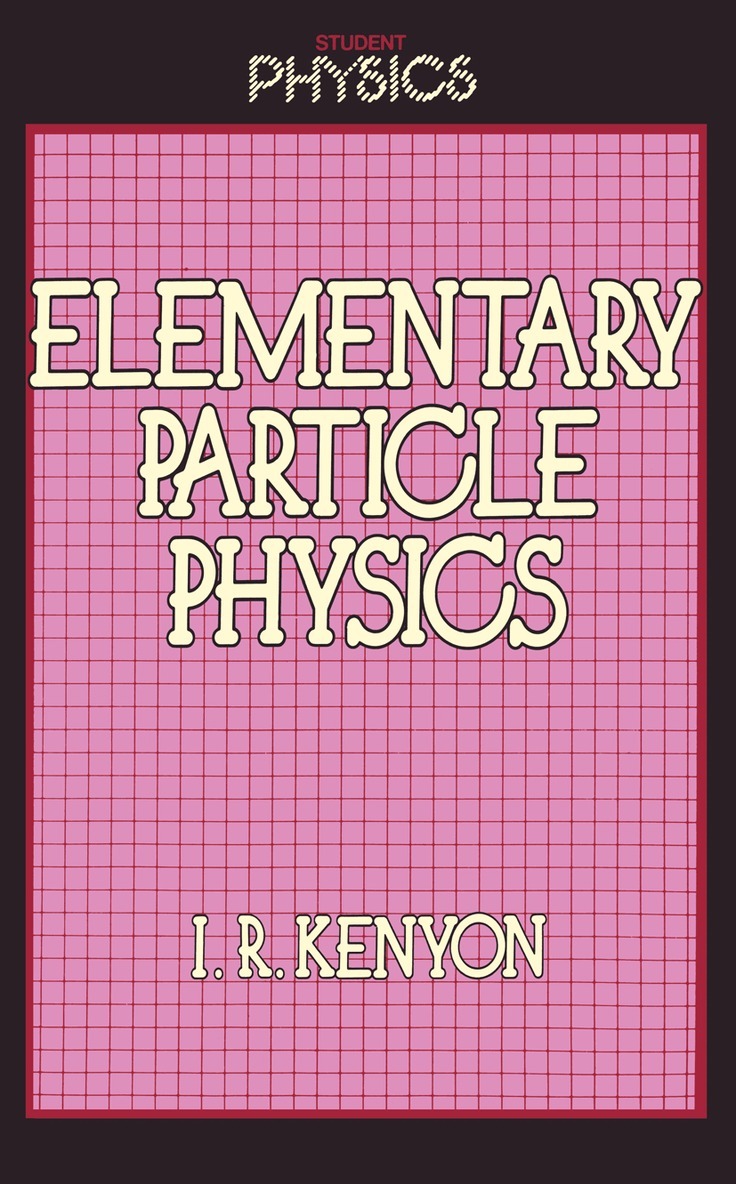
    Elementary Particle Physics

    AvIan Kenyon

    Häftad, Engelska, 2012

    Del i serien Student Physics Series

    539 kr

    Beställningsvara. Skickas inom 10-15 vardagar. Fri frakt över 249 kr.

    Beskrivning

    This book is intended for the use of final-year undergraduates and first-year postgraduates. The aim has been to concentrate on the 'Standard Model' and the gauge symmetries because these form the core of the subject. Leptons, quarks and forces are introduced at the beginning of the book, with a minimum of detail; then follow the experimental techniques. After this introduction the gauge theories are dealt with in order of increasing complexity. Attention is then focused on the hadrons. Deep inelastic scattering ofhadrons is dealt with first, then hadron spectroscopy and finally hadron interactions. Current developments beyond the standard model appear in a last chapter. The appendices contain mathematical detail and other material not included in the main text. These appendices cover kinematic, cross-section and decay-rate formulae; Breit-Wigner resonances; some Clebsch-Gordan coefficient tables; a table of particle properties; a set of exercises and detailed answers; and the Dirac equation. One appendix is devoted to calculating the scattering amplitudes for fermion + fermion going to fermion + fermion, which is, if anything, the 'basic' process. The appendices, apart from tabulations, are mainly intended for the postgraduate, though the interested undergraduate may also find them valuable. Up-to-date references are given at the end of the book.

    Produktinformation

    • Utgivningsdatum:2012-04-22
    • Mått:127 x 203 x 19 mm
    • Vikt:358 g
    • Format:Häftad
    • Språk:Engelska
    • Serie:Student Physics Series
    • Antal sidor:312
    • Förlag:Springer
    • ISBN:9789401092913

    Utforska kategorier

    • Referensverk och tvärvetenskap inom Samhälle och politik

    Innehållsförteckning

    • 1 Introduction.- 1.1 Units and notation.- 2 Leptons, quarks and forces.- 2.1 The electron and its neutrino.- 2.2 The heavy leptons.- 2.3 The quark model.- 2.4 Forces.- 3 Experimental techniques.- 3.1 Accelerators and beams.- 3.2 Particle interactions with matter.- 3.3 Bubble chambers.- 3.4 Wire chambers.- 3.5 Scintillation counters.- 3.6 Calorimeters.- 3.7 The UA1 detector.- 3.8 Particle identification.- 3.9 Detectors for neutrino interactions.- 4 QED and the gauge principle.- 4.1 Dirac’s theory of the electron.- 4.2 Feynman diagrams.- 4.3 Electron-positron annihilation.- 4.4 Local gauge invariance.- 5 Symmetries and conservation laws.- 5.1 Quantum requirements.- 5.2 Groups of transformations.- 5.3 Lie groups.- 5.4 Rotation group.- 5.5 Lorentz and Poincaré groups.- 5.6 Internal symmetries.- 5.7 Discrete symmetries.- 5.8 Summary on conservation laws.- 6 Colour and QCD.- 6.1 SU(3) The colour symmetry.- 6.2 The group properties of SU(3).- 6.3 The colour force.- 6.4 Quantum chromodynamics.- 7 The V—A theory of weak interactions.- 7.1 Fermi’s model.- 7.2 The V-A theory.- 7.3 Neutral K-mesons.- 7.4 The Cabibbo hypothesis and its extension.- 8 Electroweak unification.- 8.1 Weak isospin and hypercharge.- 8.2 Electroweak unification based on SU(2)L(?)U(l).- 8.3 The discovery of the weak neutral current.- 8.4 The discovery of the W± and Z0 bosons.- 8.5 Strangeness-changing neutral currents (SCNC).- 8.6 Particle number conservation laws.- 9 Electroweak probes of hadron structure.- 9.1 Deep inelastic electron scattering.- 9.2 Deep inelastic neutrino scattering.- 9.3 The nucleon structure functions.- 9.4 The Drell-Yan process.- 10 Hadronic flavour.- 10.1 Electron-positron annihilation to vector mesons.- 10.2 Flavour symmetries.- 10.3 The determination of meson quantum numbers.- 10.4 The determination of baryon quantum numbers.- 11 Hadron-hadron interactions.- 11.1 Geometric effects.- 11.2 Jet production.- 11.3 Peripheralism and Reggeized exchange.- 12 Ways forward.- 12.1 Grand unification.- 12.2 Supersymmetry.- 12.3 Cosmology.- 12.4 Gravitation.- Appendix A.- Appendix B.- Appendix C.- Appendix D.- Appendix E.- Appendix F.- Appendix G.