Student Physics Series – serie
Visar alla böcker i serien Student Physics Series. Handla med fri frakt och snabb leverans.
9 produkter
9 produkter
Häftad, Engelska, 1988
543 kr
Skickas inom 10-15 vardagar
Statistical physics is not a difficult subject, and I trust that this will not be found a difficult book. It contains much that a number of generations of Lancaster students have studied with me, as part of their physics honours degree work. The lecture course was of twenty hours duration, and I have added comparatively little to the lecture syllabus. A pre requisite is that the reader should have a working knowledge of basic thermal physics (i.e. the laws of thermodynamics and their application to simple substances). The book Thermal Physics by Colin Finn in this series forms an ideal introduc tion. Statistical physics has a thousand and one different ways of approaching the same basic results. I have chosen a rather down-to-earth and unsophisticated approach, without I hope totally obscuring the considerable interest of the fun damentals. This enables applications to be introduced at an early stage in the book. As a low-temperature physicist, I have always found a particular interest in statistical physics, and especially in how the absolute zero is approached. I should not, therefore, apologize for the low-temperature bias in the topics which I have selected from the many possibilities.
Del 170 - Student Physics Series
Relativity Physics
Häftad, Engelska, 1984
543 kr
Skickas inom 10-15 vardagar
cB) 114 7. 8 Constant electric and magnetic fields at right angles (8,
Häftad, Engelska, 1984
543 kr
Skickas inom 10-15 vardagar
Electromagnetism is basic to our understanding of the properties of matter and yet is often regarded as a difficult part of an under graduate physics course. In this book answers are developed from first principles to such questions as: What is electricity? What is electromagnetism? Why are some materials magnetic and others non-magnetic? What is magnetism? Physics answers these questions in two related ways. On the one hand the classical explanation is in terms of classical concepts: electric charge q, electric and magnetic fields (E and B) and electric currents. On the other hand the microscopic (or 'atomic ') explanation is in terms of quantum concepts: electrons, nuclei, electron orbits in atoms, electron spin and photons. Microscopic explanations underlie classical ones, but do not deny them. The great triumphs of classical physics are mechanics, gravitation, thermodynamics, electromagnetism and relativity. Historically they began at the time of Newton (seventeenth century) and were completed by Maxwell (nineteenth century) and Einstein (early twentieth century). Microscopic explanations began with J J. Thomson's discovery of the electron in 1897. For most physical phenomena it is best to seek a classical explanation first, especially phenomena at room temperature, or low energy, when quantum effects are small. Although this text is primarily concerned with classical explanations in a logical, self-consistent sequence, they are related to microscopic (quantum) explanations at each stage.
Häftad, Engelska, 1984
972 kr
Skickas inom 10-15 vardagar
The study of mechanics plays a central role in physics for a whole variety of reasons. It was one of the earliest of the quantitative sciences, and had immediate practical applications. These ranged from the study of the motion of projectiles in warfare to the motion of the planets, predicting the seasons, eclipses, etc. At the present time, even though superseded on the very small scale by quantum theory and on the very large scale by the theory of relativity, the mechanics of Newton is perfectly adequate for treating a wide spectrum of problems from the • '"etic theory of gases to the motion of space vehicles. Furthermore, the science of mechanics is regarded by many as the epitome of a good scientific theory and for this reason is studied by philosophers and social scientists alike as an exemplar of the 'scientific method'. We shall commence in Chapter 1 with a brief historical outline of the development of mechanics, mentioning the names and dates of the main participants and summarizing their contributions. Preface vii Chapter 1 Newton's laws 1. 1 Historical introduction Primitive ideas about mechanics were exemplified by the state ments of Aristotle (384-322 Be), who asserted that a force was necessary to maintain motion. Furthermore, he believed that there were different laws for heavenly and earthly bodies.
Häftad, Engelska, 1985
543 kr
Skickas inom 10-15 vardagar
6. 2 Creeping viscous flow in a semi-infinite channel 140 6. 3 Poiseuille flow in tubes of circular cross-section 144 6. 4 Motion of a Newtonian liquid between two coaxial cylinders 148 151 6. 5 Bodies in liquids 6. 6 liquid flow and intermolecular forces 154 Non-Newtonian liquids 157 6. 7 6. 8 Viscometers 160 Chapter 7 Surface effects 163 7. 1 Introduction 163 7. 2 Excess surface free energy and surface tension of liquids 163 7. 3 The total surface energy of liquids 167 7. 4 Surface tension and intermolecular forces 168 7. 5 Solid surfaces 171 7. 6 Specific surface free energy and the intermolecular potential 172 7. 7 liquid surfaces and the Laplace-Young equation 174 7. 8 liquid spreading 178 7. 9 Young's relation 181 7. 10 Capillary effects 184 7. 11 The sessile drop 187 7. 12 Vapour pressure and liquid-surface curvature 189 7. 13 The measurement of surface free energies 191 Chapter 8 High polymers and liquid crystals 197 8. 1 Introduction 197 8. 2 High polymers 197 8. 3 The mechanisms of polymerisation 198 8. 4 The size and shape of polymer molecules 199 8. 5 The structure of solid polymers 201 8. 6 The glass transition temperature 203 8. 7 Young's modulus of solid polymers 205 Stress-strain curves of polymers 8. 8 206 8. 9 Viscous flow in polymers 209 liquid crystals 8.
Häftad, Engelska, 1985
919 kr
Skickas inom 10-15 vardagar
Electromagnetism began in the nineteenth century when Faraday showed electricity and magnetism were not distinct, separate phenomena, but interacted when there were time-varying electric or magnetic fields. In Electricity and Magnetism I have shown from first principles how Faraday's experiments led finally to Maxwell's four equations, which with the electromagnetic-force law summarise the whole of classical electromagnetism. This book therefore begins with Maxwell's equations and then uses them to study the propagation and generation of electromagnetic waves. Physics is a subject in which the more advanced the treatment of a topic, the deeper the understanding of common occurrences that is revealed. In studying the solutions of Maxwell's equations you will find answers to such questions as: What is an electro magnetic wave? Why does a radio wave travel through space at the speed of light? How is a radio wave generated? Why does light pass through a straight tunnel when a radio wave does not? How does light travel down a curved glass fibre? It is a remarkable fact that the classical laws of electromagnetism are fully consistent with Einstein's special theory of relativity and this is discussed in Chapter 2. The following four chapters provide solutions of Maxwell's equations for the propagation of electro magnetic waves in free space, in dielectrics, across interfaces and in conductors respectively.
Häftad, Engelska, 1987
543 kr
Skickas inom 10-15 vardagar
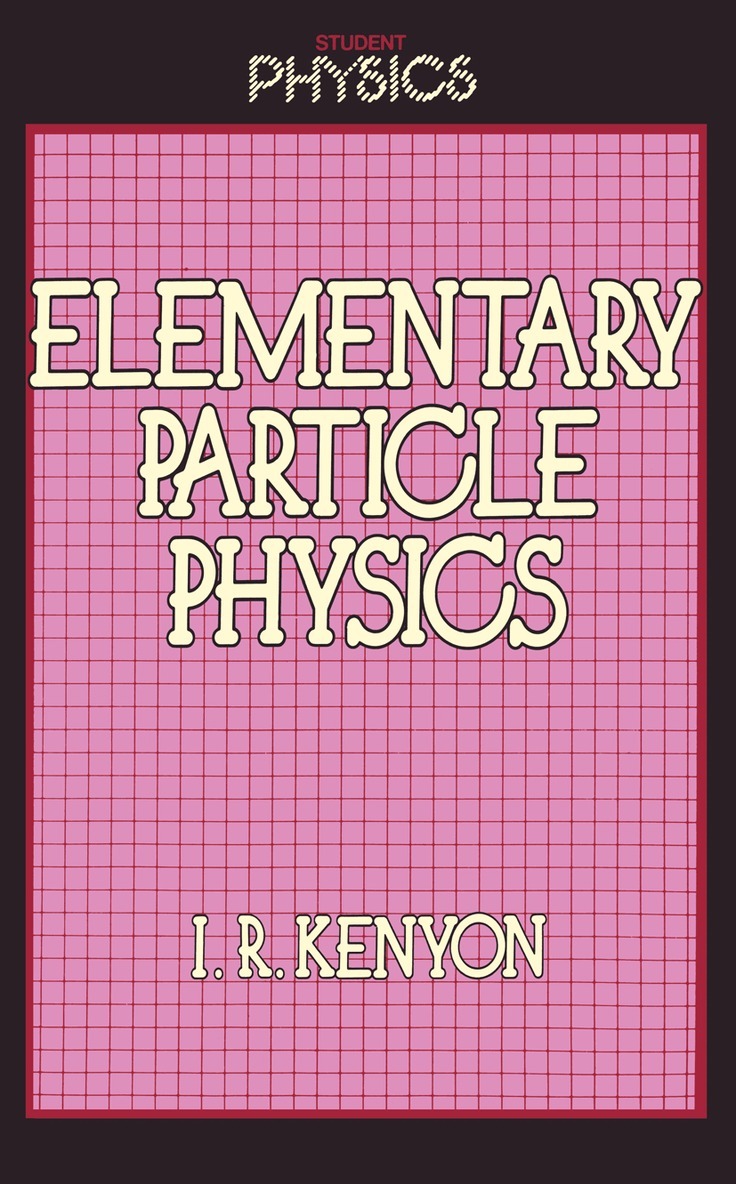
The last few years have seen particular excitement in particle physics, culminating in the experimental confirmation of the W and Z particles. Ian Kenyon, who was involved in the UA1 experiment at CERN that searched for the particles, provides an introduction to particle physics and takes a refreshingly non-historical approach. The aim of the book has been to concentrate on the 'standard model' and the gauge symmetries because these form the core of the subject. Leptons, quarks and forces are introduced at the beginning. After this introduction the gauge theories are dealt with in order of increasing complexity. Attention is then focussed on the hadrons - deep inelastic scattering of hadrons, then hadron spectroscopy and finally hadron interactions. Current developments beyond the standard model appear in the last chapter. This book should be of interest to third year undergraduate students; postgraduates in particle physics, nuclear physics; researchers in nuclear physics.
Häftad, Engelska, 2007
704 kr
Skickas inom 10-15 vardagar
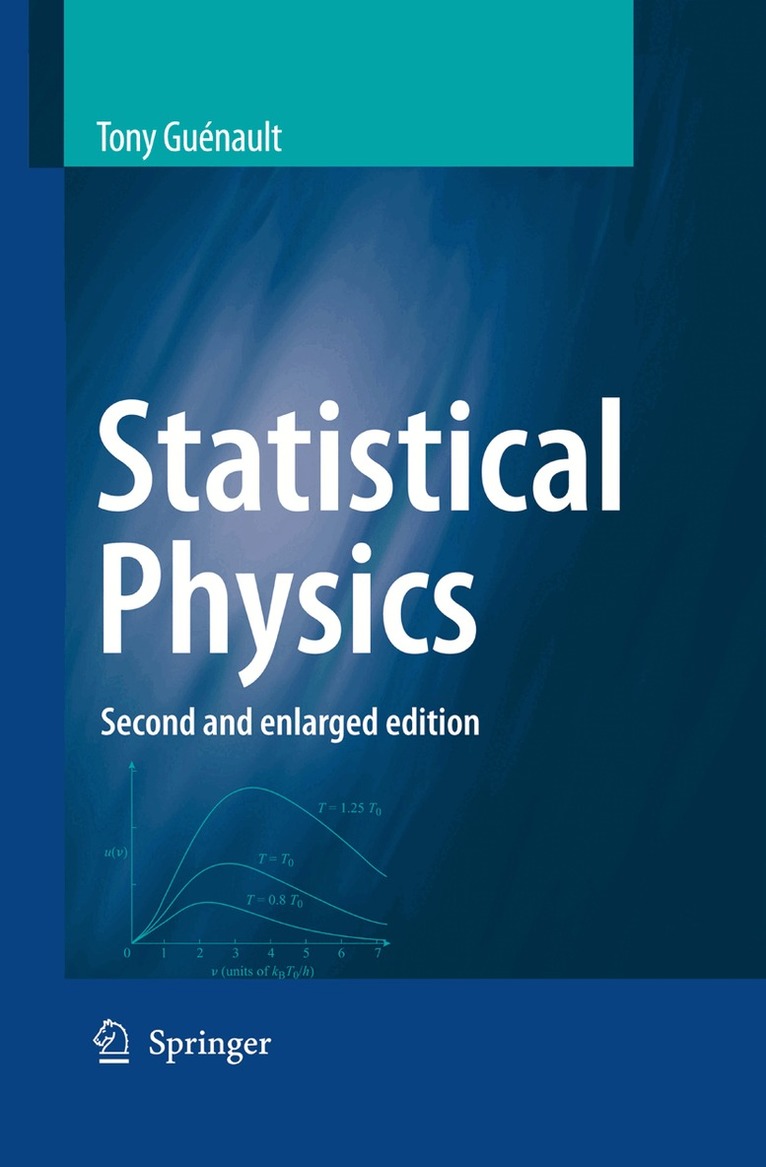
In this revised and enlarged second edition of an established text Tony Guénault provides a clear and refreshingly readable introduction to statistical physics, an essential component of any first degree in physics. The treatment itself is self-contained and concentrates on an understanding of the physical ideas, without requiring a high level of mathematical sophistication.A straightforward quantum approach to statistical averaging is adopted from the outset (easier, the author believes, than the classical approach). The initial part of the book is geared towards explaining the equilibrium properties of a simple isolated assembly of particles. Thus, several important topics, for example an ideal spin-½ solid, can be discussed at an early stage. The treatment of gases gives full coverage to Maxwell-Boltzmann, Fermi-Dirac and Bose-Einstein statistics.Towards the end of the book the student is introduced to a wider viewpoint and new chapters are included on chemical thermodynamics, interactions in, for example, liquid helium-3 and helium-4, and statistics under extreme conditions (superconductivity and astrophysical systems).
Häftad, Engelska, 2012
535 kr
Skickas inom 10-15 vardagar
This book is intended for the use of final-year undergraduates and first-year postgraduates. The aim has been to concentrate on the 'Standard Model' and the gauge symmetries because these form the core of the subject. Leptons, quarks and forces are introduced at the beginning of the book, with a minimum of detail; then follow the experimental techniques. After this introduction the gauge theories are dealt with in order of increasing complexity. Attention is then focused on the hadrons. Deep inelastic scattering ofhadrons is dealt with first, then hadron spectroscopy and finally hadron interactions. Current developments beyond the standard model appear in a last chapter. The appendices contain mathematical detail and other material not included in the main text. These appendices cover kinematic, cross-section and decay-rate formulae; Breit-Wigner resonances; some Clebsch-Gordan coefficient tables; a table of particle properties; a set of exercises and detailed answers; and the Dirac equation. One appendix is devoted to calculating the scattering amplitudes for fermion + fermion going to fermion + fermion, which is, if anything, the 'basic' process. The appendices, apart from tabulations, are mainly intended for the postgraduate, though the interested undergraduate may also find them valuable. Up-to-date references are given at the end of the book.