Igor Candido - Böcker
Visar alla böcker från författaren Igor Candido. Handla med fri frakt och snabb leverans.
3 produkter
3 produkter
1 865 kr
Skickas inom 5-8 vardagar
The early modern and modern cultural world in the West would be unthinkable without Petrarch and Boccaccio. Despite this fact, there is still no scholarly contribution entirely devoted to analysing their intellectual revolution. Internationally renowned scholars are invited to discuss and rethink the historical, intellectual, and literary roles of Petrarch and Boccaccio between the great model of Dante’s encyclopedia and the ideas of a double or multifaceted culture in the era of Italian Renaissance Humanism. In his lyrical poems and Latin treatises, Petrarch created a cultural pattern that was both Christian and Classical, exercising immense influence on the Western World in the centuries to come. Boccaccio translated this pattern into his own vernacular narratives and erudite works, ultimately claiming as his own achievement the reconstructed unity of the Ancient Greek and Latin world in his contemporary age. The volume reconsiders Petrarch’s and Boccaccio’s heritages from different perspectives (philosophy, theology, history, philology, paleography, literature, theory), and investigates how these heritages shaped the cultural transition between the end of the Middle Ages and the early modern era, as well as European identity.
432 kr
Skickas inom 5-8 vardagar
The early modern and modern cultural world in the West would be unthinkable without Petrarch and Boccaccio. Despite this fact, there is still no scholarly contribution entirely devoted to analysing their intellectual revolution. Internationally renowned scholars are invited to discuss and rethink the historical, intellectual, and literary roles of Petrarch and Boccaccio between the great model of Dante’s encyclopedia and the ideas of a double or multifaceted culture in the era of Italian Renaissance Humanism. In his lyrical poems and Latin treatises, Petrarch created a cultural pattern that was both Christian and Classical, exercising immense influence on the Western World in the centuries to come. Boccaccio translated this pattern into his own vernacular narratives and erudite works, ultimately claiming as his own achievement the reconstructed unity of the Ancient Greek and Latin world in his contemporary age. The volume reconsiders Petrarch’s and Boccaccio’s heritages from different perspectives (philosophy, theology, history, philology, paleography, literature, theory), and investigates how these heritages shaped the cultural transition between the end of the Middle Ages and the early modern era, as well as European identity.
1 612 kr
Skickas inom 7-10 vardagar
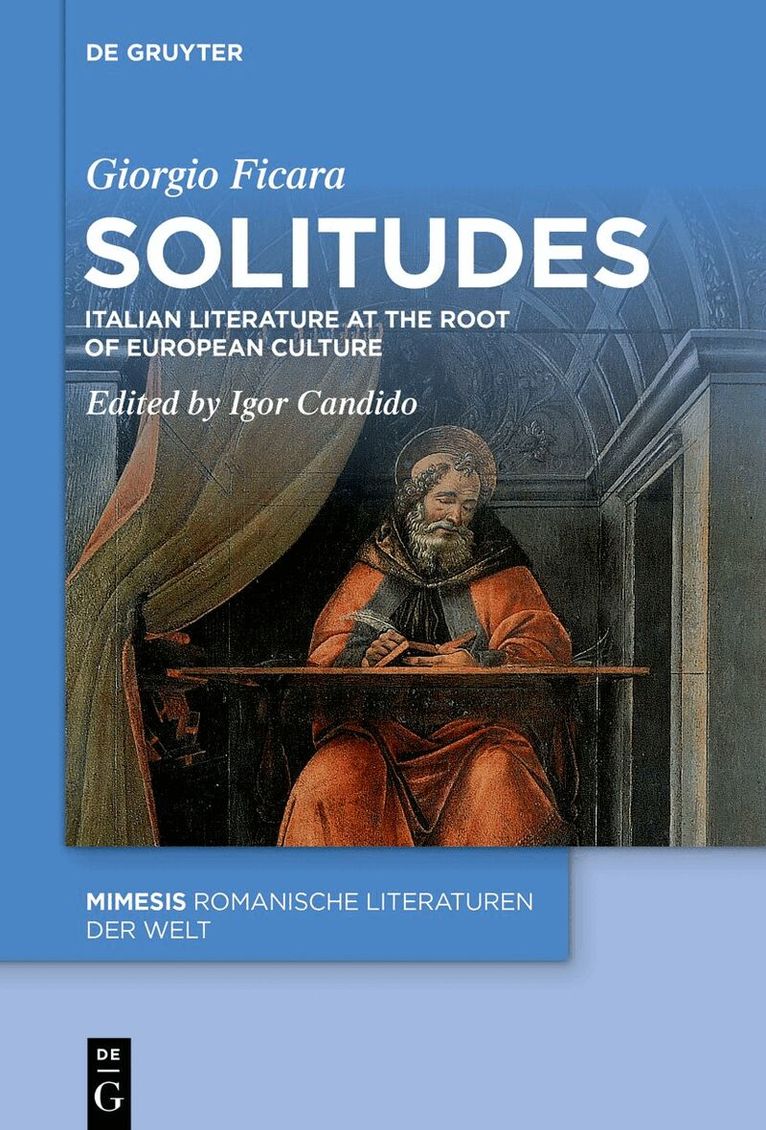
By the end of modern times, the solitary man had become a destitute and infirm man, though curable with the balms of sociability; today, the "hyperconnected" condition of the contemporary men is quite the opposite: their infirmity a new and more dangerous one. The paradox of the solitude of the poet, who distances himself from everyone to be able to speak to everyone, is one of the myths par excellence of Italian literature. In Solitudes, Giorgio Ficara pens the stories of great solitary poets from the Middle Ages to the twentieth century: Petrarch, lost in an unattainable dream of inner peace and solitary life; Tasso, alone in the small circle of creation; Alfieri, who yearns to be alone amidst the voices of the world; Foscolo on his lonely way to the heliconic peaks; Leopardi, whose effective solitude of the poet-philosopher faces the divine solitude of nature; D'Annunzio, alone in front of a necklace that breaks. For all of them, solitude "in the end is destiny itself, the necessity to which one is subject at the acme of poetic expression". Over the centuries, this intellectual legacy of solitary life has become one of the many ways in which Italy deeply influenced European literature and culture at large.