Imre Csiszar - Böcker
Visar alla böcker från författaren Imre Csiszar. Handla med fri frakt och snabb leverans.
4 produkter
4 produkter
855 kr
Skickas inom 10-15 vardagar
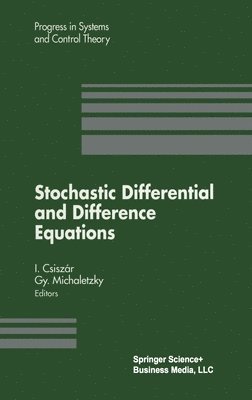
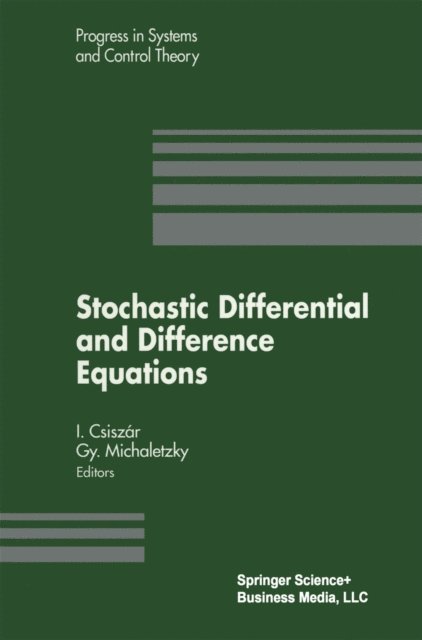
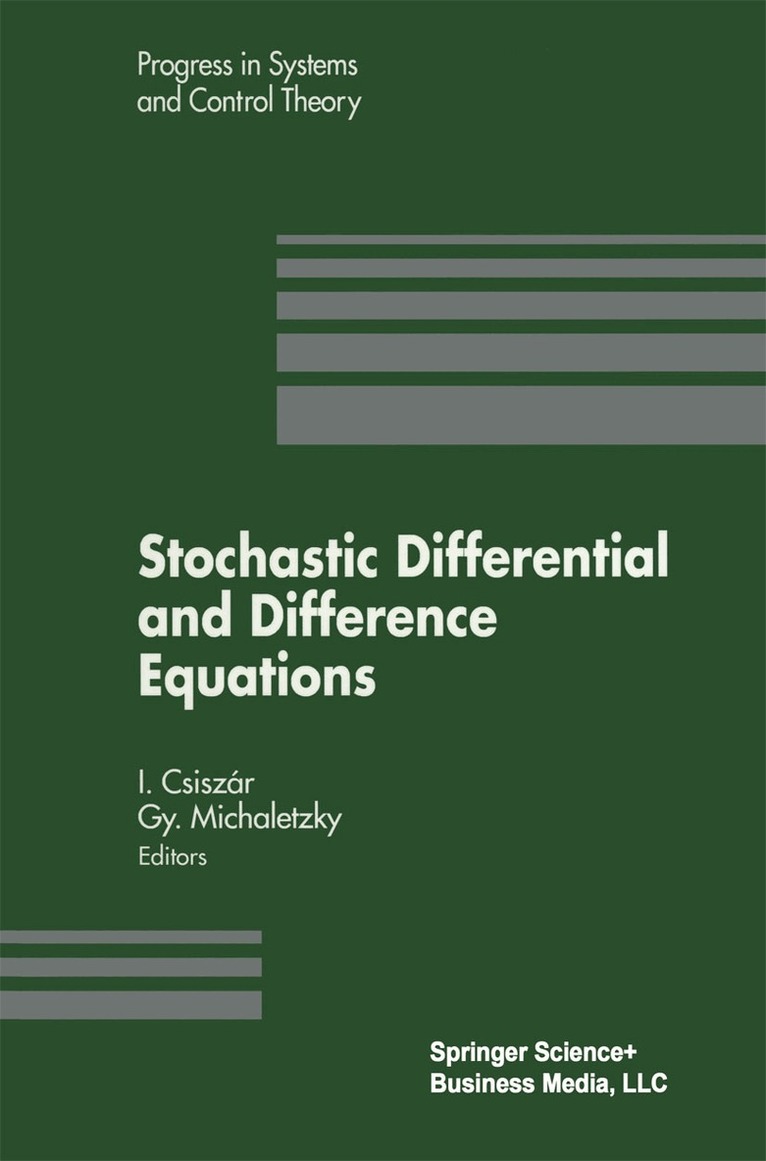
This volume contains a selection of papers presented at the Conference on Stochastic Differential and Difference Equations held in Hungary, August 1996. The papers cover a wide range of contemporary topics in stochastics with particular reference to control theory.
Del 23 - Progress in Systems and Control Theory
Stochastic Differential and Difference Equations
Häftad, Engelska, 2012
537 kr
Skickas inom 10-15 vardagar
The Conference on Stochastic Differential and Difference Equations held at Gyor, Hungary, August 21-24,1996 was organized jointly by Eotvos Lonind University, Budapest and Kossuth Lajos University, Debrecen, with the sponsorship of the Hungarian Regional, the International Executive and the European Regional Committees of the Bernoulli Society as a satellite event to the 4th World Congress of the Bernoulli Society, August 26-31, 1996, Vienna, Austria. It is noteworthy that the meeting had a strong international flavour with 76 participants from 21 countries, including 6 each from Japan and the USA. The core of the conference consisted of the 14 invited lectures, delivered by distinguished experts in their research fields. The majority of contemporary research areas have been covered in these lectures. The list of the invited speakers included T. Duncan, M. Fukushima, T. Funaki, 1. Gyongy, R. Khasminskii, 1. Kubo, H. Kunita, A. Lindquist, D. Nualart, R. Ober, M. Pavon, G. Picci, T. SubbaRao, M. Zakai. Invited lectures were presented in plenary sessions, while the con- tributed papers were presented in two parallel sessions.The first session was devoted to various problems of stochastic partial differential equations (SPDE) and related random fields. The second session covered discrete and continuous time parameter ARMA processes and stochastic differen- tial equations in general. The Szechenyi Istvan College in Gyor provided the venue of the event, seemingly the satisfaction of the participants.
1 067 kr
Skickas inom 10-15 vardagar
The present volume is a collection of survey papers in the ?elds given in the title. They summarize the latest developments in their respective areas. More than half of the papers belong to search theory which lies on the borderline of mathematics and computer science, information theory and combinatorics, respectively. The volume is slightly related to the twin conferences “Search And Communication Complexity” and “Information Theory In Mathematics” held at Balatonlelle, Hungary in 2000. These conferences led us to believe that there is a need for such a collection of papers. The paper written by Martin Aigner starts with the following relatively new search problem. Given n boolean variables as input one has to ?nd one of them whose value is in majority. The goal is to minimize the number of tests needed for this where one test is to compare two input variables for equality. The paper surveys the large set of problems and results which grew out of this one. In the traditional search model an unknown element is sought in a ?nite set, based on the information that the unknown element is or is not in some (asked) subsets. A variant is when a 0,1 function is given on the underlying set, and only the values of this function at the unknown element x is sought rather than x itself. This is called the recognition problem.
1 067 kr
Skickas inom 10-15 vardagar
The present volume is a collection of survey papers in the ?elds given in the title. They summarize the latest developments in their respective areas. More than half of the papers belong to search theory which lies on the borderline of mathematics and computer science, information theory and combinatorics, respectively. The volume is slightly related to the twin conferences “Search And Communication Complexity” and “Information Theory In Mathematics” held at Balatonlelle, Hungary in 2000. These conferences led us to believe that there is a need for such a collection of papers. The paper written by Martin Aigner starts with the following relatively new search problem. Given n boolean variables as input one has to ?nd one of them whose value is in majority. The goal is to minimize the number of tests needed for this where one test is to compare two input variables for equality. The paper surveys the large set of problems and results which grew out of this one. In the traditional search model an unknown element is sought in a ?nite set, based on the information that the unknown element is or is not in some (asked) subsets. A variant is when a 0,1 function is given on the underlying set, and only the values of this function at the unknown element x is sought rather than x itself. This is called the recognition problem.