Ingo Althofer – författare
2 741 kr
Läs direkt efter köp
1 367 kr
Läs direkt efter köp
The fifth volume of Rudolf Ahlswede’s lectures on Information Theory focuses on several problems that were at the heart of a lot of his research. One of the highlights of the entire lecture note series is surely Part I of this volume on arbitrarily varying channels (AVC), a subject in which Ahlswede was probably the world''s leading expert. Appended to Part I is a survey by Holger Boche and Ahmed Mansour on recent results concerning AVC and arbitrarily varying wiretap channels (AVWC). After a short Part II on continuous data compression, Part III, the longest part of the book, is devoted to distributed information. This Part includes discussions on a variety of related topics; among them let us emphasize two which are famously associated with Ahlswede: "multiple descriptions", on which he produced some of the best research worldwide, and "network coding", which had Ahlswede among the authors of its pioneering paper. The final Part IV on "Statistical Inference under Communication constraints" is mainly based on Ahlswede’s joint paper with Imre Csiszar, which received the Best Paper Award of the IEEE Information Theory Society.
The lectures presented in this work, which consists of 10 volumes, are suitable for graduate students in Mathematics, and also for those working in Theoretical Computer Science, Physics, and Electrical Engineering with a background in basic Mathematics. The lectures can be used either as the basis for courses or to supplement them in many ways. Ph.D. students will also find research problems, often with conjectures, that offer potential subjects for a thesis. More advanced researchers may find questions which form the basis of entire research programs.
2 194 kr
Läs direkt efter köp
The sixth volume of Rudolf Ahlswede''s lectures on Information Theory is focused on Identification Theory. In contrast to Shannon''s classical coding scheme for the transmission of a message over a noisy channel, in the theory of identification the decoder is not really interested in what the received message is, but only in deciding whether a message, which is of special interest to him, has been sent or not. There are also algorithmic problems where it is not necessary to calculate the solution, but only to check whether a certain given answer is correct. Depending on the problem, this answer might be much easier to give than finding the solution. ``Easier'''' in this context means using fewer resources like channel usage, computing time or storage space.
Ahlswede and Dueck''s main result was that, in contrast to transmission problems, where the possible code sizes grow exponentially fast with block length, the size of identification codes will grow doubly exponentially fast. The theory of identification has now developed into a sophisticated mathematical discipline with many branches and facets, forming part of the Post Shannon theory in which Ahlswede was one of the leading experts. New discoveries in this theory are motivated both by concrete engineering problems and by explorations of the inherent properties of the mathematical structures.
Rudolf Ahlswede wrote:
It seems that the whole body of present day Information Theory will undergo serious revisions and some dramatic expansions. In this book we will open several directions of future research and start the mathematical description of communication models in great generality. For some specific problems we provide solutions or ideas for their solutions.
The lectures presented in this work, which consists of 10 volumes, are suitable for graduate students in Mathematics, and also for those working in Theoretical Computer Science, Physics, and Electrical Engineering with abackground in basic Mathematics. The lectures can be used as the basis for courses or to supplement courses in many ways. Ph.D. students will also find research problems, often with conjectures, that offer potential subjects for a thesis. More advanced researchers may find questions which form the basis of entire research programs.
The book also contains an afterword by Gunter Dueck.
1 250 kr
Läs direkt efter köp
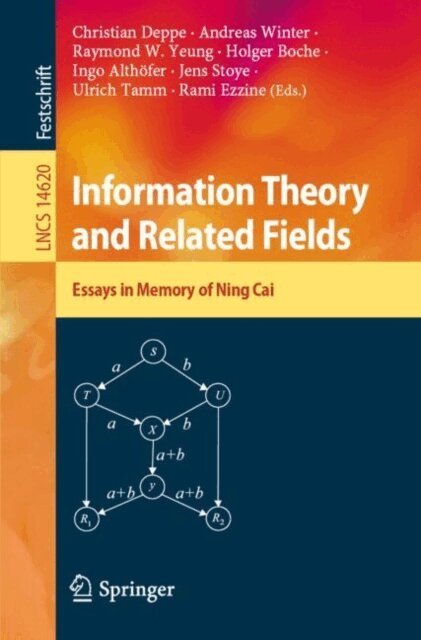
Ning Cai was an eminent mathematician, engineer and computer scientist who made many significant contributions to information theory. In particular, his work on network coding theory created a new research direction for the community.
Prof. Cai’s passion for science inspired his collaborators across the fields of classical and quantum information theory, combinatorics, computation, post-Shannon theory, and coding theory, and the contributions in this volume reflect his success as a researcher and mentor.
789 kr
Läs direkt efter köp
Die 3., ergänzte Auflage stellt auf breiter fachlicher Ebene einfache elementare zahlentheoretische Inhalte vor sowie Stoffkomplexe aus der analytischen und algebraischen Zahlentheorie. Das Lehrbuch bietet auf überschaubaren mathematischen Niveau einen leicht verständlichen Einstieg in ausgewählte Themen der Zahlentheorie und beschreibt aktuelle Forschungsergebnisse zum RSA-Algorithmus.
Sämtliche Kapitel enthalten umfassende Beispiele, Übungsaufgaben mit Lösungen und ausführlich durchgerechnete Beweise, so dass es sich sehr gut zur Prüfungsvorbereitung eignet.
789 kr
Läs direkt efter köp
Die 3., ergänzte Auflage stellt auf breiter fachlicher Ebene einfache elementare zahlentheoretische Inhalte vor sowie Stoffkomplexe aus der analytischen und algebraischen Zahlentheorie. Das Lehrbuch bietet auf überschaubaren mathematischen Niveau einen leicht verständlichen Einstieg in ausgewählte Themen der Zahlentheorie und beschreibt aktuelle Forschungsergebnisse zum RSA-Algorithmus.
Sämtliche Kapitel enthalten umfassende Beispiele, Übungsaufgaben mit Lösungen und ausführlich durchgerechnete Beweise, so dass es sich sehr gut zur Prüfungsvorbereitung eignet.
708 kr
Läs direkt efter köp
The volume “Storing and Transmitting Data” is based on Rudolf Ahlswede''s introductory course on "Information Theory I" and presents an introduction to Shannon Theory. Readers, familiar or unfamiliar with the technical intricacies of Information Theory, will benefit considerably from working through the book; especially Chapter VI with its lively comments and uncensored insider views from the world of science and research offers informative and revealing insights. This is the first of several volumes that will serve as a collected research documentation of Rudolf Ahlswede’s lectures on information theory. Each volume includes comments from an invited well-known expert. Holger Boche contributed his insights in the supplement of the present volume.
Classical information processing concerns the main tasks of gaining knowledge, storage, transmitting and hiding data. The first task is the prime goal of Statistics. For the two next, Shannon presented an impressive mathematical theorycalled Information Theory, which he based on probabilistic models. The theory largely involves the concept of codes with small error probabilities in spite of noise in the transmission, which is modeled by channels. The lectures presented in this work are suitable for graduate students in Mathematics, and also in Theoretical Computer Science, Physics, and Electrical Engineering with background in basic Mathematics. The lectures can be used as the basis for courses or to supplement courses in many ways. Ph.D. students will also find research problems, often with conjectures, that offer potential subjects for a thesis. More advanced researchers may find the basis of entire research programs.
708 kr
Läs direkt efter köp
The calculation of channel capacities was one of Rudolf Ahlswede''s specialties and is the main topic of this second volume of his Lectures on Information Theory. Here we find a detailed account of some very classical material from the early days of Information Theory, including developments from the USA, Russia, Hungary and (which Ahlswede was probably in a unique position to describe) the German school centered around his supervisor Konrad Jacobs. These lectures made an approach to a rigorous justification of the foundations of Information Theory. This is the second of several volumes documenting Rudolf Ahlswede''s lectures on Information Theory. Each volume includes comments from an invited well-known expert. In the supplement to the present volume, Gerhard Kramer contributes his insights.
Classical information processing concerns the main tasks of gaining knowledge and the storage, transmission and hiding of data. The first task is the prime goal of Statistics. For transmission and hiding data, Shannon developed an impressive mathematical theory called Information Theory, which he based on probabilistic models. The theory largely involves the concept of codes with small error probabilities in spite of noise in the transmission, which is modeled by channels. The lectures presented in this work are suitable for graduate students in Mathematics, and also for those working in Theoretical Computer Science, Physics, and Electrical Engineering with a background in basic Mathematics. The lectures can be used as the basis for courses or to supplement courses in many ways. Ph.D. students will also find research problems, often with conjectures, that offer potential subjects for a thesis. More advanced researchers may find questions which form the basis of entire research programs.
1 408 kr
Läs direkt efter köp
Devoted to information security, this volume begins with a short course on cryptography, mainly basedon lectures given by Rudolf Ahlswede at the University of Bielefeld in the mid1990s. It was the second of his cycle of lectures on information theory whichopened with an introductory course on basic coding theorems, as covered inVolume 1 of this series. In this third volume, Shannon’s historical work onsecrecy systems is detailed, followed by an introduction to aninformation-theoretic model of wiretap channels, and such important concepts ashomophonic coding and authentication. Once the theoretical arguments have beenpresented, comprehensive technical details of AES are given. Furthermore, ashort introduction to the history of public-key cryptology, RSA and El Gamalcryptosystems is provided, followed by a look at the basic theory of ellipticcurves, and algorithms for efficient addition in elliptic curves. Lastly, theimportant topic of “oblivious transfer” is discussed, which is stronglyconnected to the privacy problem in communication. Today, the importance ofthis problem is rapidly increasing, and further research and practical realizationsare greatly anticipated.
This is the third of several volumes serving as thecollected documentation of Rudolf Ahlswede’s lectures on information theory.Each volume includes comments from an invited well-known expert. In thesupplement to the present volume, Rüdiger Reischuk contributes his insights.
Classicalinformation processing concerns the main tasks of gaining knowledge and thestorage, transmission and hiding of data. The first task is the prime goal ofStatistics. For transmission and hiding data, Shannon developed an impressivemathematical theory called Information Theory, which he based on probabilisticmodels. The theory largely involves the concept of codes with small errorprobabilities in spite of noise in the transmission, which is modeled bychannels. The lectures presentedin this work are suitable for graduatestudents in Mathematics, and also for those working in Theoretical ComputerScience, Physics, and Electrical Engineering with a background in basicMathematics. The lectures can be used as the basis for courses or to supplementcourses in many ways. Ph.D. students will also find research problems, oftenwith conjectures, that offer potential subjects for a thesis. More advancedresearchers may find questions which form the basis of entire researchprograms.
1 138 kr
Läs direkt efter köp
The fourth volume of Rudolf Ahlswede’s lectures on Information Theory is focused on Combinatorics. Ahlswede was originally motivated to study combinatorial aspects of Information Theory via zero-error codes: in this case the structure of the coding problems usually drastically changes from probabilistic to combinatorial. The best example is Shannon’s zero error capacity, where independent sets in graphs have to be examined. The extension to multiple access channels leads to the Zarankiewicz problem.
A code can be regarded combinatorially as a hypergraph; and many coding theorems can be obtained by appropriate colourings or coverings of the underlying hypergraphs. Several such colouring and covering techniques and their applications are introduced in this book. Furthermore, codes produced by permutations and one of Ahlswede’s favourite research fields -- extremal problems in Combinatorics -- are presented.
Whereas the first part of the book concentrateson combinatorial methods in order to analyse classical codes as prefix codes or codes in the Hamming metric, the second is devoted to combinatorial models in Information Theory. Here the code concept already relies on a rather combinatorial structure, as in several concrete models of multiple access channels or more refined distortions. An analytical tool coming into play, especially during the analysis of perfect codes, is the use of orthogonal polynomials.
Classical information processing concerns the main tasks of gaining knowledge and the storage, transmission and hiding of data. The first task is the prime goal of Statistics. For transmission and hiding data, Shannon developed an impressive mathematical theory called Information Theory, which he based on probabilistic models. The theory largely involves the concept of codes with small error probabilities in spite of noise in the transmission, which is modeled by channels. The lectures presentedin this work are suitable for graduate students in Mathematics, and also for those working in Theoretical Computer Science, Physics, and Electrical Engineering with a background in basic Mathematics. The lectures can be used as the basis for courses or to supplement courses in many ways. Ph.D. students will also find research problems, often with conjectures, that offer potential subjects for a thesis. More advanced researchers may find questions which form the basis of entire research programs.432 kr
Läs direkt efter köp
428 kr
Läs direkt efter köp
128 kr
Läs direkt efter köp
Wie kann man das Mühle-Spiel vor dem Remis-Tod retten? Wie werden heutzutage neue Spiele erfunden? Welche Varianten des Sudokus lohnen einen näheren Blick?
Die Autoren berichten Ihnen Spannendes und Amüsantes, Anregendes und Herausforderndes aus den folgenden vier großen Bereichen:
Sie lernen fünf moderne 2-Personen-Spiele und ihre Geschichten kennen: Lasker-Mühle, Havannah, Clobber, EinStein würfelt nicht, Yavalath.Ausgehend von dem Sudoku, dem bekanntesten Vertreter, werden Sie in die Welt logischer Rätsel eingeführt. Dabei werden sowohl konkrete Rätselarten vorgestellt als auch allgemeine mathematische Hintergründe diskutiert.Erzählt und diskutiert wird die Computerisierung des Leistungs-Schachs, mit dem 3-Hirn-Ansatz als einem Schwerpunkt und eDoping als einem anderen.Aus der Wunderwelt der Zahlen werden zwei Experimente in Text und Bild vorgestellt: Transport-Optimierung in Ritterspordanien und Tanzfigurenin der komplexen Zahlen-Ebene.Ingo Althöfer ist angewandter Mathematiker an der Universität Jena. Spielen und Spiele sind seine Leidenschaft. Roland Voigt ist Diplom-Mathematiker aus Leipzig und beschäftigt sich seit vielen Jahren mit logischen Rätseln.