Rudolf Ahlswede – författare
Visar alla böcker från författaren Rudolf Ahlswede. Handla med fri frakt och snabb leverans.
22 produkter
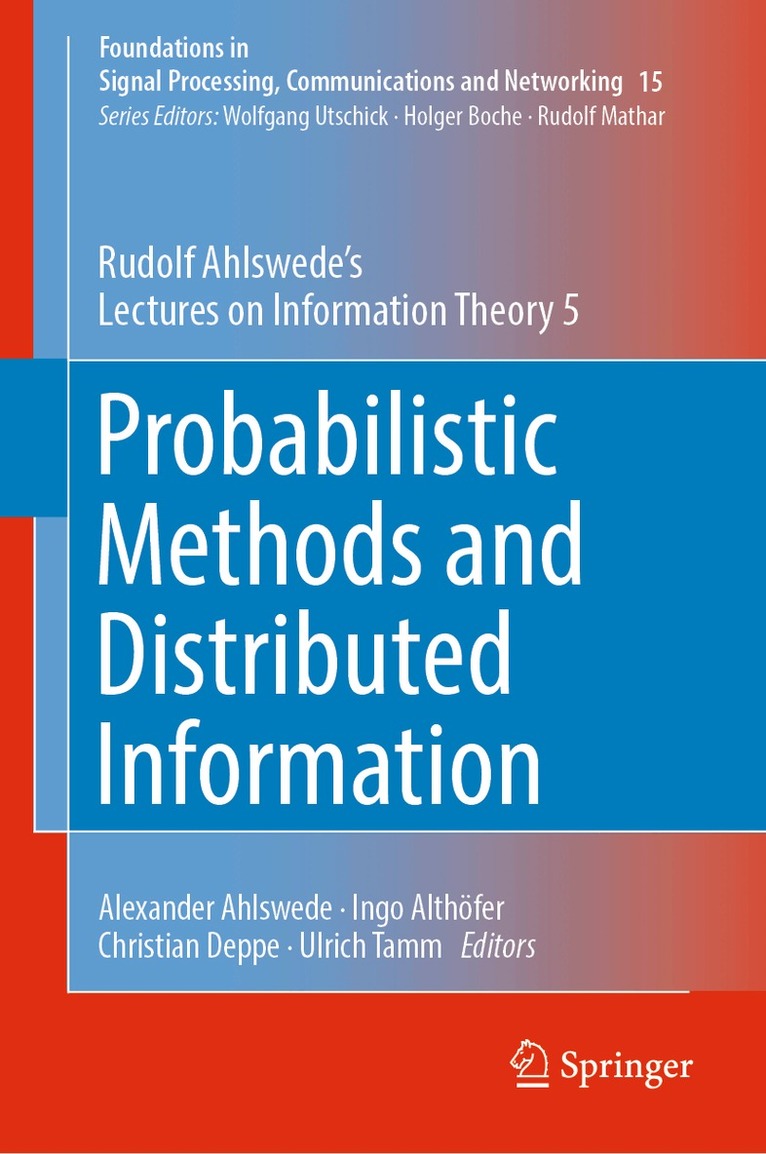
Probabilistic Methods and Distributed Information
Rudolf Ahlswede’s Lectures on Information Theory 5
Av Rudolf Ahlswede, Alexander Ahlswede m. fl.
Inbunden, 2019
1094 kr
Lägg i varukorg
The fifth volume of Rudolf Ahlswede’s lectures on Information Theory focuses on several problems that were at the heart of a lot of his research. One of the highlights of the entire lecture note series is surely Part I of this volume on arbitrarily varying channels (AVC), a subject in which …
Probabilistic Methods and Distributed Information
Rudolf Ahlswede’s Lectures on Information Theory 5
Av Rudolf Ahlswede, Ulrich Tamm m. fl.
E-bok, 2018
1413 kr
Lägg i varukorg
The fifth volume of Rudolf Ahlswede’s lectures on Information Theory focuses on several problems that were at the heart of a lot of his research. One of the highlights of the entire lecture note series is surely Part I of this volume on arbitrarily varying channels (AVC), a subject in which …
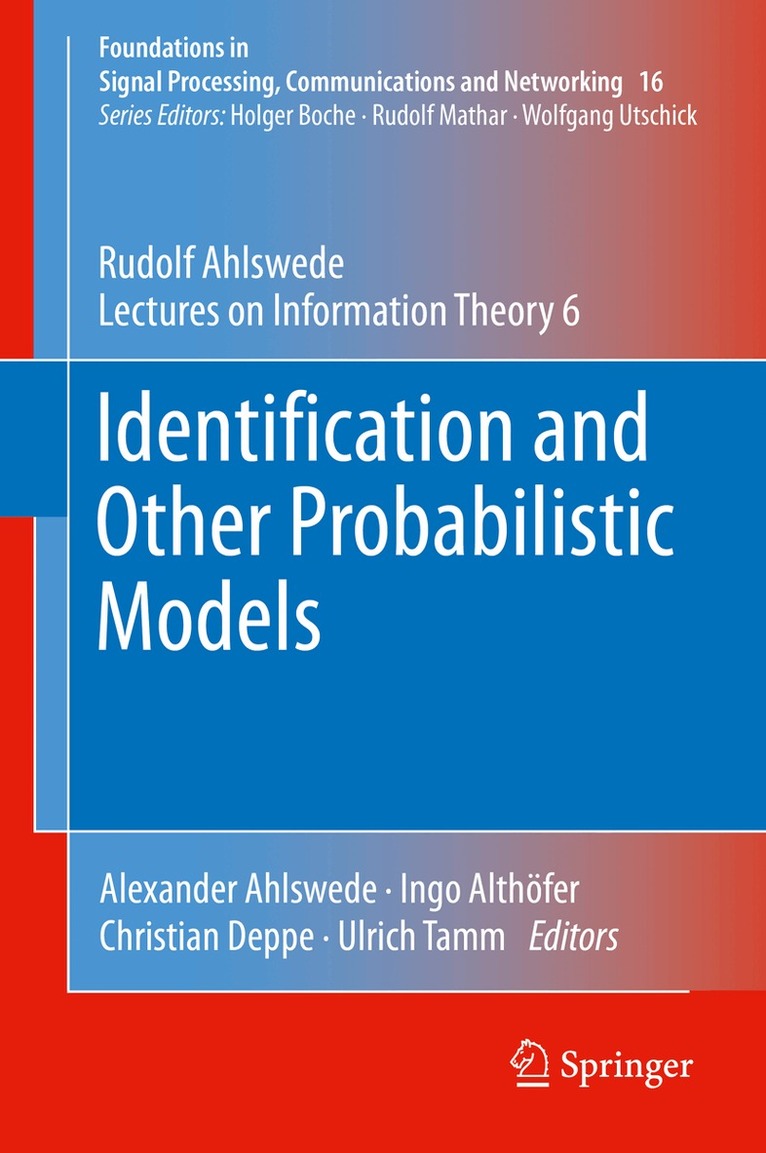
Identification and Other Probabilistic Models
Rudolf Ahlswede’s Lectures on Information Theory 6
Av Rudolf Ahlswede, Alexander Ahlswede m. fl.
Inbunden, 2021
1747 kr
Lägg i varukorg
The sixth volume of Rudolf Ahlswede's lectures on Information Theory is focused on Identification Theory. In contrast to Shannon's classical coding scheme for the transmission of a message over a noisy channel, in the theory of identification the decoder is not really interested in what the …
Identification and Other Probabilistic Models
Rudolf Ahlswede’s Lectures on Information Theory 6
Av Rudolf Ahlswede, Ulrich Tamm m. fl.
E-bok, 2021
2267 kr
Lägg i varukorg
The sixth volume of Rudolf Ahlswede''s lectures on Information Theory is focused on Identification Theory. In contrast to Shannon''s classical coding scheme for the transmission of a message over a noisy channel, in the theory of identification the decoder is not really interested in what the …
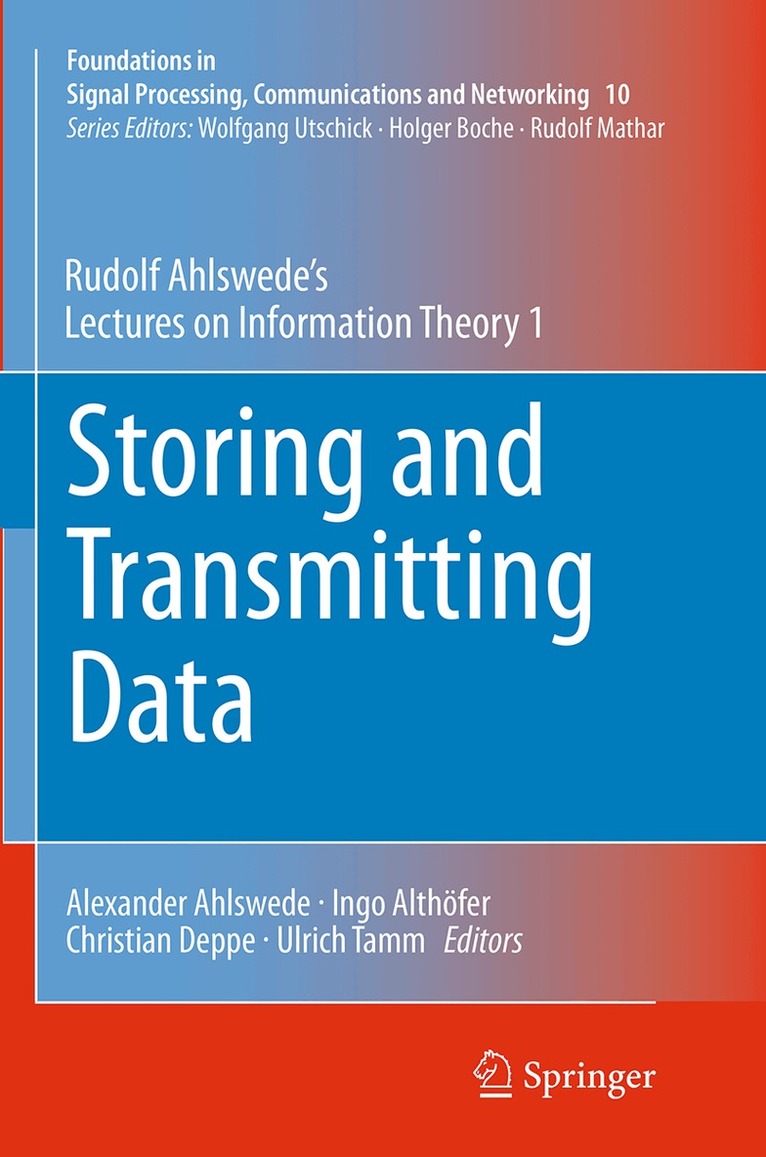
Storing and Transmitting Data
Rudolf Ahlswede’s Lectures on Information Theory 1
Av Rudolf Ahlswede, Alexander Ahlswede m. fl.
Inbunden, 2014
551 kr
Lägg i varukorg
The volume “Storing and Transmitting Data” is based on Rudolf Ahlswede's introductory course on "Information Theory I" and presents an introduction to Shannon Theory. Readers, familiar or unfamiliar with the technical intricacies of Information Theory, will benefit considerably from working through …
Storing and Transmitting Data
Rudolf Ahlswede’s Lectures on Information Theory 1
Av Rudolf Ahlswede, Ulrich Tamm m. fl.
E-bok, 2014
739 kr
Lägg i varukorg
The volume “Storing and Transmitting Data” is based on Rudolf Ahlswede''s introductory course on "Information Theory I" and presents an introduction to Shannon Theory. Readers, familiar or unfamiliar with the technical intricacies of Information Theory, will benefit considerably from working …
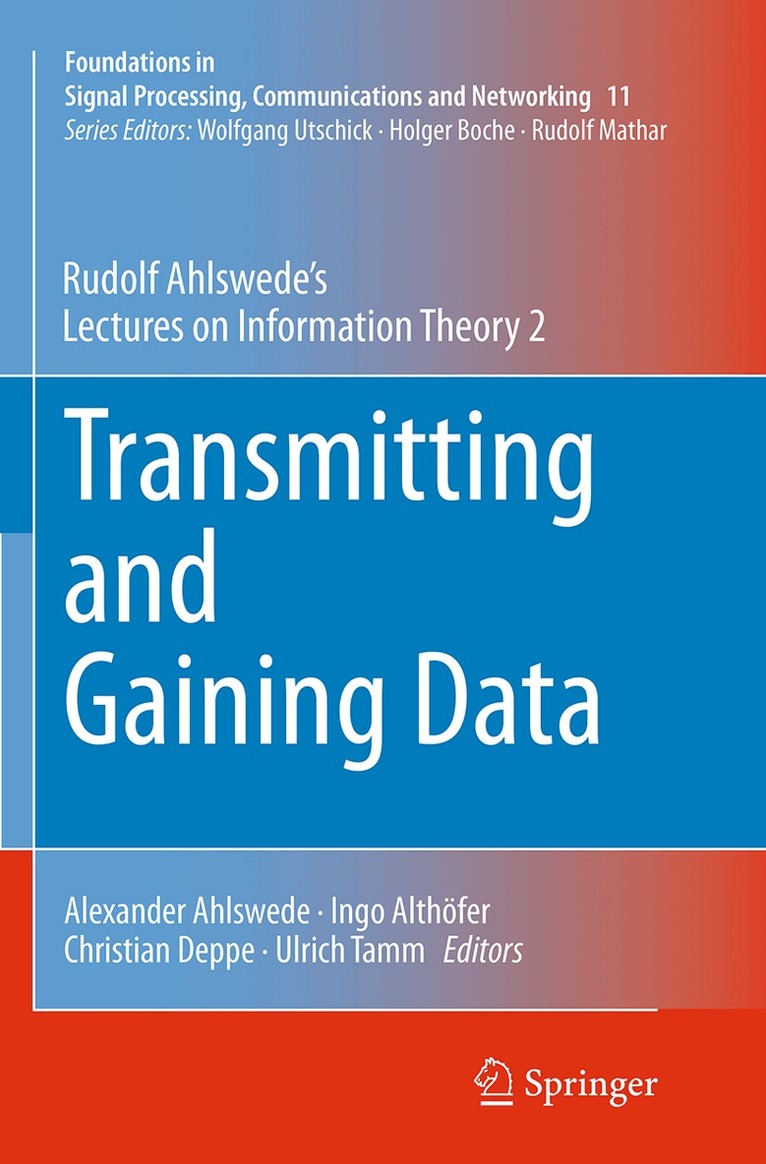
Transmitting and Gaining Data
Rudolf Ahlswede’s Lectures on Information Theory 2
Av Rudolf Ahlswede, Alexander Ahlswede m. fl.
Inbunden, 2014
567 kr
Lägg i varukorg
The calculation of channel capacities was one of Rudolf Ahlswede's specialties and is the main topic of this second volume of his Lectures on Information Theory. Here we find a detailed account of some very classical material from the early days of Information Theory, including developments from …
Transmitting and Gaining Data
Rudolf Ahlswede’s Lectures on Information Theory 2
Av Rudolf Ahlswede, Ulrich Tamm m. fl.
E-bok, 2014
739 kr
Lägg i varukorg
The calculation of channel capacities was one of Rudolf Ahlswede''s specialties and is the main topic of this second volume of his Lectures on Information Theory. Here we find a detailed account of some very classical material from the early days of Information Theory, including developments from …
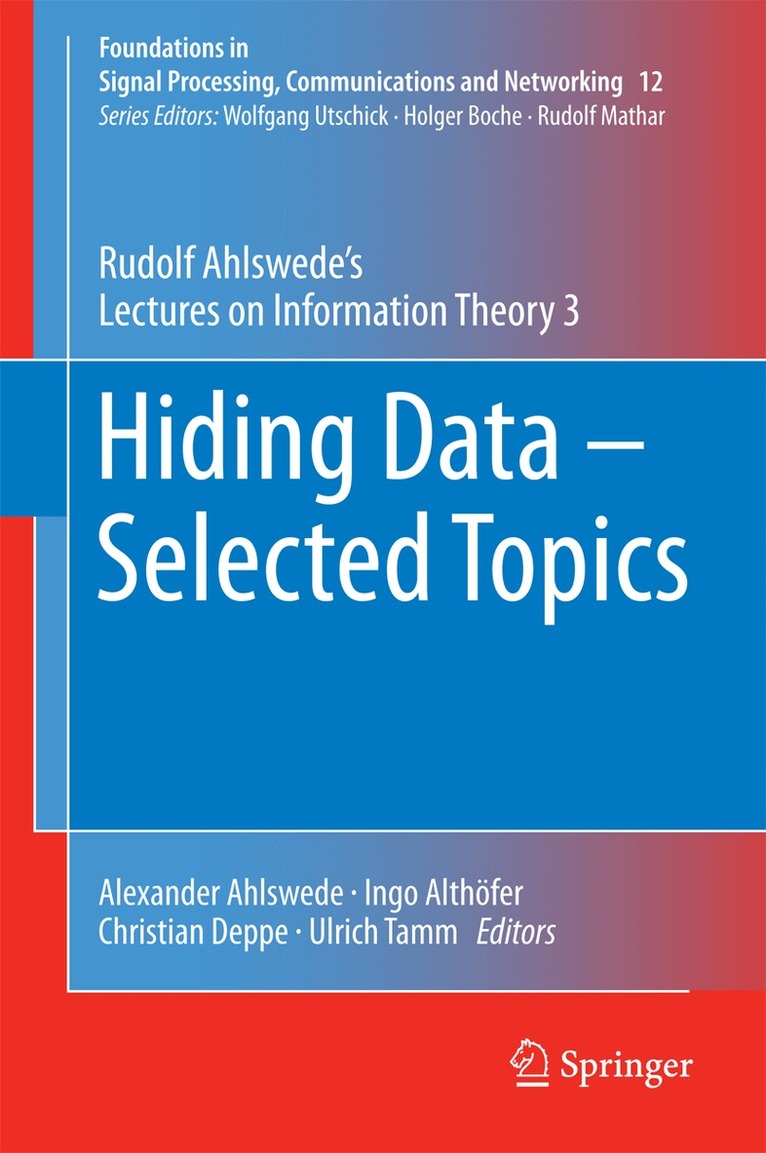
Hiding Data - Selected Topics
Rudolf Ahlswede’s Lectures on Information Theory 3
Av Rudolf Ahlswede, Alexander Ahlswede m. fl.
Inbunden, 2016
1127 kr
Lägg i varukorg
Devoted to information security, this volume begins with a short course on cryptography, mainly basedon lectures given by Rudolf Ahlswede at the University of Bielefeld in the mid1990s. It was the second of his cycle of lectures on information theory whichopened with an introductory course on basic …
Hiding Data - Selected Topics
Rudolf Ahlswede’s Lectures on Information Theory 3
Av Rudolf Ahlswede, Ulrich Tamm m. fl.
E-bok, 2016
1470 kr
Lägg i varukorg
Devoted to information security, this volume begins with a short course on cryptography, mainly basedon lectures given by Rudolf Ahlswede at the University of Bielefeld in the mid1990s. It was the second of his cycle of lectures on information theory whichopened with an introductory course on basic …
Storing and Transmitting Data
Rudolf Ahlswede’s Lectures on Information Theory 1
Av Rudolf Ahlswede, Alexander Ahlswede m. fl.
Häftad, 2016
567 kr
Lägg i varukorg
The volume “Storing and Transmitting Data” is based on Rudolf Ahlswede's introductory course on "Information Theory I" and presents an introduction to Shannon Theory. Readers, familiar or unfamiliar with the technical intricacies of Information Theory, will benefit considerably from working through …
Transmitting and Gaining Data
Rudolf Ahlswede’s Lectures on Information Theory 2
Av Rudolf Ahlswede, Alexander Ahlswede m. fl.
Häftad, 2016
567 kr
Lägg i varukorg
The calculation of channel capacities was one of Rudolf Ahlswede's specialties and is the main topic of this second volume of his Lectures on Information Theory. Here we find a detailed account of some very classical material from the early days of Information Theory, including developments from …
Combinatorial Methods and Models
Rudolf Ahlswede’s Lectures on Information Theory 4
Av Rudolf Ahlswede, Alexander Ahlswede m. fl.
Inbunden, 2017
1312 kr
Lägg i varukorg
The fourth volume of Rudolf Ahlswede’s lectures on Information Theory is focused on Combinatorics. Ahlswede was originally motivated to study combinatorial aspects of Information Theory via zero-error codes: in this case the structure of the coding problems usually drastically changes from …
Combinatorial Methods and Models
Rudolf Ahlswede’s Lectures on Information Theory 4
Av Rudolf Ahlswede, Ulrich Tamm m. fl.
E-bok, 2017
1188 kr
Lägg i varukorg
The fourth volume of Rudolf Ahlswede’s lectures on Information Theory is focused on Combinatorics. Ahlswede was originally motivated to study combinatorial aspects of Information Theory via zero-error codes: in this case the structure of the coding problems usually drastically changes from …
Hiding Data - Selected Topics
Rudolf Ahlswede’s Lectures on Information Theory 3
Av Rudolf Ahlswede, Alexander Ahlswede m. fl.
Häftad, 2018
1203 kr
Lägg i varukorg
Devoted to information security, this volume begins with a short course on cryptography, mainly basedon lectures given by Rudolf Ahlswede at the University of Bielefeld in the mid1990s. It was the second of his cycle of lectures on information theory whichopened with an introductory course on basic …
Combinatorial Methods and Models
Rudolf Ahlswede’s Lectures on Information Theory 4
Av Rudolf Ahlswede, Alexander Ahlswede m. fl.
Häftad, 2018
931 kr
Lägg i varukorg
The fourth volume of Rudolf Ahlswede’s lectures on Information Theory is focused on Combinatorics. Ahlswede was originally motivated to study combinatorial aspects of Information Theory via zero-error codes: in this case the structure of the coding problems usually drastically changes from …
Suchprobleme
Av Ingo Wegener, Rudolf Ahlswede
E-bok, 2013
554 kr
Lägg i varukorg
In den vergangenen drei Jahrzehnten findet man sowohl in theo retisch ausgerichteten als auch in anwendungsorientierten Zeit schriften in zunehmendem Maße Beiträge zum Thema "Suchen". Dabei ist auffallend, daß sehr verschiedenartige Probleme als Suchpro bleme klassifiziert werden und daß …
Suchprobleme
Av Rudolf Ahlswede, Ingo Wegener
Häftad, 1979
515 kr
Lägg i varukorg
In den vergangenen drei Jahrzehnten findet man sowohl in theo retisch ausgerichteten als auch in anwendungsorientierten Zeit schriften in zunehmendem Maße Beiträge zum Thema "Suchen". Dabei ist auffallend, daß sehr verschiedenartige Probleme als Suchpro bleme klassifiziert werden und daß …
General Theory of Information Transfer and Combinatorics
Av Rudolf Ahlswede, Lars Bäumer m. fl.
Häftad, 2006
1127 kr
Lägg i varukorg
This book constitutes the thoroughly refereed research papers contributed to a research project on the 'General Theory of Information Transfer and Combinatorics' that was hosted from 2001-2004 at the Center for Interdisciplinary Research (ZIF) of Bielefeld University and also papers of several …
General Theory of Information Transfer and Combinatorics
Av Haik Mashurian, Christian Deppe m. fl.
E-bok, 2006
1459 kr
Lägg i varukorg
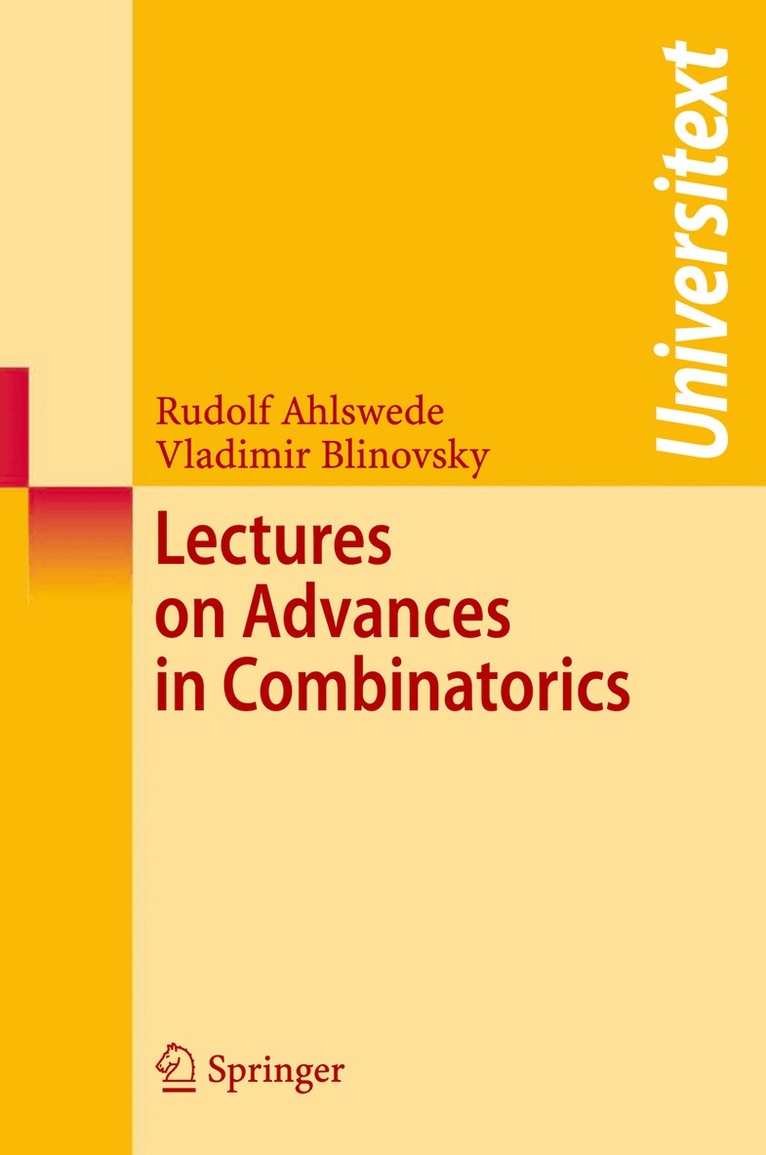
Lectures on Advances in Combinatorics
Av Rudolf Ahlswede, Vladimir Blinovsky
Häftad, 2008
551 kr
Lägg i varukorg
The lectures concentrate on highlights in Combinatorial (ChaptersII and III) and Number Theoretical (ChapterIV) Extremal Theory, in particular on the solution of famous problems which were open for many decades. However, the organization of the lectures in six chapters does neither follow the …
Lectures on Advances in Combinatorics
Av Vladimir Blinovsky, Rudolf Ahlswede
E-bok, 2008
734 kr
Lägg i varukorg
The lectures concentrate on highlights in Combinatorial (ChaptersII and III) and Number Theoretical (ChapterIV) Extremal Theory, in particular on the solution of famous problems which were open for many decades. However, the organization of the lectures in six chapters does neither follow the …