Ingrid Monson - Böcker
Visar alla böcker från författaren Ingrid Monson. Handla med fri frakt och snabb leverans.
9 produkter
9 produkter
1 810 kr
Skickas inom 5-8 vardagar
An insightful examination of the impact of the Civil Rights Movement and African Independence on jazz in the 1950s and 60s, Freedom Sounds traces the complex relationships among music, politics, aesthetics, and activism through the lens of the hot button racial and economic issues of the time. Ingrid Monson illustrates how the contentious and soul-searching debates in the Civil Rights, African Independence, and Black Power movements shaped aesthetic debates and exerted a moral pressure on musicians to take action. Throughout, her arguments show how jazz musicians' quest for self-determination as artists and human beings also led to fascinating and far reaching musical explorations and a lasting ethos of social critique and transcendence. Across a broad body of issues of cultural and political relevance, Freedom Sounds considers the discursive, structural, and practical aspects of life in the jazz world in the 1950s and 1960s. In domestic politics, Monson explores the desegregation of the American Federation of Musicians, the politics of playing to segregated performance venues in the 1950s, the participation of jazz musicians in benefit concerts, and strategies of economic empowerment. Issues of transatlantic importance such as the effects of anti-colonialism and African nationalism on the politics and aesthetics of the music are also examined, from Paul Robeson's interest in Africa, to the State Department jazz tours, to the interaction of jazz musicians such Art Blakey and Randy Weston with African and African diasporic aesthetics. Monson deftly explores musicians' aesthetic agency in synthesizing influential forms of musical expression from a multiplicity of stylistic and cultural influences--African American music, popular song, classical music, African diasporic aesthetics, and other world musics--through examples from cool jazz, hard bop, modal jazz, and the avant-garde. By considering the differences between aesthetic and socio-economic mobility, she presents a fresh interpretation of debates over cultural ownership, racism, reverse racism, and authenticity. Freedom Sounds will be avidly read by students and academics in musicology, ethnomusicology, anthropology, popular music, African American Studies, and African diasporic studies, as well as fans of jazz, hip hop, and African American music.
390 kr
Skickas inom 5-8 vardagar
An insightful examination of the impact of the Civil Rights Movement and African Independence on jazz in the 1950s and 60s, Freedom Sounds traces the complex relationships among music, politics, aesthetics, and activism through the lens of the hot button racial and economic issues of the time. Ingrid Monson illustrates how the contentious and soul-searching debates in the Civil Rights, African Independence, and Black Power movements shaped aesthetic debates and exerted a moral pressure on musicians to take action. Throughout, her arguments show how jazz musicians' quest for self-determination as artists and human beings also led to fascinating and far reaching musical explorations and a lasting ethos of social critique and transcendence.Across a broad body of issues of cultural and political relevance, Freedom Sounds considers the discursive, structural, and practical aspects of life in the jazz world in the 1950s and 1960s. In domestic politics, Monson explores the desegregation of the American Federation of Musicians, the politics of playing to segregated performance venues in the 1950s, the participation of jazz musicians in benefit concerts, and strategies of economic empowerment. Issues of transatlantic importance such as the effects of anti-colonialism and African nationalism on the politics and aesthetics of the music are also examined, from Paul Robeson's interest in Africa, to the State Department jazz tours, to the interaction of jazz musicians such Art Blakey and Randy Weston with African and African diasporic aesthetics.Monson deftly explores musicians' aesthetic agency in synthesizing influential forms of musical expression from a multiplicity of stylistic and cultural influences--African American music, popular song, classical music, African diasporic aesthetics, and other world musics--through examples from cool jazz, hard bop, modal jazz, and the avant-garde. By considering the differences between aesthetic and socio-economic mobility, she presents a fresh interpretation of debates over cultural ownership, racism, reverse racism, and authenticity.Freedom Sounds will be avidly read by students and academics in musicology, ethnomusicology, anthropology, popular music, African American Studies, and African diasporic studies, as well as fans of jazz, hip hop, and African American music.
813 kr
Skickas inom 7-10 vardagar
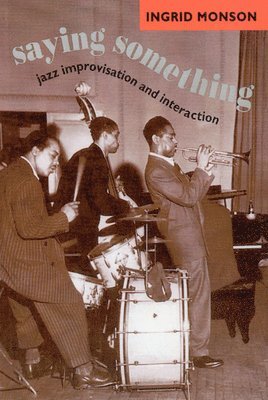
In this work, Ingrid Monson juxtaposes musicians' talk and musical examples to ask how musicians go about "saying something" through music in a way that articulates identity, politics, and race. Through interviews with Jaki Byard, Richard Davis, Sir Roland Hanna, Billy Higgins, Cecil McBee, and others, she develops a perspective on jazz improvisation that has "interactiveness" at its core, in the creation of music through improvisational interaction, in the shaping of social communities and networks through music, and in the development of cultural meanings and ideologies that inform the interpretation of jazz in twentieth-century American cultural life.
284 kr
Skickas inom 7-10 vardagar
In this work, Ingrid Monson juxtaposes musicians' talk and musical examples to ask how musicians go about "saying something" through music in a way that articulates identity, politics, and race. Through interviews with Jaki Byard, Richard Davis, Sir Roland Hanna, Billy Higgins, Cecil McBee, and others, she develops a perspective on jazz improvisation that has "interactiveness" at its core, in the creation of music through improvisational interaction, in the shaping of social communities and networks through music, and in the development of cultural meanings and ideologies that inform the interpretation of jazz in twentieth-century American cultural life.
859 kr
Skickas inom 10-15 vardagar
The African Diaspora presents musical case studies from various regions of the African diaspora, including Africa, the Caribbean, Latin America, and Europe, that engage with broader interdisciplinary discussions about race, gender, politics, nationalism, and music.
2 151 kr
Skickas inom 10-15 vardagar
The African Diaspora presents musical case studies from various regions of the African diaspora, including Africa, the Caribbean, Latin America, North America, and Europe, that engage with broader interdisciplinary discussions about race, gender, politics, nationalism, and music. Featured here are jazz, wassoulou music, and popular and traditional musics of the Caribbean and Africa, framed with attention to the reciprocal relationships of the local and the global.
373 kr
Skickas inom 7-10 vardagar
Kay Kaufman Shelemay’s impact as a mentor and colleague to a generation of scholars shines brightly in this wide-ranging edited collection. Shelemay took the field of ethnomusicology by storm with her bold and historically rich ethnography of Ethiopian Jewish music, pioneering the field of musical diaspora studies. Her investigation of musical communities—emphasizing memory, mobility, and the shifting of boundaries—has inspired many of the authors of this volume.The essays treat such diverse topics as cantorial life in America, gender and fertility among Ethiopians in Israel, transnational performance itineraries of griots and Korean drummers, and video games. This volume embraces Western art music, American music, African music, music and ritual, the performing body, and the internet. The seamless flow between ethnomusicology and historical musicology in this volume will interest a wide range of music scholars for generations to come.
2 577 kr
Skickas inom 10-15 vardagar
The African Diaspora presents musical case studies from various regions of the African diaspora, including Africa, the Caribbean, Latin America, and Europe, that engage with broader interdisciplinary discussions about race, gender, politics, nationalism, and music.
736 kr
Skickas inom 10-15 vardagar
The African Diaspora presents musical case studies from various regions of the African diaspora, including Africa, the Caribbean, Latin America, North America, and Europe, that engage with broader interdisciplinary discussions about race, gender, politics, nationalism, and music. Featured here are jazz, wassoulou music, and popular and traditional musics of the Caribbean and Africa, framed with attention to the reciprocal relationships of the local and the global.