I.S. Krasil'shchik – författare
Visar alla böcker från författaren I.S. Krasil'shchik. Handla med fri frakt och snabb leverans.
9 produkter
9 produkter
Inbunden, Engelska, 1998
1 091 kr
Skickas inom 10-15 vardagar
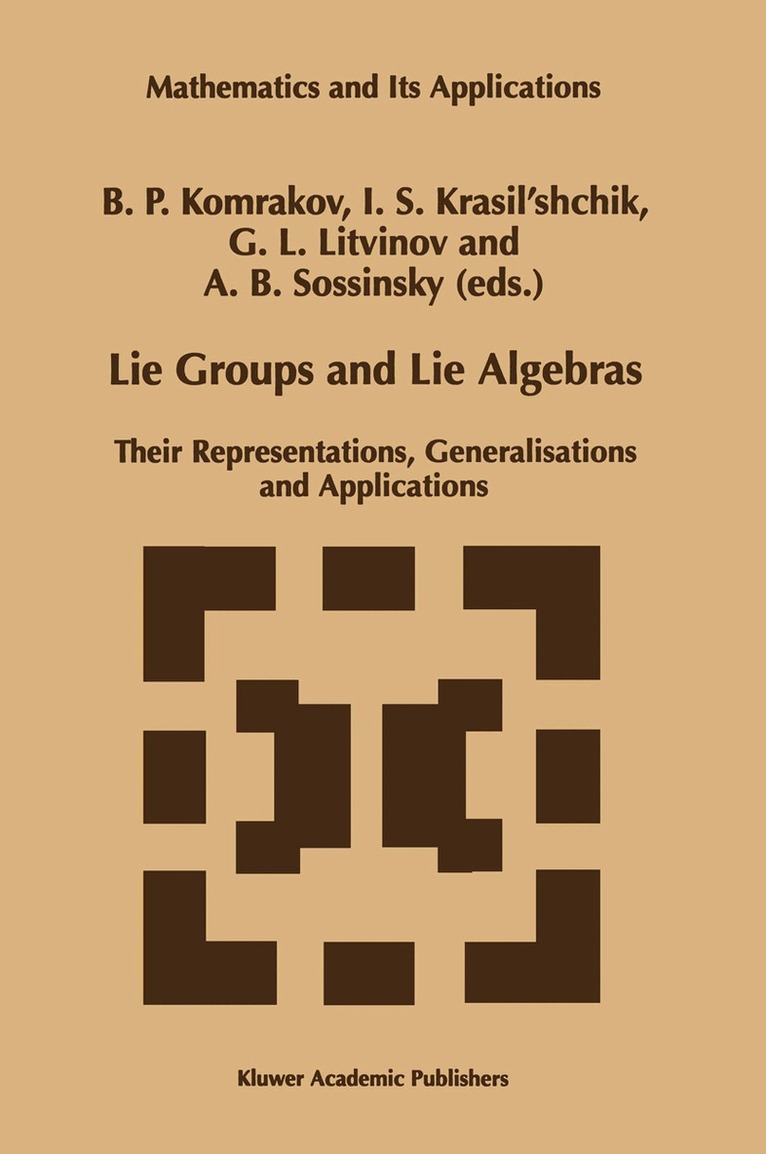
This collection contains papers conceptually related to the classical ideas of Sophus Lie (i.e., to Lie groups and Lie algebras). Obviously, it is impos sible to embrace all such topics in a book of reasonable size. The contents of this one reflect the scientific interests of those authors whose activities, to some extent at least, are associated with the International Sophus Lie Center. We have divided the book into five parts in accordance with the basic topics of the papers (although it can be easily seen that some of them may be attributed to several parts simultaneously). The first part (quantum mathematics) combines the papers related to the methods generated by the concepts of quantization and quantum group. The second part is devoted to the theory of hypergroups and Lie hypergroups, which is one of the most important generalizations of the classical concept of locally compact group and of Lie group. A natural harmonic analysis arises on hypergroups, while any abstract transformation of Fourier type is gen erated by some hypergroup (commutative or not). Part III contains papers on the geometry of homogeneous spaces, Lie algebras and Lie superalgebras. Classical problems of the representation theory for Lie groups, as well as for topological groups and semigroups, are discussed in the papers of Part IV. Finally, the last part of the collection relates to applications of the ideas of Sophus Lie to differential equations.
Inbunden, Engelska, 2000
1 633 kr
Skickas inom 10-15 vardagar
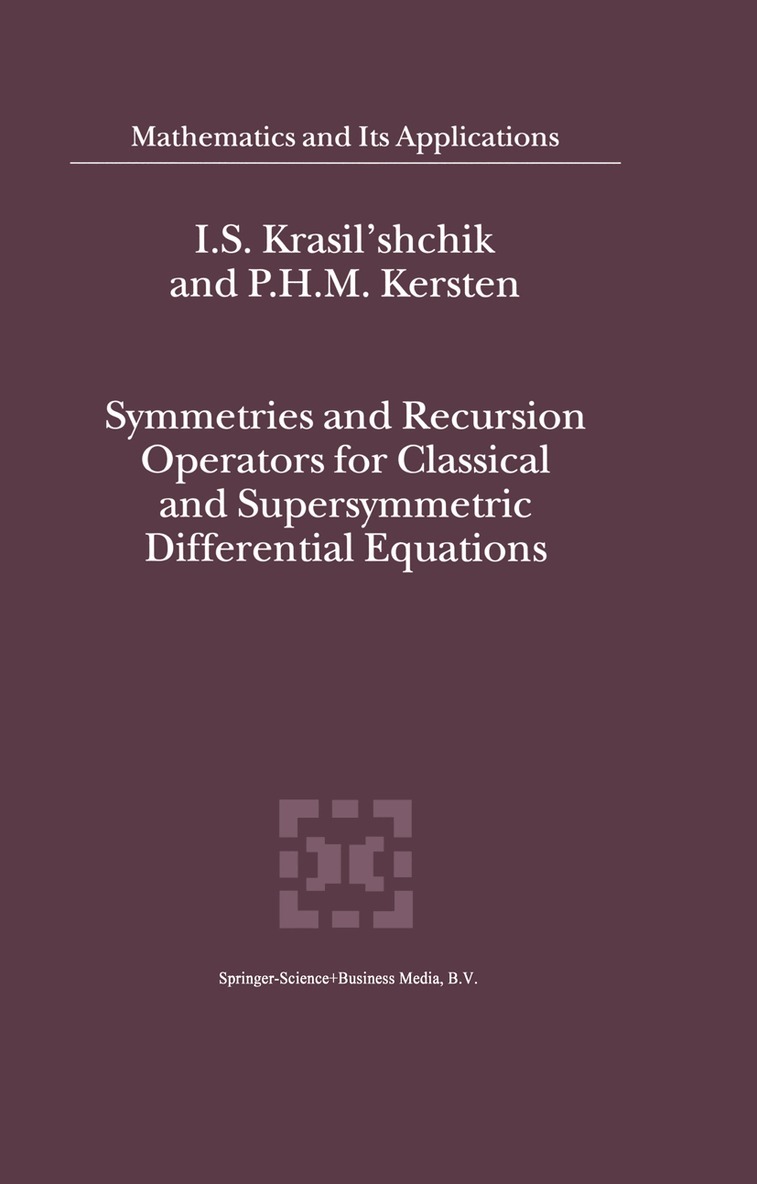
To our wives, Masha and Marian Interest in the so-called completely integrable systems with infinite num ber of degrees of freedom was aroused immediately after publication of the famous series of papers by Gardner, Greene, Kruskal, Miura, and Zabusky [75, 77, 96, 18, 66, 19J (see also [76]) on striking properties of the Korteweg-de Vries (KdV) equation. It soon became clear that systems of such a kind possess a number of characteristic properties, such as infinite series of symmetries and/or conservation laws, inverse scattering problem formulation, L - A pair representation, existence of prolongation structures, etc. And though no satisfactory definition of complete integrability was yet invented, a need of testing a particular system for these properties appeared. Probably one of the most efficient tests of this kind was first proposed by Lenard [19]' who constructed a recursion operator for symmetries of the KdV equation. It was a strange operator, in a sense: being formally integro-differential, its action on the first classical symmetry (x-translation) was well-defined and produced the entire series of higher KdV equations; but applied to the scaling symmetry, it gave expressions containing terms of the type J u dx which had no adequate interpretation in the framework of the existing theories. It is not surprising that P. Olver wrote "The de duction of the form of the recursion operator (if it exists) requires a certain amount of inspired guesswork. . . " [80, p.
Inbunden, Engelska, 1999
2 098 kr
Skickas inom 11-20 vardagar
This book presents developments in the geometric approach to nonlinear partial differential equations (PDEs). The expositions discuss the main features of the approach, and the theory of symmetries and the conservation laws based on it. The book combines rigorous mathematics with concrete examples. Nontraditional topics, such as the theory of nonlocal symmetries and cohomological theory of conservation laws, are also included. The volume is largely self-contained and includes detailed motivations, extensive examples and exercises, and careful proofs of all results. Readers interested in learning the basics of applications of symmetry methods to differential equations of mathematical physics will find the text useful. Experts will also find it useful as it gathers many results previously only available in journals.
Häftad, Engelska, 2010
1 633 kr
Skickas inom 10-15 vardagar
To our wives, Masha and Marian Interest in the so-called completely integrable systems with infinite num ber of degrees of freedom was aroused immediately after publication of the famous series of papers by Gardner, Greene, Kruskal, Miura, and Zabusky [75, 77, 96, 18, 66, 19J (see also [76]) on striking properties of the Korteweg-de Vries (KdV) equation. It soon became clear that systems of such a kind possess a number of characteristic properties, such as infinite series of symmetries and/or conservation laws, inverse scattering problem formulation, L - A pair representation, existence of prolongation structures, etc. And though no satisfactory definition of complete integrability was yet invented, a need of testing a particular system for these properties appeared. Probably one of the most efficient tests of this kind was first proposed by Lenard [19]' who constructed a recursion operator for symmetries of the KdV equation. It was a strange operator, in a sense: being formally integro-differential, its action on the first classical symmetry (x-translation) was well-defined and produced the entire series of higher KdV equations; but applied to the scaling symmetry, it gave expressions containing terms of the type J u dx which had no adequate interpretation in the framework of the existing theories. It is not surprising that P. Olver wrote "The de duction of the form of the recursion operator (if it exists) requires a certain amount of inspired guesswork. . . " [80, p.
E-bok
PDF, Engelska, 2012687 kr
Läs direkt efter köp
The geometrical theory of nonlinear differential equations originates from classical works by S. Lie and A. Bäcklund. It obtained a new impulse in the sixties when the complete integrability of the Korteweg-de Vries equation was found and it became clear that some basic and quite general geometrical and algebraic structures govern this property of integrability. Nowadays the geometrical and algebraic approach to partial differential equations constitutes a special branch of modern mathematics. In 1993, a workshop on algebra and geometry of differential equations took place at the University of Twente (The Netherlands), where the state-of-the-art of the main problems was fixed. This book contains a collection of invited lectures presented at this workshop. The material presented is of interest to those who work in pure and applied mathematics and especially in mathematical physics.
Häftad, Engelska, 2012
1 091 kr
Skickas inom 10-15 vardagar
This collection contains papers conceptually related to the classical ideas of Sophus Lie (i.e., to Lie groups and Lie algebras). Obviously, it is impos sible to embrace all such topics in a book of reasonable size. The contents of this one reflect the scientific interests of those authors whose activities, to some extent at least, are associated with the International Sophus Lie Center. We have divided the book into five parts in accordance with the basic topics of the papers (although it can be easily seen that some of them may be attributed to several parts simultaneously). The first part (quantum mathematics) combines the papers related to the methods generated by the concepts of quantization and quantum group. The second part is devoted to the theory of hypergroups and Lie hypergroups, which is one of the most important generalizations of the classical concept of locally compact group and of Lie group. A natural harmonic analysis arises on hypergroups, while any abstract transformation of Fourier type is gen erated by some hypergroup (commutative or not). Part III contains papers on the geometry of homogeneous spaces, Lie algebras and Lie superalgebras. Classical problems of the representation theory for Lie groups, as well as for topological groups and semigroups, are discussed in the papers of Part IV. Finally, the last part of the collection relates to applications of the ideas of Sophus Lie to differential equations.
Häftad, Engelska, 2011
549 kr
Skickas inom 10-15 vardagar
The geometrical theory of nonlinear differential equations originates from classical works by S. Lie and A. Bäcklund. It obtained a new impulse in the sixties when the complete integrability of the Korteweg-de Vries equation was found and it became clear that some basic and quite general geometrical and algebraic structures govern this property of integrability. Nowadays the geometrical and algebraic approach to partial differential equations constitutes a special branch of modern mathematics. In 1993, a workshop on algebra and geometry of differential equations took place at the University of Twente (The Netherlands), where the state-of-the-art of the main problems was fixed. This book contains a collection of invited lectures presented at this workshop. The material presented is of interest to those who work in pure and applied mathematics and especially in mathematical physics.
E-bok
PDF, Engelska, 20121 367 kr
Läs direkt efter köp
This collection contains papers conceptually related to the classical ideas of Sophus Lie (i.e., to Lie groups and Lie algebras). Obviously, it is impos sible to embrace all such topics in a book of reasonable size. The contents of this one reflect the scientific interests of those authors whose activities, to some extent at least, are associated with the International Sophus Lie Center. We have divided the book into five parts in accordance with the basic topics of the papers (although it can be easily seen that some of them may be attributed to several parts simultaneously). The first part (quantum mathematics) combines the papers related to the methods generated by the concepts of quantization and quantum group. The second part is devoted to the theory of hypergroups and Lie hypergroups, which is one of the most important generalizations of the classical concept of locally compact group and of Lie group. A natural harmonic analysis arises on hypergroups, while any abstract transformation of Fourier type is gen erated by some hypergroup (commutative or not). Part III contains papers on the geometry of homogeneous spaces, Lie algebras and Lie superalgebras. Classical problems of the representation theory for Lie groups, as well as for topological groups and semigroups, are discussed in the papers of Part IV. Finally, the last part of the collection relates to applications of the ideas of Sophus Lie to differential equations.
E-bok
PDF, Engelska, 20132 049 kr
Läs direkt efter köp
To our wives, Masha and Marian Interest in the so-called completely integrable systems with infinite num ber of degrees of freedom was aroused immediately after publication of the famous series of papers by Gardner, Greene, Kruskal, Miura, and Zabusky [75, 77, 96, 18, 66, 19J (see also [76]) on striking properties of the Korteweg-de Vries (KdV) equation. It soon became clear that systems of such a kind possess a number of characteristic properties, such as infinite series of symmetries and/or conservation laws, inverse scattering problem formulation, L - A pair representation, existence of prolongation structures, etc. And though no satisfactory definition of complete integrability was yet invented, a need of testing a particular system for these properties appeared. Probably one of the most efficient tests of this kind was first proposed by Lenard [19]'' who constructed a recursion operator for symmetries of the KdV equation. It was a strange operator, in a sense: being formally integro-differential, its action on the first classical symmetry (x-translation) was well-defined and produced the entire series of higher KdV equations; but applied to the scaling symmetry, it gave expressions containing terms of the type J u dx which had no adequate interpretation in the framework of the existing theories. It is not surprising that P. Olver wrote "The de duction of the form of the recursion operator (if it exists) requires a certain amount of inspired guesswork. . . " [80, p.