Israel Drori - Böcker
Visar alla böcker från författaren Israel Drori. Handla med fri frakt och snabb leverans.
11 produkter
11 produkter
1 009 kr
Skickas inom 10-15 vardagar
Arab entrepreneurs in Israel form part of a traditional, yet peripheral, ethnic minority attempting to integrate into Israel's larger economy. This study, based on extensive fieldwork, focuses on the obstacles that these Arab entrepreneurs and new industrialists must overcome in their development towards industrialization. The research exposes a highly flexible entrepreneurial culture making use of a limited set of opportunities and resources. The work makes a strong contribution to comparative cross-cultural research and theoretical formulations on issues of ethnic entrepreneurship.
1 057 kr
Tillfälligt slut
Explores how the entry of migrant workers into Israel raises questions beyond just those of the labor market.In this account of a social experiment gone awry, Israel Drori exposes a little-known and recent phenomenon: the importation of foreign workers from Third World economies to Israel. Focusing on Romanian, Thai, and Filipina migrants brought to Israel for specified periods of employment, Drori examines the effect of migrants on Israeli society, particularly the issue of national identity. What began as a political corrective-avoiding the danger of hiring Palestinians to do work that Jewish Israelis would not-has developed into a social and economic problem the state does not know how to handle. In addition to examining the work experiences and social lives of these workers, Drori also situates the Israeli case within a global context, where many affluent nations have significant populations of marginalized, undocumented workers.
394 kr
Tillfälligt slut
Explores how the entry of migrant workers into Israel raises questions beyond just those of the labor market.In this account of a social experiment gone awry, Israel Drori exposes a little-known and recent phenomenon: the importation of foreign workers from Third World economies to Israel. Focusing on Romanian, Thai, and Filipina migrants brought to Israel for specified periods of employment, Drori examines the effect of migrants on Israeli society, particularly the issue of national identity. What began as a political corrective-avoiding the danger of hiring Palestinians to do work that Jewish Israelis would not-has developed into a social and economic problem the state does not know how to handle. In addition to examining the work experiences and social lives of these workers, Drori also situates the Israeli case within a global context, where many affluent nations have significant populations of marginalized, undocumented workers.
1 473 kr
Skickas inom 10-15 vardagar
Many Arab communities in Israel's Galilee region are home to export-oriented textile factories, owned by multinational corporations, whose Jewish managers employ local Arab and Druse women as seamstresses and low-level work supervisors. Based on five years of ethnographic research, this book explores how these managers and workers negotiate the terms and meanings of factory work, integrating work culture with the norms and values of the host towns in order for employment arrangements to succeed.The entrance of industrial corporations into developing areas of the world, particularly in those industries employing primarily women, has generated tension between traditional familial and social roles and the demands of industrial working life. In Israel these tensions are further complicated by the social and political dynamics of Arab-Jewish conflict, as well as the strictly demarcated roles of women and men in traditional Arab society. The resolution of these tensions on the shop floor shapes the social relations of production, the factories' management systems, family life in the industrial towns, and individual status and autonomy. The negotiation involves unequal power relations, manifested in a dual patriarchal structure: the Arab cultural practice of male domination of women as well as the formal management system of the textile concern, which dictates the nature of relationships between Jewish managers and Arab women workers.To meet their business goals, the managers must cooperate with the community that provides their workforce, adapting its norms and appropriating its worldview. The managers are constrained by the strict social rules of Arab and Druse society, and respond by attempting to harness and manipulate local family values to foster personal commitment, furthering production goals through paternal control. The consequence of this paternalism is a workforce that relates to the organization as family, identifies with its goals, and internalizes feelings of loyalty. However, the workforce also uses the plant as the arena for developing self-awareness and enhancing personal independence and status within the family. The seamstresses emerge as active shapers of the organizational culture, forcing the managers to adapt to and comply with their personal needs and perceptions of work.
364 kr
Skickas inom 7-10 vardagar
Many Arab communities in Israel's Galilee region are home to export-oriented textile factories, owned by multinational corporations, whose Jewish managers employ local Arab and Druse women as seamstresses and low-level work supervisors. Based on five years of ethnographic research, this book explores how these managers and workers negotiate the terms and meanings of factory work, integrating work culture with the norms and values of the host towns in order for employment arrangements to succeed.The entrance of industrial corporations into developing areas of the world, particularly in those industries employing primarily women, has generated tension between traditional familial and social roles and the demands of industrial working life. In Israel these tensions are further complicated by the social and political dynamics of Arab-Jewish conflict, as well as the strictly demarcated roles of women and men in traditional Arab society. The resolution of these tensions on the shop floor shapes the social relations of production, the factories' management systems, family life in the industrial towns, and individual status and autonomy. The negotiation involves unequal power relations, manifested in a dual patriarchal structure: the Arab cultural practice of male domination of women as well as the formal management system of the textile concern, which dictates the nature of relationships between Jewish managers and Arab women workers.To meet their business goals, the managers must cooperate with the community that provides their workforce, adapting its norms and appropriating its worldview. The managers are constrained by the strict social rules of Arab and Druse society, and respond by attempting to harness and manipulate local family values to foster personal commitment, furthering production goals through paternal control. The consequence of this paternalism is a workforce that relates to the organization as family, identifies with its goals, and internalizes feelings of loyalty. However, the workforce also uses the plant as the arena for developing self-awareness and enhancing personal independence and status within the family. The seamstresses emerge as active shapers of the organizational culture, forcing the managers to adapt to and comply with their personal needs and perceptions of work.
769 kr
Skickas inom 7-10 vardagar
The Evolution of a New Industry traces the emergence and growth of the Israeli hi-tech sector to provide a new understanding of industry evolution.In the case of Israel, the authors reveal how the hi-tech sector built an entrepreneurial culture with a capacity to disseminate intergenerational knowledge of how to found new ventures, as well as an intricate network of support for new firms. Following the evolution of this industry from embryonic to mature, Israel Drori, Shmuel Ellis, and Zur Shapira develop a genealogical approach that relies on looking at the sector in the way that one might consider a family tree. The principles of this genealogical analysis enable them to draw attention to the dynamics of industry evolution, while relating the effects of the parent companies' initial conditions to their respective corporate genealogies and imprinting potential. The text suggests that genealogical evolution is a key mechanism for understanding the rate and extent of founding new organizations, comparable to factors such as opportunity structures, capabilities, and geographic clusters.
1 096 kr
Skickas inom 10-15 vardagar
The decision to engage in corporate social action (CSA), and the debates regarding its costs, benefits and implications to corporate performance represent a demanding issue for scholars and managers. Research is inconclusive regarding the causal relations between CSA, corporate social performance (CSP) and corporate financial performance (CFP), despite numerous empirical and theoretical studies devoted to the issue. This book presents an in-depth study of corporate social action and the factors influencing a decision to engage in it. Going beyond the causal relationship between CSA and firm performance, the book stresses the link between CSA and a firm's core managerial policies and practices, reflecting the complexity and varied facets of CSA and the numerous internal and external factors that influence its outcomes. The book draws on the experiences of various industrial sectors to reveal the importance of a range of issues such as top management pay dispersion and ownership structure, which may influence the firm's decision to engage in CSA. It also explores some of the external influences on firms, such as institutional norms, the geopolitical environment and the industrial sector. The first part of the book provides an overview of the thematic issues of CSA and performance. The second part presents a series of empirical studies that examine factors and determinants of CSA. The third part presents case studies to illustrate the processes and outcomes of CSA policy and strategy in environmentally hazardous industries.
589 kr
Skickas inom 7-10 vardagar
Transnational entrepreneurs are individuals who migrate from one country to another, concurrently maintaining business-related linkages with their countries of origin and their adopted countries and communities. Once thought of as contributing primarily to ethnic enterprise and small business, they are recognized now as playing a leading role around the world in important start-ups and high technology ventures.Transnational and Immigrant Entrepreneurship in a Globalized World brings together leading international scholars from a cross-disciplinary basis to examine the economic, social, regulatory, technological, and theoretical issues related to the impact of transnational entrepreneurs on business and economic development. Drawing on the work of French sociologist Pierre Bourdieu and other international perspectives, the scholars in this volume examine both theory and case studies to discuss how entrepreneurial activity relates to international business, economic development, and the institutional and regulatory implications of globalization.
2 714 kr
Skickas inom 7-10 vardagar
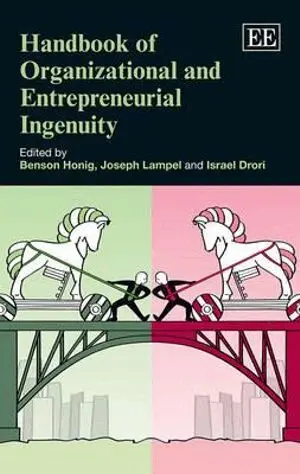
The editors of this Handbook, Benson Honig, Joseph Lampel and Israel Drori, define organizational ingenuity as 'the ability to create innovative solutions within structural constraints using limited resources and imaginative problem solving'. They examine the dichotomy between organizational freedom and necessity in order to better understand the role of ingenuity in the success of an organization.Organizational ingenuity is essential for effective action in a world where resources are increasingly scarce and regulations are ever more demanding. The authors examine existing models of this phenomenon and offer case studies and theoretical perspectives that illuminate the processes that shape high-quality outcomes. The Handbook concludes with a theoretical summary and a discussion of future research opportunities.This coherent collection, with rich and varied contributions from leading entrepreneurial thinkers, will appeal to students and scholars of business and entrepreneurship as well as to practitioners interested in creativity and innovation.Contributors: A. Banerjee, S. Clegg, L.W. Cox, M. Pina e Cunha, I. Drori, G. Gorse, P. Groenewegen, B. Honig, J. Koch, J.M. Korhonen, J. Lampel, S.R.H. Mariano, F. Masciarelli, J. Matthews, D.T. Methé, J. Moraes, P. Neves, P. Oliveira, A. Prencipe, A. Rego, W. Rothmann, T. Sagiv, N. Senf, J.G. Shearer, A.C.O. Siqueira, A.M.C.E. Stam, L. Välikangas, I.A.M. Wakkee, D.B. Zoogah
1 740 kr
Skickas inom 7-10 vardagar
'The editors have assembled a distinguished group of scholars to weigh in on a timely, important, and under-researched topic: the role of accelerators in venture creation and growth. The end result is a lucid and insightful book. This is a ''must read'' for scholars, policymakers, and practitioners with an interest in the role of incubators/accelerators in entrepreneurship and regional economic development.'- Donald Siegel, Arizona State University, USUnderstanding how accelerators build an entrepreneurial ecosystem, generate innovations and create new technologies is key for anyone wishing to nurture a start-up company. This book compares the success of accelerators in comparison to the independent growth of new companies or incubators through a series of in-depth studies.Accelerators: Successful Venture Creation and Growth examines how the organisational structures and practices of start-up accelerators generate innovations and identify new technologies, products and services. Mike Wright and Israel Drori have developed an entrepreneurial approach to this topic, exploring accelerators and start-ups as temporary organisations. This allows the contributing authors to highlight issues relating to both internal and external processes. This book focuses on an important entrepreneurship trend that is growing, but has not yet undergone thorough research, and as such, is key for anyone wishing to understand the topic. This would be a stimulating and valuable read for entrepreneurs, policymakers and students looking to enter accelerators.Contributors include: M. Bliemel, M.G. Colombo, S. de Klerk, I. Drori, R. Flores, J.-Y. Fu, J. Gonzalez-Uribe, J. Koch, M. Leatherbee, M.P. Miles, C. Rossi-Lamastra, J. Van Hove, I. Vanaelst, L. Vandeweghe, M. Wenzel, M. Wright, R. Yitshaki
Vision and Change in Institutional Entrepreneurship
The Transformation from Science to Commercialization
Inbunden, Engelska, 2011
2 014 kr
Skickas inom 3-6 vardagar
Sheltered for a long time within the public sector environment with high job security and professional research autonomy, defense R&D organizations faced unprecedented challenges when government support was being withdrawn and closure threatening. They needed to be led by a suitable vision in order to implement comprehensive changes to their operations and remain viable. This study explores this constitution of vision as a mechanism of intentional change, a strategic tool to reach the desired future for the organization. Going beyond the current literature, the authors ask to what extent, and how, organizational members reconstruct vision in a way that it can support or detain change, a question of importance for management scholars as well as professional managers in both public and private organizations.