J. M. Beattie – författare
Visar alla böcker från författaren J. M. Beattie. Handla med fri frakt och snabb leverans.
5 produkter
5 produkter
1 020 kr
Skickas inom 5-8 vardagar
This comprehensive work explores the broad question of how the English courts dealt with crime in the period during which the foundations of modern forms of judicial administration were being laid.
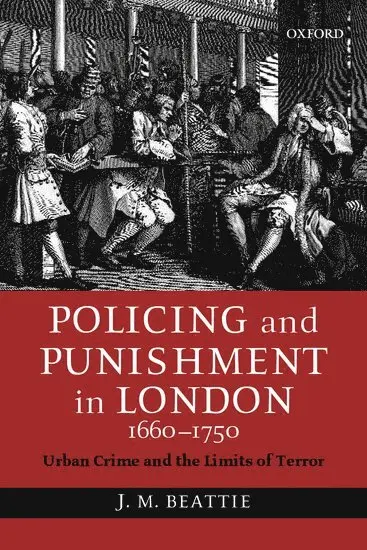
Policing and Punishment in London 1660-1750
Urban Crime and the Limits of Terror
Inbunden, Engelska, 2001
3 517 kr
Skickas inom 7-10 vardagar
This study examines the considerable changes that took place in the criminal justice system in the City of London in the century after the Restoration, well before the inauguration of the so-called 'age of reform'. The policing institutions of the City were transformed in response to the problems created by the rapid expansion of the metropolis during the early modern period, and as a consequence of the emergence of a polite urban culture. At the same time, the City authorities were instrumental in the establishment of new forms of punishment - particularly transportation to the American colonies and confinement at hard labour - that for the first time made secondary sanctions available to the English courts for convicted felons and diminished the reliance on the terror created by capital punishment. The book investigates why in the century after 1660 the elements of an alternative means of dealing with crime in urban society were emerging in policing, in the practices and procedures of prosecution, and in the establishment of new forms of punishment.
Policing and Punishment in London 1660-1750
Urban Crime and the Limits of Terror
Häftad, Engelska, 2002
1 180 kr
Skickas inom 7-10 vardagar
This study examines the considerable changes that took place in the criminal justice system in the City of London in the century after the Restoration, well before the inauguration of the so-called 'age of reform'. The policing institutions of the City were transformed in response to the problems created by the rapid expansion of the metropolis during the early modern period, and as a consequence of the emergence of a polite urban culture. At the same time, the City authorities were instrumental in the establishment of new forms of punishment - particularly transportation to the American colonies and confinement at hard labour - that for the first time made secondary sanctions available to the English courts for convicted felons and diminished the reliance on the terror created by capital punishment. The book investigates why in the century after 1660 the elements of an alternative means of dealing with crime in urban society were emerging in policing, in the practices and procedures of prosecution, and in the establishment of new forms of punishment.
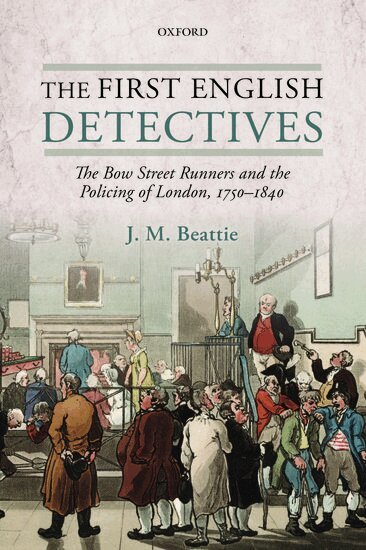
The First English Detectives
The Bow Street Runners and the Policing of London, 1750-1840
Häftad, Engelska, 2014
705 kr
Skickas inom 7-10 vardagar
This is the first comprehensive study of the Bow Street Runners, a group of men established in the middle of the eighteenth century by Henry Fielding, with the financial support of the government, to confront violent offenders on the streets and highways around London. They were developed over the following decades by his half-brother, John Fielding, into what became a well-known and stable group of officers who acquired skill and expertise in investigating crime, tracking and arresting offenders, and in presenting evidence at the Old Bailey, the main criminal court in London. They were, Beattie argues, detectives in all but name. Fielding also created a magistrates' court that was open to the public, at stated times every day.A second, intimately-related theme in the book concerns attitudes and ideas about the policing of London more broadly, particularly from the 1780s, when the detective and prosecutorial work of the runners came to be challenged by arguments in favour of the prevention of crime by surveillance and other means. The last three chapters of the book continue to follow the runners' work, but at the same time are concerned with discussions of the larger structure of policing in London - in parliament, in the Home Office, and in the press. These discussions were to intensify after 1815, in the face of a sharp increase in criminal prosecutions. They led - in a far from straightforward way - to a fundamental reconstitution of the basis of policing in the capital by Robert Peel's Metropolitan Police Act of 1829. The runners were not immediately affected by the creation of the New Police, but indirectly it led to their disbandment a decade later.
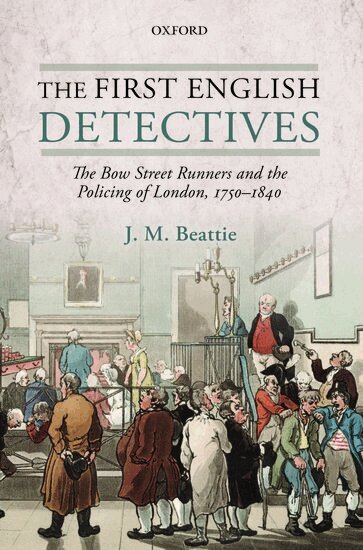
The First English Detectives
The Bow Street Runners and the Policing of London, 1750-1840
Inbunden, Engelska, 2012
1 666 kr
Skickas inom 5-8 vardagar
This is the first comprehensive study of the 90-year history of the Bow Street Runners, a group of men established in the middle of the eighteenth century by Henry Fielding, with the financial support of the government, to confront violent offenders on the streets and highways around London. They were developed over the following decades by his half-brother, John Fielding, into what became a well-known and stable group of officers who acquired skill and expertise in investigating crime, tracking and arresting offenders, and in presenting evidence at the Old Bailey, the main criminal court in London. They were, Beattie argues, detectives in all but name. Fielding also created a magistrates' court that was open to the public for the first time, at stated times every day. A second, intimately-related theme in the book concerns attitudes and ideas about the policing of London more broadly, particularly from the 1780s, when the detective and prosecutorial work of the runners came to be increasingly opposed by arguments in favour of the prevention of crime by surveillance and other means. The last three chapters of the book continue to follow the runners' work, but at the same time are concerned with discussions of the larger structure of policing in London - in parliament, in the Home Office, and in the press. These discussions were to intensify after 1815, in the face of a sharp increase in criminal prosecutions. They led - in a far from straightforward way - to a fundamental reconstitution of the basis of policing in the capital by Robert Peel's Metropolitan Police act of 1829. The runners were not immediately affected by the creation of the New Police, but indirectly it led to their disbandment a decade later.