J Stewart Cameron - Böcker
Visar alla böcker från författaren J Stewart Cameron. Handla med fri frakt och snabb leverans.
4 produkter
4 produkter
3 021 kr
Skickas inom 5-8 vardagar
This book tells the extraordinary story of how the function of the first - and so far almost the only - human organ was replaced by a machine, and the "artificial kidney" entered medical and public folk-lore. A practical artificial kidney, or dialyser, came about by advances in science followed by the acquisition of new synthetic materials which made the application of these ideas possible. However it was the dedication and persistence of a number of talented pioneers who pressed ahead against professional opposition to achieve success, first in the treatment of temporary, recoverable kidney failure, and then permanent renal shut-down which made it a success. The apparent high cost and limited availability of this form of treatment immediately raised ethical questions which had never been questioned before, centering around equity of access to treatment, when and if treatment could be denied, and - worst of all - the agonising decision of when, once established, it should be stopped. Spiralling costs as the true number of people with kidney failure became evident raised major political and financial questions, which were addressed in different countries in different ways which reflected - but also helped change - patterns of how medical care is provided. In developed countries, the problem could be solved by allocating a disproportionate amount of money to the treatment of relatively few kidney patients, but in the developing world the cost of treatment still limits its availability, as it does all forms of modern health care.Nevertheless, today almost one million people world-wide are maintained alive following terminal kidney failure, two thirds of them by various forms of dialysis and the remainder bearing kidney transplants, almost always placed after a period on dialysis. The story is also the sum of the often heroic lives of these hundreds of thousands of patients, a few of whom have today been maintained alive and active for more than 35 years, and many of whom suffered known, but also unexpected complications as a result of their treatment.
2 201 kr
Skickas inom 7-10 vardagar
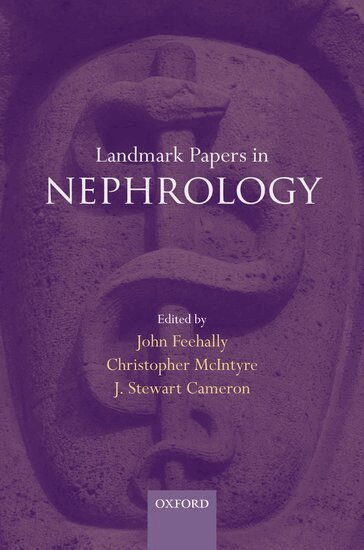
Landmarks in Nephrology points the reader to some of the seminal observations which have led to the practice of nephrology as we know it today.Twenty areas of nephrology are covered by discrete chapters, with the editors selecting the ten most important papers ever published in that field. These range from observational and experimental studies from the 18th century, which laid the groundwork for our current understanding of the kidney, through to recent randomized controlled clinical trials. The papers also reflect the emergence of nephrology as a speciality in the last fifty years, stimulated particularly by the introduction of renal biopsy and the development of dialysis and transplantation as effective forms of renal replacement therapy. For each paper, there is a succinct commentary which highlights the importance of the work in its historical context, as well as a recommended reading section to encourage the interested reader to explore further.It is of course a near-impossible task to choose only two hundred papers from the whole oeuvre of nephrology. However, these chosen few are undoubtedly among the great landmarks of nephrology, reflecting the varying coincidences of brilliance, persistence, and good fortune which are necessary for progress in medical science. Encompassing the breadth, range and depth of the intellectual journey which precedes us in the development of nephrology, they provide a telling illustration of Sir Isaac Newton's words to Robert Hooke in 1675: 'If I have seen further, it is by standing on the shoulders of giants'.
2 179 kr
Skickas inom 10-15 vardagar
It is a great pleasure to respond to the invitation to write a foreword for this book. With a worldwide increase in an aging population, the practice of medicine is increasingly focused on elderly patients with chronic diseases and episodic acute exacerbations rather than the previous model of acute disease management only. As nephrologists around the world deal with millions of elderly individuals, many of whom are classified as suffering from chronic kidney disease in stages 2–5, they are, of necessity, practicing geriatrics without specific training or previous exposure in this field. Therefore, most nephrologists, as well as dealing with new types of clinical presentations, and geriatric evaluation tools, will face the difficulties of reaching the treatment targets specific to geriatric patients. These geriatric targets include, in addition to the usual diagnosis and medical or surgical treatment for young adults, the recuperation of the ability to perform activities of daily living, which are often partially or totally lost in renal disease. Apart from these clinical difficulties, physicians will also face enormous ethical challenges. These issues are clearly dealt with by geriatricians and nephrologists. Improvements in care and advancing clinical knowledge will enable us to delineate more clearly those changes that are due to aging as opposed to those changes due to disease. This book provides an important step in further clarifying and quantifying the differences between an aging and a diseased kidney.
2 722 kr
Skickas inom 10-15 vardagar
It is a great pleasure to respond to the invitation to write a foreword for this book. With a worldwide increase in an aging population, the practice of medicine is increasingly focused on elderly patients with chronic diseases and episodic acute exacerbations rather than the previous model of acute disease management only. As nephrologists around the world deal with millions of elderly individuals, many of whom are classified as suffering from chronic kidney disease in stages 2–5, they are, of necessity, practicing geriatrics without specific training or previous exposure in this field. Therefore, most nephrologists, as well as dealing with new types of clinical presentations, and geriatric evaluation tools, will face the difficulties of reaching the treatment targets specific to geriatric patients. These geriatric targets include, in addition to the usual diagnosis and medical or surgical treatment for young adults, the recuperation of the ability to perform activities of daily living, which are often partially or totally lost in renal disease. Apart from these clinical difficulties, physicians will also face enormous ethical challenges. These issues are clearly dealt with by geriatricians and nephrologists. Improvements in care and advancing clinical knowledge will enable us to delineate more clearly those changes that are due to aging as opposed to those changes due to disease. This book provides an important step in further clarifying and quantifying the differences between an aging and a diseased kidney.