
Jacqueline Pope - Böcker
Visar alla böcker från författaren Jacqueline Pope. Handla med fri frakt och snabb leverans.
2 produkter
2 produkter
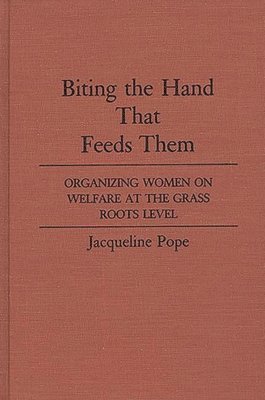
Biting the Hand that Feeds Them
Organizing Women on Welfare at the Grass Roots Level
Inbunden, Engelska, 1989
809 kr
Skickas inom 10-15 vardagar
This book examines the successful organizing and mobilization activities of urban poor women for social change and how they struggled to convince the larger society of the legitimacy of their cause. Challenging traditional views of poverty, women on welfare began demanding structural changes in the institution of social welfare in this country, but lacking the support of others their efforts were unsuccessful. To explore this issue an analysis is made of the Brooklyn Welfare Action Council (B-WAC), a grassroots cooperative established in 1967 and disbanded in 1973. Its purpose was to obtain social and economic benefits for its members through the promotion of changes within the system. The Brooklyn Council distinguished itself by being the sole welfare rights group controlled by and addressing the needs of the recipients. Demonstrations at welfare centers, disruptions at a major store as well as selling their blood are among the activities presented in sensitive, poignant, even humorous style. Taking large bites of the bureaucracy that fed them, for a time, recipients held hostage one of the most powerful agencies in the nation.The author employs an historical approach to chronicle the welfare recipients' activities, analyze their strategies and examine B-WAC's weaknesses and strengths. Social scientists, activists, and social and program planners will find this a particularly timely book written from the perspective of an urban planner who was herself personally involved in the 1960's welfare rights movement and in this unique grassroots organization.

833 kr
Skickas inom 10-15 vardagar
Sheriffs, marshals, and bounty hunters are remembered as relics of our Wild West past. Pope looks at these agents of the law who operate outside police departments, particularly their roles in urban areas. She examines reasons for becoming a sheriff, marshal (usually appointed and not elected), or bounty hunter, as well as employment requirements, responsibilities, and relationships with local police and city officials. Pope argues ultimately that these law enforcers, to a much greater degree than the police, threaten low-income people. Urban sheriffs do not make arrests, but rather serve summonses, track down scofflaws, and confiscate property. Marshals carry out evictions. Bounty hunters are usually armed and work often in urban areas, hunting down wanted persons for a variety of crimes. Although they are not policemen, they are authorized to capture people and can do so without the restrictions imposed on traditional law enforcement officers.Pope focuses her attention on sheriffs, marshals, and bounty hunters in Arizona, New Jersey, New Mexico and New York. She examines their activities in the nineteenth century and today, providing interviews with sheriffs, marshals, bounty hunters, policemen, and with people who have been pursued by them. A work of interest to students, researchers, and citizens concerned with the workings of the U.S. criminal justice system.