Jacques Brodeur - Böcker
Visar alla böcker från författaren Jacques Brodeur. Handla med fri frakt och snabb leverans.
4 produkter
4 produkter
2 408 kr
Skickas inom 7-10 vardagar
Parasites that manipulate the behaviour of their hosts represent striking examples of adaptation by natural selection. This field of study is now moving beyond its descriptive phase and into more exciting areas where the processes and patterns of such dramatic adaptations can be better understood. This innovative text provides an up-to-date, authoritative, and challenging review of host manipulation by parasites that assesses the current state of developments in the field and lays out a framework for future research. It also promotes a greater integration of behavioral ecology with studies of host manipulation (behavioral ecology has tended to concentrate mainly on behaviour expressed by free living organisms and is far less focused on the role of parasites in shaping behaviour). To help achieve this, the editors adopt a novel approach of having a prominent expert on behavioral ecology (but who does not work directly on parasites) to provide an afterword to each chapter.
1 027 kr
Skickas inom 7-10 vardagar
Parasites that manipulate the behaviour of their hosts represent striking examples of adaptation by natural selection. This field of study is now moving beyond its descriptive phase and into more exciting areas where the processes and patterns of such dramatic adaptations can be better understood. This innovative text provides an up-to-date, authoritative, and challenging review of host manipulation by parasites that assesses the current state of developments in the field and lays out a framework for future research. It also promotes a greater integration of behavioral ecology with studies of host manipulation (behavioral ecology has tended to concentrate mainly on behaviour expressed by free living organisms and is far less focused on the role of parasites in shaping behaviour). To help achieve this, the editors adopt a novel approach of having a prominent expert on behavioral ecology (but who does not work directly on parasites) to provide an afterword to each chapter.
1 593 kr
Skickas inom 10-15 vardagar
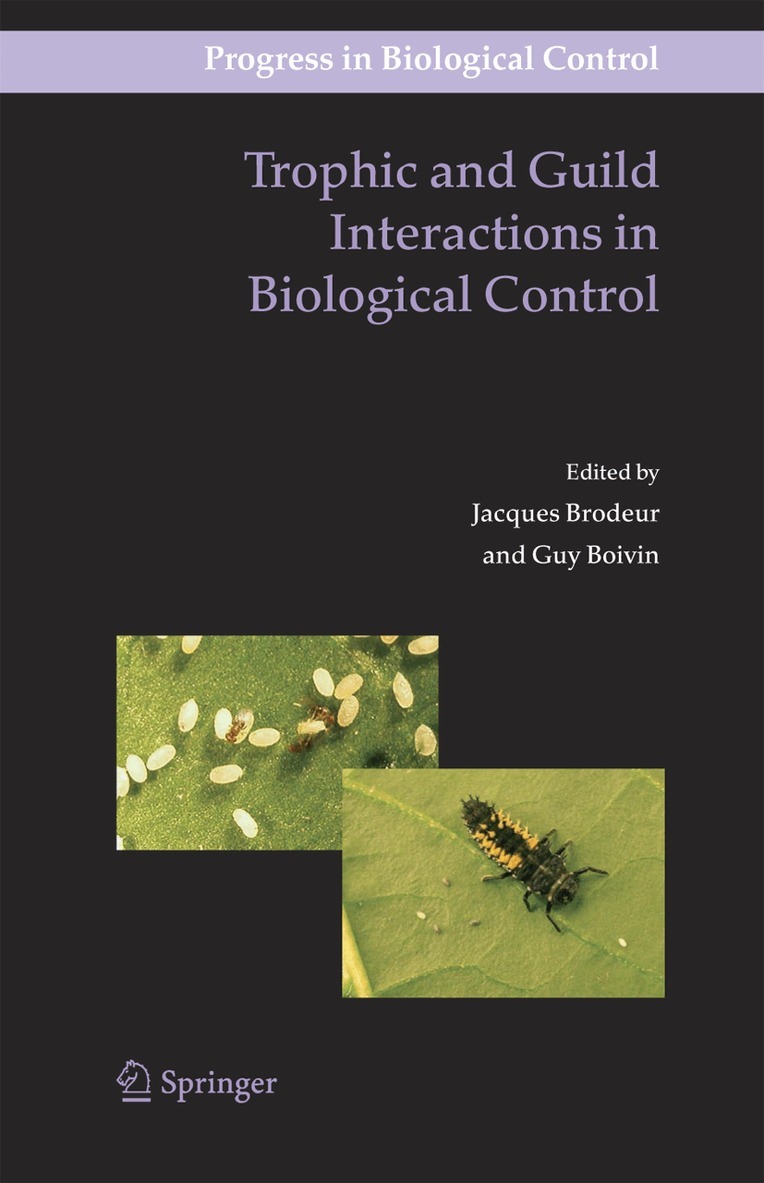
This book origins from a symposium we organized in May 2005 at a joint meeting of the Biocontrol Network of Canada and the International Organization for Biological Control in Magog, Québec, Canada. During this symposium, we discussed concepts of direct and indirect interactions among natural enemies of herbivores in natural and agricultural ecosystems — a field of growing interest in ecology and biological control. Natural enemies of herbivores exist in nature as an assemblage of species that interact with one another and may transcend trophic levels. The community embracing a natural enemy can be complex and includes taxonomically dissimilar species of pathogens, parasitoids, and predators. These interactions involve predation and competition processes and share the typical characteristics of resource-consumer relationships where the resource species is killed and consumed by the other. Although they are mostly viewed as primary carnivores (developing on herbivores), natural enemies can also be secondary carnivores (when they attack other natural enemies), hosts, prey, or even herbivores, as several species may also feed on and acquire energy from plant resources.
1 593 kr
Skickas inom 10-15 vardagar
This book origins from a symposium we organized in May 2005 at a joint meeting of the Biocontrol Network of Canada and the International Organization for Biological Control in Magog, Québec, Canada. During this symposium, we discussed concepts of direct and indirect interactions among natural enemies of herbivores in natural and agricultural ecosystems — a field of growing interest in ecology and biological control. Natural enemies of herbivores exist in nature as an assemblage of species that interact with one another and may transcend trophic levels. The community embracing a natural enemy can be complex and includes taxonomically dissimilar species of pathogens, parasitoids, and predators. These interactions involve predation and competition processes and share the typical characteristics of resource-consumer relationships where the resource species is killed and consumed by the other. Although they are mostly viewed as primary carnivores (developing on herbivores), natural enemies can also be secondary carnivores (when they attack other natural enemies), hosts, prey, or even herbivores, as several species may also feed on and acquire energy from plant resources.