Jacques Taminiaux - Böcker
Visar alla böcker från författaren Jacques Taminiaux. Handla med fri frakt och snabb leverans.
6 produkter
6 produkter
1 057 kr
Tillfälligt slut
"It is by all means a dubious thing to depend and rest on what an author himself has brought to the forefront. The important thing is rather to give attention to those things he left shrouded in silence."Such was the methodological advice, given in 1924 by Heidegger himself, that is rigorously followed in this book, Heidegger and the Project of Fundamental Ontology. The project involves the vast complex of problems that emerged around Being and Time (1927) and then continued from the time of the Marburg lecture courses (1923-1928) up to the Freiburg lectures (1928-1935), today available in the Gesamtausgabe. Heidegger's silence concerning some of his foundational sources is a fact fully recognized by those who have carefully read him. This book systematically explores and critically assesses the silences concerning Husserl, the Aristotle of Book VI of the Nicomachean Ethics, the Hegel of Phenomenology, Nietzsche, and even Descartes. What emerges is a systematic and original reinterpretation of 'fundamental ontology' focused on the self-understanding of the human Dasein as the key for understanding the various meanings of Being and the entire deconstructed history of ontology. The project culminated in the pretensions to absoluteness rampant in modern metaphysics, with its peak and paroxysm to be found in The Introduction to Metaphysics (1935).In regard to the 'Heidegger affair', this book, which was begun well before the present turmoil, shows both the ambiguity and coherence of Heidegger's involvement with the Nazis, and, for the first time, exposes the work of the young Heidegger to a rigorous and wholesome internal criticism. By delineating the origins, the shifts, and the final outcome from within his own field, phenomenology, it allows us to reflect on this difficult question at its depth and origin.
353 kr
Skickas inom 7-10 vardagar
"It is by all means a dubious thing to depend and rest on what an author himself has brought to the forefront. The important thing is rather to give attention to those things he left shrouded in silence."Such was the methodological advice, given in 1924 by Heidegger himself, that is rigorously followed in this book, Heidegger and the Project of Fundamental Ontology. The project involves the vast complex of problems that emerged around Being and Time (1927) and then continued from the time of the Marburg lecture courses (1923-1928) up to the Freiburg lectures (1928-1935), today available in the Gesamtausgabe. Heidegger's silence concerning some of his foundational sources is a fact fully recognized by those who have carefully read him. This book systematically explores and critically assesses the silences concerning Husserl, the Aristotle of Book VI of the Nicomachean Ethics, the Hegel of Phenomenology, Nietzsche, and even Descartes. What emerges is a systematic and original reinterpretation of 'fundamental ontology' focused on the self-understanding of the human Dasein as the key for understanding the various meanings of Being and the entire deconstructed history of ontology. The project culminated in the pretensions to absoluteness rampant in modern metaphysics, with its peak and paroxysm to be found in The Introduction to Metaphysics (1935).In regard to the 'Heidegger affair', this book, which was begun well before the present turmoil, shows both the ambiguity and coherence of Heidegger's involvement with the Nazis, and, for the first time, exposes the work of the young Heidegger to a rigorous and wholesome internal criticism. By delineating the origins, the shifts, and the final outcome from within his own field, phenomenology, it allows us to reflect on this difficult question at its depth and origin.
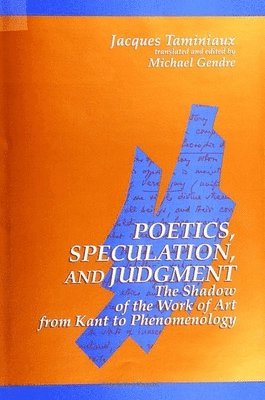
Poetics, Speculation, and Judgment
The Shadow of the Work of Art from Kant to Phenomenology
Inbunden, Engelska, 1993
1 057 kr
Tillfälligt slut
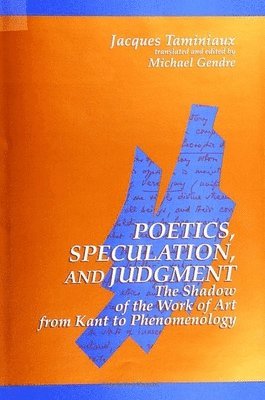
Traces the development of aesthetic judgment from Kant through German Idealism to modern continental philosophy, offering detailed readings of major thinkers to show how debates about art, truth, and metaphysics continue to shape philosophical thought today.In this sweeping and intellectually rigorous study, Jacques Taminiaux establishes his stature as one of the foremost historians and philosophers of post-Kantian continental thought. Tracing the fate of aesthetic judgment from its pivotal emergence in Kant's philosophy, Taminiaux follows its reverberations through German Idealism and into the most influential currents of modern and contemporary thought.At the center of Poetics, Speculation, and Judgment lies a sustained investigation into how questions of judgment, speculation, and aesthetic experience reshape the trajectory of philosophy after Kant. Through meticulous and incisive readings, Taminiaux engages a remarkable constellation of thinkers—including Friedrich Schiller, Friedrich Hölderlin, Friedrich Wilhelm Joseph Schelling, Georg Wilhelm Friedrich Hegel, Arthur Schopenhauer, Friedrich Nietzsche, Martin Heidegger, and Maurice Merleau-Ponty—revealing how each reconfigures the tension between art, truth, and metaphysics.From the "end of metaphysics" to the "death of art," from the nostalgia for ancient Greece to the transformation of aesthetic experience in modern philosophy, Taminiaux illuminates the enduring philosophical stakes of aesthetic judgment. His analyses are as historically grounded as they are conceptually daring, offering new clarity on some of the most contested problems in continental philosophy.More than a commentary on German Idealism and its aftermath, Poetics, Speculation, and Judgment also charts the intellectual itinerary of Taminiaux’s own thought across three decades—showing a thinker continually testing, refining, and renewing his insights in response to the tradition he interrogates.
Poetics, Speculation, and Judgment
The Shadow of the Work of Art from Kant to Phenomenology
Häftad, Engelska, 1993
552 kr
Skickas inom 3-6 vardagar
382 kr
Tillfälligt slut
Argues that Hannah Arendt's two major philosophical works, The Human Condition and The Life of the Mind, reveal not a dependency upon Heidegger, but rather a constant and increasing ironic debate with him.Appearing for the first time in English, this book by Jacques Taminiaux is a systematic investigation into Hannah Arendt's intellectual relationship to Heidegger, the implications of which are indispensable to understanding the philosophical choices of our times.Beginning his investigation with Heidegger's 1924-25 lecture course on Plato's Sophist, wherein Heidegger originally formulated his fundamental ontology, Taminiaux focuses on the student Hannah Arendt's first encountering "a set of problems of immediate importance and urgency." The author shows that Arendt's The Human Condition may be read both in its structure and in its themes-action, the world, the principle of individuation, the public realm-as a veritable retort and reply to Heidegger. Arendt is likened to the Maid from Thrace, a reference to Plato's Theaetetus wherein the Maid laughs at the philosopher who, while walking with his gaze to the stars above, falls into a well. But Arendt's critique of Heidegger cuts much deeper than this. While the political import of Arendt's work has long been recognized, Taminiaux's book systematically develops the philosophical framework which helps give shape to those political views. Thus one of the functions of The Life of the Mind, Taminiaux argues, is to reject the rigid division between the speculative thinker and the "common man", or the vita contemplativa and the vita activa.Contrary to other recent studies on these two figures, Taminiaux claims "that Arendt's two major works...reveal at every page not at all a dependency upon Heidegger...but rather a constant, and increasingly ironic, debate with him." In the process, Heidegger's philosophical work is interpreted in terms of its own political significance.
229 kr
Skickas inom 11-20 vardagar