Jaime S. Sichman – författare
Visar alla böcker från författaren Jaime S. Sichman. Handla med fri frakt och snabb leverans.
9 produkter
9 produkter
Häftad, Engelska, 2003
566 kr
Skickas inom 10-15 vardagar
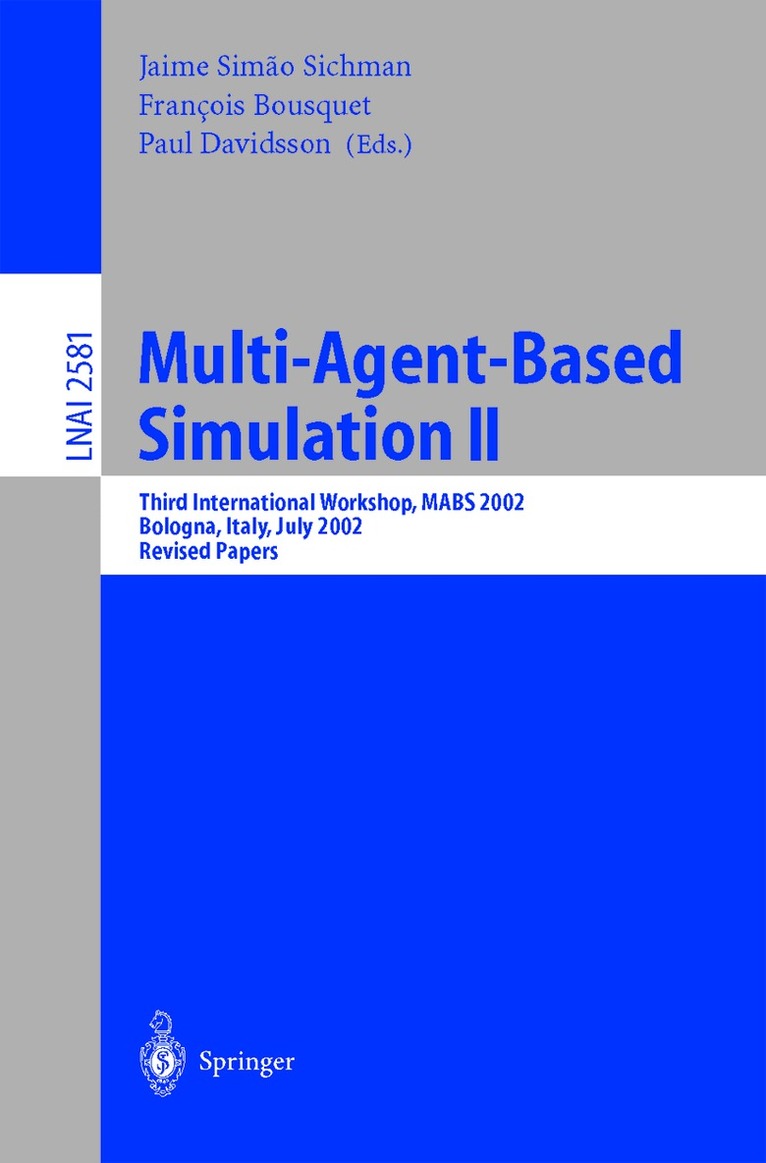
This volume presents extended and revised versions of the papers presented at the Third International Workshop on Multi-Agent Based Simulation (MABS 2002), a workshop federated with the First International Joint Conference on Autonomous Agents and Multi-Agent Systems (AAMAS 2002), which was held in Bologna, Italy, in July, 2002. This workshop was the third in the MABS series. The earlier two were - ganized as workshops of the two most recent ICMAS conferences (ICMAS 1998, Paris, France and ICMAS 2000, Boston, USA). Revised versions of the papers presented at these workshops were published as volumes 1534 and 1979 in the Lecture Notes in Arti?cial Intelligence series. One aim of the workshop was to develop stronger links between those wo- ing in the social sciences and those involved with multi-agent systems. We are pleased to note that many important conferences in various disciplines such as geography, economics, ecology, sociology, and physics have hosted workshops on MABS-related topics and that many respected journals publish papers that - clude elements of MABS. But although MABS is gradually acquiring legitimacy in many disciplinary ?elds, much remains to be done to clarify the potential use of MABS in these disciplines. Researchers from these disciplines have di?erent points of view on issues such as time-frame, space, geographical scales, or- nizational levels, etc. Moreover, the interest in MABS goes beyond the scienti?c community, as MABS models have been developed and used interactively with other communities as well.
Häftad, Engelska, 2006
566 kr
Skickas inom 10-15 vardagar
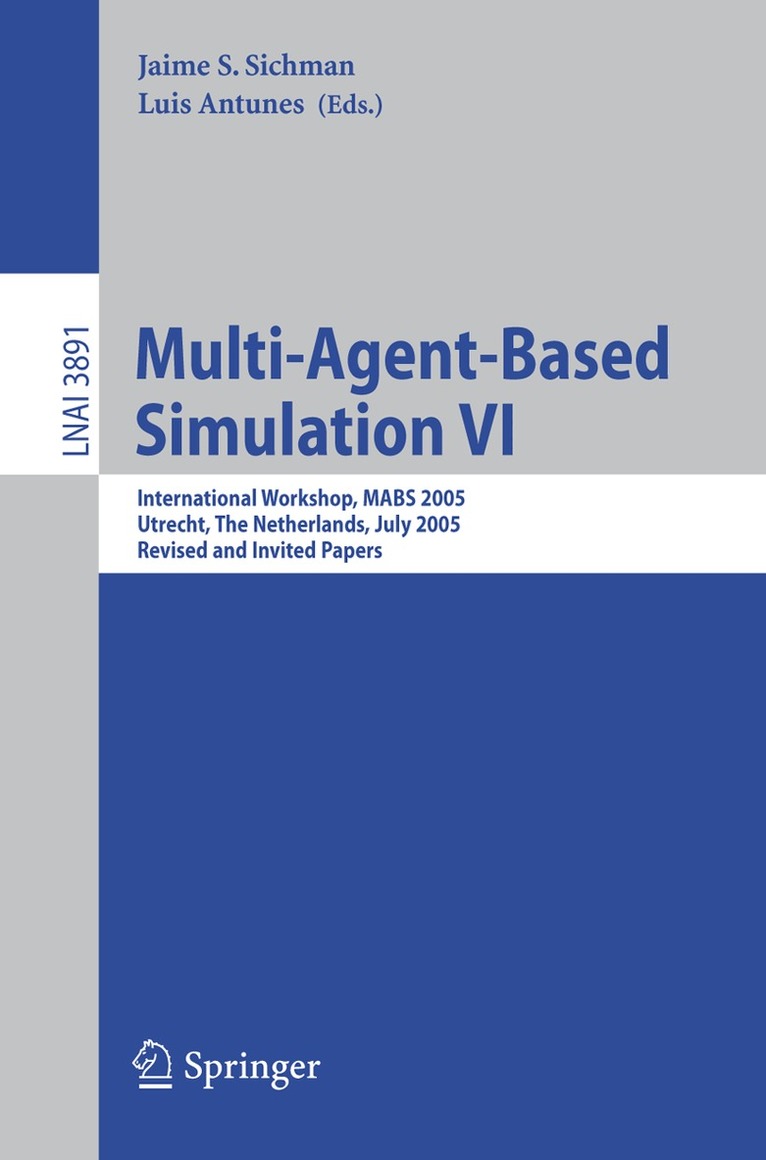
This book constitutes the thoroughly refereed post-proceedings of the 6th International Workshop on Multi-Agent-Based Simulation, MABS 2005, held in Utrecht, The Netherlands in July 2005 as an associated event of AAMAS 2005, the main international conference on autonomous agents and multi-agent systems. The 12 revised full papers presented together with 1 invited talk were carefully reviewed. The papers are organized in topical sections on coalition emergence, theories and models, applications, and environments.
E-bok
PDF, Engelska, 2006687 kr
Läs direkt efter köp
E-bok
PDF, Engelska, 2003687 kr
Läs direkt efter köp
This volume presents extended and revised versions of the papers presented at the Third International Workshop on Multi-Agent Based Simulation (MABS 2002), a workshop federated with the First International Joint Conference on Autonomous Agents and Multi-Agent Systems (AAMAS 2002), which was held in Bologna, Italy, in July, 2002. This workshop was the third in the MABS series. The earlier two were - ganized as workshops of the two most recent ICMAS conferences (ICMAS 1998, Paris, France and ICMAS 2000, Boston, USA). Revised versions of the papers presented at these workshops were published as volumes 1534 and 1979 in the Lecture Notes in Arti?cial Intelligence series. One aim of the workshop was to develop stronger links between those wo- ing in the social sciences and those involved with multi-agent systems. We are pleased to note that many important conferences in various disciplines such as geography, economics, ecology, sociology, and physics have hosted workshops on MABS-related topics and that many respected journals publish papers that - clude elements of MABS. But although MABS is gradually acquiring legitimacy in many disciplinary ?elds, much remains to be done to clarify the potential use of MABS in these disciplines. Researchers from these disciplines have di?erent points of view on issues such as time-frame, space, geographical scales, or- nizational levels, etc. Moreover, the interest in MABS goes beyond the scienti?c community, as MABS models have been developed and used interactively with other communities as well.
565 kr
Skickas inom 10-15 vardagar
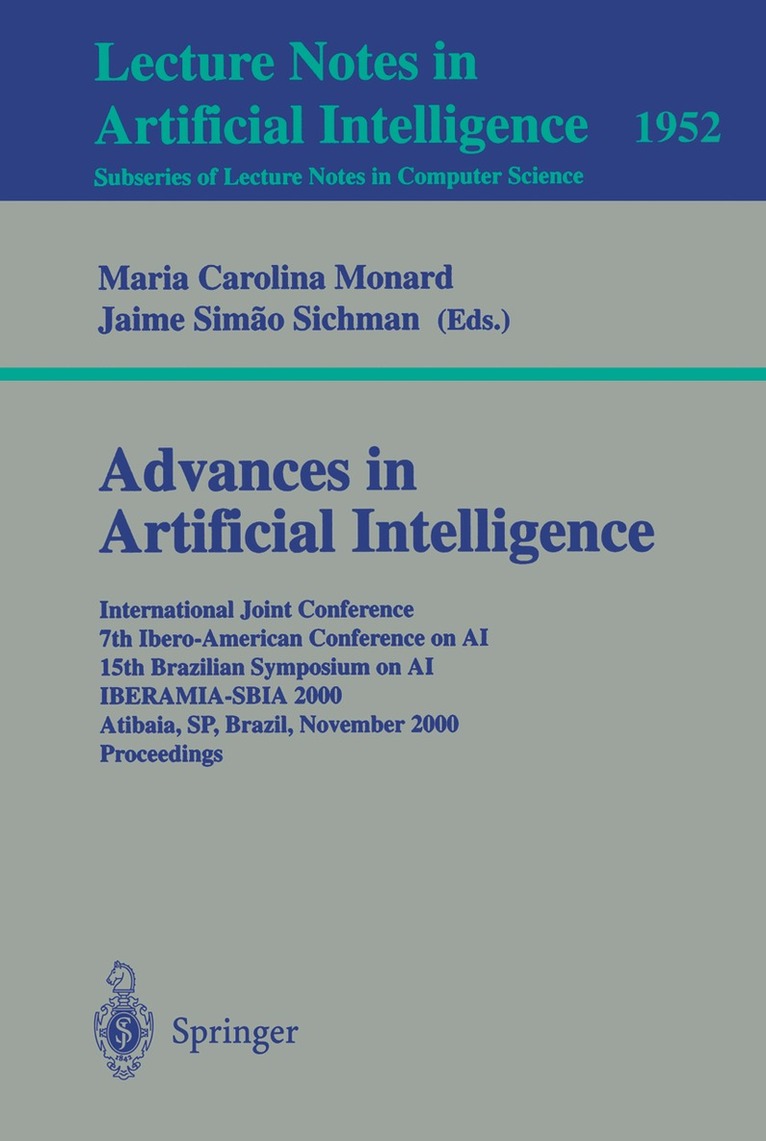
This year, Brazil celebrates its 500 years of discovery. To mark this great event, the Brazilian Arti cial Intelligence (AI) community organized a special int- national joint conference putting together SBIA 2000 (the Brazilian AI Sym- sium) and IBERAMIA 2000 (the Ibero-American AI Conference). SBIA 2000 is the 15th conference of the SBIA conference series, which is the leading conference in Brazil for presentation of research and applications in Arti cial Intelligence. Since 1995, SBIA has become an international conference, with papers written in English, an international program committee, and p- ceedings published in Springer-Verlag’s Lecture Notes in Arti cial Intelligence (LNAI) series. IBERAMIA 2000 is the 7th conference of the IBERAMIA conference series, which has been one of the most suitable forums for ibero-american AI rese- chers (from South and Central America, Mexico, Spain, and Portugal) to present their results. Following the SBIA and EPIA (Portuguese conference on AI) ex- riences, from IBERAMIA’98 on, it has also become an international conference, with proceedings published in Springer-Verlag’s LNAI series.
E-bok
PDF, Engelska, 2003734 kr
Läs direkt efter köp
This year, Brazil celebrates its 500 years of discovery. To mark this great event, the Brazilian Arti cial Intelligence (AI) community organized a special int- national joint conference putting together SBIA 2000 (the Brazilian AI Sym- sium) and IBERAMIA 2000 (the Ibero-American AI Conference). SBIA 2000 is the 15th conference of the SBIA conference series, which is the leading conference in Brazil for presentation of research and applications in Arti cial Intelligence. Since 1995, SBIA has become an international conference, with papers written in English, an international program committee, and p- ceedings published in Springer-Verlag’s Lecture Notes in Arti cial Intelligence (LNAI) series. IBERAMIA 2000 is the 7th conference of the IBERAMIA conference series, which has been one of the most suitable forums for ibero-american AI rese- chers (from South and Central America, Mexico, Spain, and Portugal) to present their results. Following the SBIA and EPIA (Portuguese conference on AI) ex- riences, from IBERAMIA’98 on, it has also become an international conference, with proceedings published in Springer-Verlag’s LNAI series.
E-bok
PDF, Engelska, 2005734 kr
Läs direkt efter köp
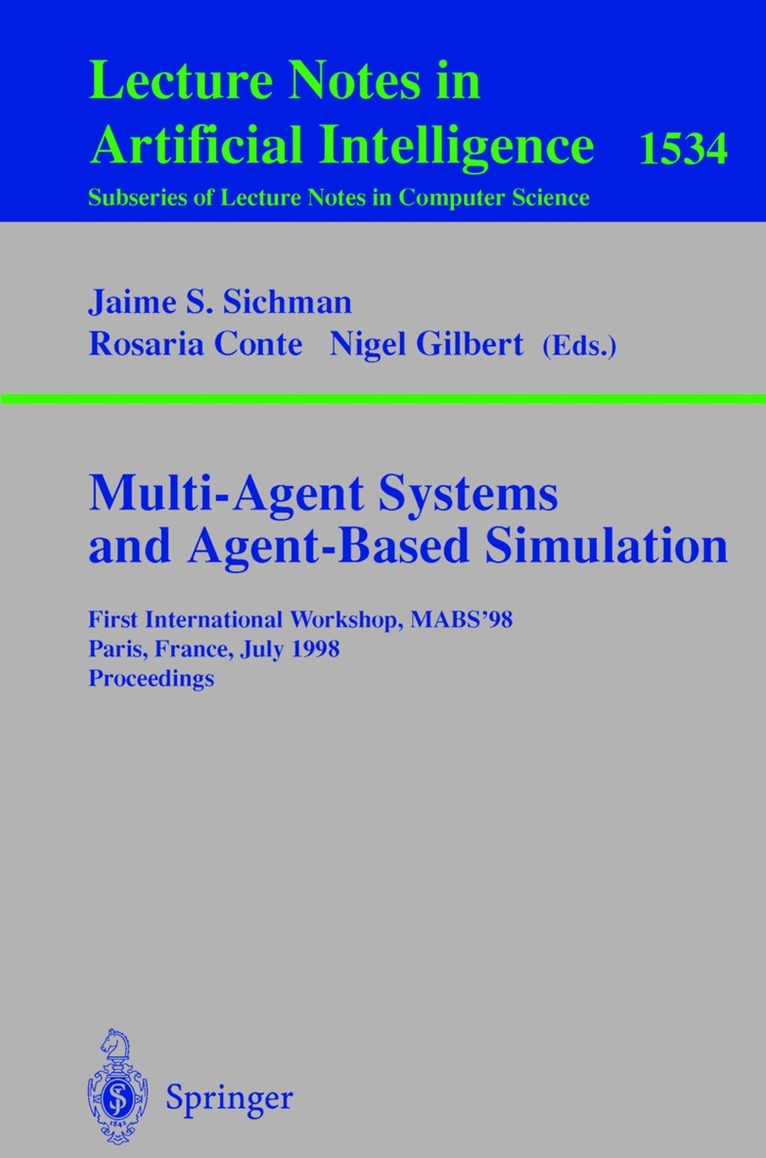
Fifteen papers were presented at the first workshop on Multi-Agent Systems and Agent-Based Simulation held as part of the Agents World conference in Paris, July 4-- 6, 1998. The workshop was designed to bring together two developing communities: the multi-agent systems researchers who were the core participants at Agents World, and social scientists interested in using MAS as a research tool. Most of the social sciences were represented, with contributions touching on sociology, management science, economics, psychology, environmental science, ecology, and linguistics. The workshop was organised in association with SimSoc, an informal group of social scientists who have arranged an irregular series of influential workshops on using simulation in the social sciences beginning in 1992. While the papers were quite heterogeneous in substantive domain and in their disciplinary origins, there were several themes which recurred during the workshop. One of these was considered in more depth in a round table discussion led by Jim Doran at the end of the workshop on ''Representing cognition for social simulation'', which addressed the issue of whether and how cognition should be modelled. Quite divergent views were expressed, with some participants denying that individual cognition needed to be modelled at all, and others arguing that cognition must be at the centre of social simulation.
Häftad, Engelska, 1998
565 kr
Skickas inom 10-15 vardagar
Fifteen papers were presented at the first workshop on Multi-Agent Systems and Agent-Based Simulation held as part of the Agents World conference in Paris, July 4-- 6, 1998. The workshop was designed to bring together two developing communities: the multi-agent systems researchers who were the core participants at Agents World, and social scientists interested in using MAS as a research tool. Most of the social sciences were represented, with contributions touching on sociology, management science, economics, psychology, environmental science, ecology, and linguistics. The workshop was organised in association with SimSoc, an informal group of social scientists who have arranged an irregular series of influential workshops on using simulation in the social sciences beginning in 1992. While the papers were quite heterogeneous in substantive domain and in their disciplinary origins, there were several themes which recurred during the workshop. One of these was considered in more depth in a round table discussion led by Jim Doran at the end of the workshop on 'Representing cognition for social simulation', which addressed the issue of whether and how cognition should be modelled. Quite divergent views were expressed, with some participants denying that individual cognition needed to be modelled at all, and others arguing that cognition must be at the centre of social simulation.
667 kr
Skickas inom 5-8 vardagar