Rosaria Conte – författare
Visar alla böcker från författaren Rosaria Conte. Handla med fri frakt och snabb leverans.
13 produkter
13 produkter
Inbunden, Engelska, 2013
824 kr
Skickas inom 5-8 vardagar
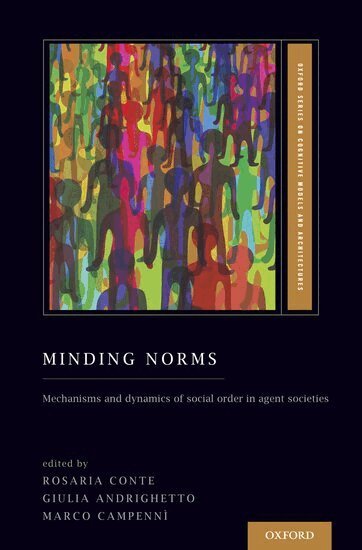
Norms are prescribed conducts applied by the majority of people. Getting across cultures and centuries, norms evolved to rule all human relationships, from the most formal to the most intimate. Impinging on any sphere of life, from religious to political, norms affect social, moral, and even aesthetical behaviours. They are enforced through centralized sanctions or distributed control, and originate through deliberate acts of issuing or from spontaneous interaction in informal settings. Despite ubiquity and universality, norms are still awaiting for a general comprehensive theory, simultaneously doing justice to three intuitions: that, under variable contents, norms correspond to a common notion; that, once brought about, norms feedback on their producers, affecting their conducts; and finally that before and in order to drive the behaviours of individuals, norms must affect their beliefs and goals: people must detect and accept norms before converting them into observable behaviours.This volume presents an unprecedented attempt to account for all the three intuitions at once, providing a systematic view of norms. Based on a unitary and operational notion of norms, as behaviours spreading thanks to and to the extent that the corresponding prescriptions spread as well, a cognitive architecture, EMIL-A, which is the main output of a research project on norm emergence, is described. EMIL-A is a BDI-like platform for simulation, endowed with modules for detecting, reasoning and deciding upon norms. Next, the EMIL-A platform is applied to generate norms in different simulated scenarios (from a multi-setting world to a virtual Wikipedia), through a complex bidirectional dynamics, i.e., the bottom-up emergence of norms thanks to a gradual, top-down process, denoted as immergence. As simulations results show, norms emerge while immerging in agents' minds, thanks to their detecting, reasoning, and deciding whether to respect them or not.
Del 2 - Multiagent Systems, Artificial Societies, and Simulated Organizations
Social Order in Multiagent Systems
Inbunden, Engelska, 2001
2 452 kr
Skickas inom 10-15 vardagar
Social Order in Multiagent Systems provides an overview of current approaches, problems, and considerations related to the study of norms and institutions in the context of multiagent systems. The contributions in this volume share the assumption that norms and other social institutions are of vital importance for the development of multiagent systems and agent-mediated interaction. Both formal and computational models of norms and normative systems are presented, including formal analysis of normative concepts and foundational models of norms; agent and systems architectures for implementing norms; and implemented systems. Social Order in Multiagent Systems is an excellent reference for researchers in artificial intelligence and computer science, and can be used as text for advanced level courses in multiagent systems.
Häftad, Engelska, 2016
695 kr
Skickas inom 10-15 vardagar
An exploration of the implications of developments in artificial intelligence for social scientific research, which builds on the theoretical and methodological insights provided by "Simulating societies".; This book is intended for worldwide library market for social science subjects such as sociology, political science, geography, archaeology/anthropology, and significant appeal within computer science, particularly artificial intelligence. Also personal reference for researchers.
Del 6 - Multiagent Systems, Artificial Societies, and Simulated Organizations
Reputation in Artificial Societies
Social Beliefs for Social Order
Inbunden, Engelska, 2002
1 626 kr
Skickas inom 10-15 vardagar
This text discusses the role of reputation in the achievement of social order. It proposes that reputation is an agent property that results from transmission of beliefs about how the agents are evaluated with regard to a socially desirable conduct. This desirable conduct represents one or another of the solutions to the problem of social order and may consist of co-operation or altruism, reciprocity, or norm obedience. The text distinguishes between image (direct evaluation of others) and reputation (propagating meta-belief, indirectly acquired) and investigates their effects with regard to both natural and electronic societies. The interplay between image and reputation, the processes leading to them and the set of decisions that agents make on their basis are demonstrated with supporting data from agent-based simulations.
Häftad, Engelska, 2012
1 674 kr
Skickas inom 10-15 vardagar
Reputation In Artificial Societies discusses the role of reputation in the achievement of social order. The book proposes that reputation is an agent property that results from transmission of beliefs about how the agents are evaluated with regard to a socially desirable conduct. This desirable conduct represents one or another of the solutions to the problem of social order and may consist of cooperation or altruism, reciprocity, or norm obedience. Reputation In Artificial Societies distinguishes between image (direct evaluation of others) and reputation (propagating metabelief, indirectly acquired) and investigates their effects with regard to both natural and electronic societies. The interplay between image and reputation, the processes leading to them and the set of decisions that agents make on their basis are demonstrated with supporting data from agentbased simulations.
Del 2 - Multiagent Systems, Artificial Societies, and Simulated Organizations
Social Order in Multiagent Systems
Häftad, Engelska, 2012
2 452 kr
Skickas inom 10-15 vardagar
Social Order in Multiagent Systems provides an overview of current approaches, problems, and considerations related to the study of norms and institutions in the context of multiagent systems. The contributions in this volume share the assumption that norms and other social institutions are of vital importance for the development of multiagent systems and agent-mediated interaction. Both formal and computational models of norms and normative systems are presented, including formal analysis of normative concepts and foundational models of norms; agent and systems architectures for implementing norms; and implemented systems. Social Order in Multiagent Systems is an excellent reference for researchers in artificial intelligence and computer science, and can be used as text for advanced level courses in multiagent systems.
E-bok
PDF, Engelska, 20122 110 kr
Läs direkt efter köp
Reputation In Artificial Societies discusses the role of reputation in the achievement of social order. The book proposes that reputation is an agent property that results from transmission of beliefs about how the agents are evaluated with regard to a socially desirable conduct. This desirable conduct represents one or another of the solutions to the problem of social order and may consist of cooperation or altruism, reciprocity, or norm obedience. Reputation In Artificial Societies distinguishes between image (direct evaluation of others) and reputation (propagating metabelief, indirectly acquired) and investigates their effects with regard to both natural and electronic societies. The interplay between image and reputation, the processes leading to them and the set of decisions that agents make on their basis are demonstrated with supporting data from agentbased simulations.
E-bok
PDF, Engelska, 20123 145 kr
Läs direkt efter köp
Social Order in Multiagent Systems provides an overview of current approaches, problems, and considerations related to the study of norms and institutions in the context of multiagent systems. The contributions in this volume share the assumption that norms and other social institutions are of vital importance for the development of multiagent systems and agent-mediated interaction. Both formal and computational models of norms and normative systems are presented, including formal analysis of normative concepts and foundational models of norms; agent and systems architectures for implementing norms; and implemented systems. Social Order in Multiagent Systems is an excellent reference for researchers in artificial intelligence and computer science, and can be used as text for advanced level courses in multiagent systems.
Inbunden, Engelska, 1995
2 687 kr
Skickas inom 10-15 vardagar
An exploration of the implications of developments in artificial intelligence for social scientific research, which builds on the theoretical and methodological insights provided by "Simulating societies".; This book is intended for worldwide library market for social science subjects such as sociology, political science, geography, archaeology/anthropology, and significant appeal within computer science, particularly artificial intelligence. Also personal reference for researchers.
E-bok
PDF, Engelska, 2005734 kr
Läs direkt efter köp
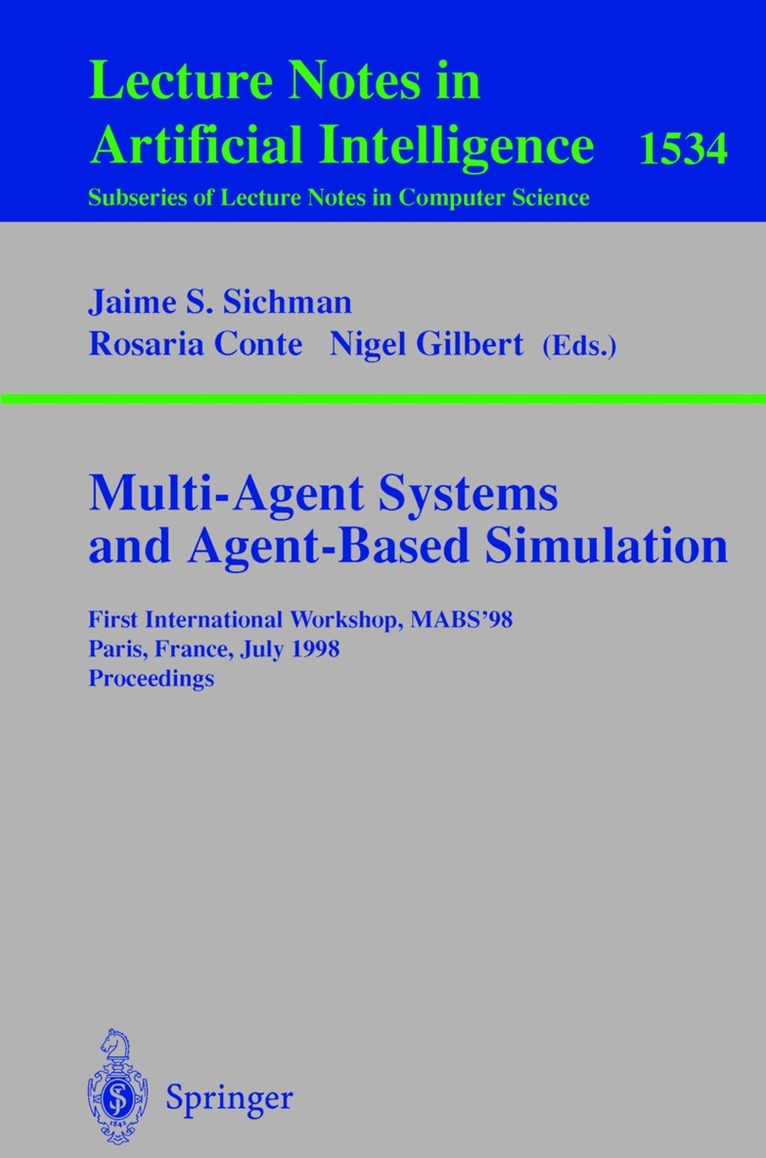
Fifteen papers were presented at the first workshop on Multi-Agent Systems and Agent-Based Simulation held as part of the Agents World conference in Paris, July 4-- 6, 1998. The workshop was designed to bring together two developing communities: the multi-agent systems researchers who were the core participants at Agents World, and social scientists interested in using MAS as a research tool. Most of the social sciences were represented, with contributions touching on sociology, management science, economics, psychology, environmental science, ecology, and linguistics. The workshop was organised in association with SimSoc, an informal group of social scientists who have arranged an irregular series of influential workshops on using simulation in the social sciences beginning in 1992. While the papers were quite heterogeneous in substantive domain and in their disciplinary origins, there were several themes which recurred during the workshop. One of these was considered in more depth in a round table discussion led by Jim Doran at the end of the workshop on ''Representing cognition for social simulation'', which addressed the issue of whether and how cognition should be modelled. Quite divergent views were expressed, with some participants denying that individual cognition needed to be modelled at all, and others arguing that cognition must be at the centre of social simulation.
Del 456 - Lecture Notes in Economics and Mathematical Systems
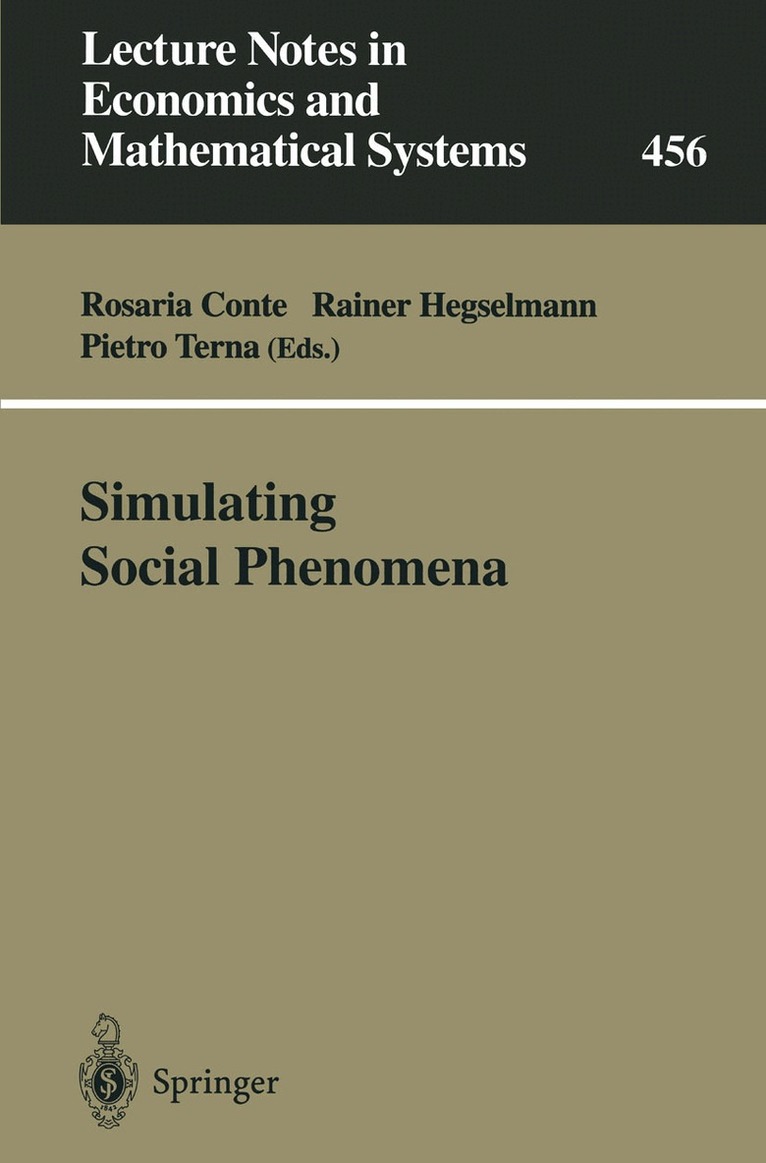
Simulating Social Phenomena
Häftad, Engelska, 1997
1 092 kr
Skickas inom 10-15 vardagar
In this book experts from quite different fields present simulations of social phenomena: economists, sociologists, political scientists, psychologists, cognitive scientists, organisational scientists, decision scientists, geographers, computer scientists, AI and AL scientists, mathematicians and statisticians. They simulate markets, organisations, economic dynamics, coalition formation, the emergence of cooperation and exchange, bargaining, decision making, learning, and adaptation. The history, problems, and perspectives of simulating social phenomena are explicitly discussed.
Häftad, Engelska, 1998
565 kr
Skickas inom 10-15 vardagar
Fifteen papers were presented at the first workshop on Multi-Agent Systems and Agent-Based Simulation held as part of the Agents World conference in Paris, July 4-- 6, 1998. The workshop was designed to bring together two developing communities: the multi-agent systems researchers who were the core participants at Agents World, and social scientists interested in using MAS as a research tool. Most of the social sciences were represented, with contributions touching on sociology, management science, economics, psychology, environmental science, ecology, and linguistics. The workshop was organised in association with SimSoc, an informal group of social scientists who have arranged an irregular series of influential workshops on using simulation in the social sciences beginning in 1992. While the papers were quite heterogeneous in substantive domain and in their disciplinary origins, there were several themes which recurred during the workshop. One of these was considered in more depth in a round table discussion led by Jim Doran at the end of the workshop on 'Representing cognition for social simulation', which addressed the issue of whether and how cognition should be modelled. Quite divergent views were expressed, with some participants denying that individual cognition needed to be modelled at all, and others arguing that cognition must be at the centre of social simulation.
E-bok
PDF, Engelska, 20131 408 kr
Läs direkt efter köp
In this book experts from quite different fields present simulations of social phenomena: economists, sociologists, political scientists, psychologists, cognitive scientists, organisational scientists, decision scientists, geographers, computer scientists, AI and AL scientists, mathematicians and statisticians. They simulate markets, organisations, economic dynamics, coalition formation, the emergence of cooperation and exchange, bargaining, decision making, learning, and adaptation. The history, problems, and perspectives of simulating social phenomena are explicitly discussed.