• Fri frakt över 249 kr
  • •
  • Snabba leveranser
  • •
  • Billiga böcker
Kundservice

Du är på sajten för privatpersoner.

Företag, bibliotek eller offentlig verksamhet?

Du handlar på classic.bokus.com, där alla dina funktioner finns intakta.
Till classic.bokus.com
Bokus logotyp. Gå till startsidan.
  • Erbjudanden
  • Nyheter
  • Student
  • Topplistor
  • Barn & ungdom
  • Bokus Play
  • E-böcker
  • Pocketböcker
  • Spel & pussel

10% rabatt på allt med kod NYSTART10 →

Sidfot

Mina sidor

    Hjälp

    • Kundservice
    • Vanliga frågor och svar
    • Frakt och leverans
    • Retur vid ångerrätt
    • Reklamera vara
    • Betalning
    • Köpvillkor
    • Allmänna villkor
    • Information om webbplatsens tillgänglighet

    Om Bokus

    • Om oss
    • Pressrum
    • För studenter
    • För företag
    • För bibliotek och offentlig verksamhet
    • För leverantörer
    • Hållbarhet

    Populärt

    • Aktuella erbjudanden
    • Presentkort
    • Studentlitteratur
    • Nya böcker
    • Topplistor
    • Signerade böcker
    • Engelska böcker

    Inspiration

    • Boktips
    • BookTok
    • Populära bokserier
    • Barnbokskaraktärer
    • Populära författare
    Logotyp för Bokus
    Följ oss på Facebook (extern länk)Följ oss på Instagram (extern länk)Följ oss på YouTube (extern länk)Följ oss på TikTok (extern länk)
    bokus @ CookiesAnpassa cookiesIntegritetspolicyKöpvillkor
    Till Citymail hemsida (extern länk)Till Budbee hemsida (extern länk)Till Postnord hemsida (extern länk)Till Schenker hemsida (extern länk)Till Early Bird hemsida (extern länk)Till Walleys hemsida (extern länk)
    1. Psykologi och pedagogik
    2. Psykologi
    3. Kognitiv psykologi

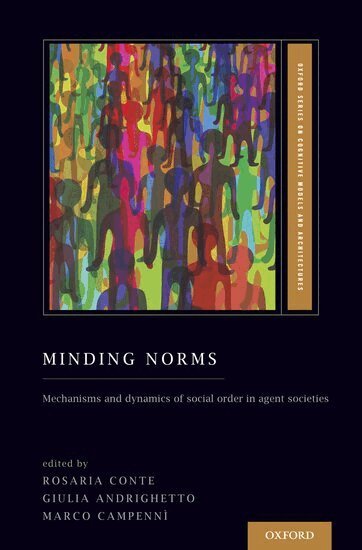
    Minding Norms

    Mechanisms and dynamics of social order in agent societies

    AvRosaria Conte,Giulia Andrighetto

    Inbunden, Engelska, 2013

    Del i serien Oxford Series on Cognitive Models and Architectures

    1 329 kr

    Beställningsvara. Skickas inom 5-8 vardagar. Fri frakt över 249 kr.

    Beskrivning

    Norms are prescribed conducts applied by the majority of people. Getting across cultures and centuries, norms evolved to rule all human relationships, from the most formal to the most intimate. Impinging on any sphere of life, from religious to political, norms affect social, moral, and even aesthetical behaviours. They are enforced through centralized sanctions or distributed control, and originate through deliberate acts of issuing or from spontaneous interaction in informal settings. Despite ubiquity and universality, norms are still awaiting for a general comprehensive theory, simultaneously doing justice to three intuitions: that, under variable contents, norms correspond to a common notion; that, once brought about, norms feedback on their producers, affecting their conducts; and finally that before and in order to drive the behaviours of individuals, norms must affect their beliefs and goals: people must detect and accept norms before converting them into observable behaviours.This volume presents an unprecedented attempt to account for all the three intuitions at once, providing a systematic view of norms. Based on a unitary and operational notion of norms, as behaviours spreading thanks to and to the extent that the corresponding prescriptions spread as well, a cognitive architecture, EMIL-A, which is the main output of a research project on norm emergence, is described. EMIL-A is a BDI-like platform for simulation, endowed with modules for detecting, reasoning and deciding upon norms. Next, the EMIL-A platform is applied to generate norms in different simulated scenarios (from a multi-setting world to a virtual Wikipedia), through a complex bidirectional dynamics, i.e., the bottom-up emergence of norms thanks to a gradual, top-down process, denoted as immergence. As simulations results show, norms emerge while immerging in agents' minds, thanks to their detecting, reasoning, and deciding whether to respect them or not.

    Produktinformation

    • Utgivningsdatum:2013-11-07
    • Mått:236 x 157 x 20 mm
    • Vikt:476 g
    • Format:Inbunden
    • Språk:Engelska
    • Serie:Oxford Series on Cognitive Models and Architectures
    • Antal sidor:208
    • Förlag:OUP USA
    • ISBN:9780199812677

    Utforska kategorier

    • Kognitiv psykologi inom Psykologi och pedagogik

    Mer om författaren

    Rosaria Conte is Director, LABSS (Laboratory of Agent Based Social Simulation) at the Institute of Cognitive Science and Technology of the National Research Council (NRC), Rome.Giulia Andrighetto is a researcher at the Institute of Cognitive Sciences and Technologies (ISTC-CNR) in Rome and at the European University Institute in Florence, Italy Marco Campennì is a postdoctoral researcher at Max Planck Institute for Evolutionary Anthropology in Leipzig, Germany

    Innehållsförteckning

    • Introduction ; 1.1 Why a new book on norms ; 1.2 Why a book on cognition ; 1.3 Our perspective and approach ; 1.4 Presentation of the volume and questions addressed ; 1.5 How to read the volume ; 1.6 Acknowledgements ; 1.7 References ; Loops in Social Dynamics ; Chapter 2 ; 2.1 Introduction ; 2.2 The Way Up: Emergence ; 2.3 The Way Back: Downward Causation ; 2.3.1 Simple loop ; 2.3.2 Complex loop (Incorporation) ; 2.3.2.1 Second Order Emergence ; 2.3.2.2 Immergence ; 2.4 Advantages of the Present Approach ; 2.5 Concluding Remarks ; 2.6 References ; Agent Based Social Simulation and its necessity for understanding socially embedded phenomena ; Chapter 3 ; 3.1 Cognitive Simulation Modelling ; 3.2 Agent Based Architectures and Frameworks ; 3.3 The Social Intelligence Hypothesis ; 3.4 Social Embeddedness ; 3.5 Micro-Macro Complexity ; 3.6 Types of Social Simulation ; 3.7 Linking Plausible Theory and Observed Evidence ; 3.8 Relevance vs. Generality in Simulation ; 3.9 Emergence and Immergence in Simulations ; 3.10 Conclusion ; References ; How are norms brought about? A state of the art ; Chapter 4 ; 4.1 Norms between conventions and legal norms ; 4.2 The game theoretical framework of simulating norms ; 4.3 The cognitive method of modelling norms ; 4.3.1 Analysis ; 4.4 Norms in current architectures ; 4.4.1 Normative modules ; 4.4.2 Norm conflicts ; 4.4.3 Concepts of norms ; 4.4.4 Drawbacks of cognitive architectures ; 4.5 Results and unresolved questions ; References ; 5.1 Introduction and motivation ; 5.2 Interaction structure and specialization ; 5.3 The structure: Local groups and a central market ; 5.4 Matching agents ; 5.5 Learning ; 5.7 The evolution of trust and division of labor - some first simulation studies ; References ; Norms' Dynamics as a Complex Loop ; Chapter 6 ; 6.1 Normative Prescriptions ; 6.2 The missing link in the formal treatment of obligations ; 6.3 The mental dynamics of norms ; 6.3.1 Norm recognition ; 6.3.2 Norm adoption ; 6.3.3 Norm compliance ; 6.4 Concluding Remarks ; References ; Hunting for norms in unpredictable societies ; Chapter 7 ; 7.1 Introduction ; 7.2 Related Work ; 7.3 The Norm Recognition Module ; 7.4 Norm Detectives Vs. Social Conformers ; 7.4.1 Results of comparison ; 7.5 Norm Detectives in a segregated world ; 7.5.1 Effects of segregation ; 7.6 Concluding remarks ; References ; The derivation of EMIL-S from EMIL-A: From cognitive architecture to software architecture ; Chapter 8 ; 8.1 General Requirements of a Multi-Agent Simulation System with Normative Agents ; 8.2 System Architecture ; 8.3 EMIL-S ; 8.4 Overview of the cognitive and normative architecture of EMIL-A ; 8.5 Correspondence between EMIL-S and EMIL-A ; 8.6 Differences between the cognitive and the implemented model ; 8.7 Additional assumptions about cognitive processes used in EMIL-S ; References ; Demonstrating the Theory: The case of Wikipedia ; Chapter 9 ; 9.1 Empirical background ; 9.2 The Case: Wikipedia ; 9.2.1 Social Self-Regulation in Wikipedia ; 9.2.2 Methodology ; 9.2.3 Results ; 9.2.4 Discussion, Conclusions and Ideas for Further Empirical Research ; 9.3 Designing the Wikipedia Simulation ; 9.4 Simulation runs and results ; 9.5 Conclusion: Comparison between the NetLogo prototype and the EMIL-S/Repast version ; References ; The Role of Norm Internalizers in Mixed Populations ; Chapter 10 ; 10.1 Introduction ; 10.2 Related Work ; 10.3 A multi-step and flexible model of norm internalization ; 10.4 Factors affecting internalization ; 10.5 Internalizer: the EMIL-I-A architecture ; 10.6 Simulating a social dilemma ; 10.6.1 Experimental Design ; 10.6.2 Experimental Results ; 10.7. Conclusions ; References ; Summary and Conclusions ; 11.1 Summary ; 11.2 Conclusions ; 11.2.1 What are norms ; 11.2.2 How norms emerge ; 10.2.3 How much mental complexity is needed ; 11.4 Balance and open questions ; 11.5 References