Pietro Terna – författare
Visar alla böcker från författaren Pietro Terna. Handla med fri frakt och snabb leverans.
10 produkter
10 produkter
Inbunden, Engelska, 2025
742 kr
Skickas inom 7-10 vardagar
The aim of this Element is to understand how far mathematical theories based on active particles methods have been applied to describe the dynamics of complex systems in economics, and to look forward to further research perspectives in the interaction between mathematics and economics. The mathematical theory of active particles and the theory of behavioral swarms are selected for the above interaction. The mathematical approach considered in this work takes into account the complexity of living systems, which is a key feature of behavioral economics. The modeling and simulation of the dynamics of prices within a heterogeneous population is reviewed to show how mathematical tools can be used in real applications.
Häftad, Engelska, 2025
230 kr
Skickas inom 7-10 vardagar
The aim of this Element is to understand how far mathematical theories based on active particles methods have been applied to describe the dynamics of complex systems in economics, and to look forward to further research perspectives in the interaction between mathematics and economics. The mathematical theory of active particles and the theory of behavioral swarms are selected for the above interaction. The mathematical approach considered in this work takes into account the complexity of living systems, which is a key feature of behavioral economics. The modeling and simulation of the dynamics of prices within a heterogeneous population is reviewed to show how mathematical tools can be used in real applications.
E-bok
PDF, Engelska, 2025275 kr
Läs direkt efter köp
E-bok
Engelska, 2025275 kr
Läs direkt efter köp
Inbunden, Engelska, 2019
1 411 kr
Skickas inom 7-10 vardagar
The birth and death of firms is one of the main features of the business cycle. Yet mainstream DGSE macroeconomic models mostly ignore this phenomenon, thereby excluding any potential impact of economic policy on the probability of the birth and death of firms. Those DGSE models that do allow for this phenomenon do so at the cost of drastic simplifications, which effectively rule out causal links between the strategic interaction of industrial firms and the macroeconomy. This innovative new book develops a bottom-up, agent-based framework that shows how strategic interactions at the level of oligopolistic firms, and even at the level of individuals, affect entire industrial sectors and the equilibrium of the macroeconomy. It will appeal to academic researchers and graduate students working in computational economics, agent-based modelling and econophysics, as well as mainstream economists interested in learning more about alternatives to DGSE models in macroeconomics.
E-bok
PDF, Engelska, 2019346 kr
Läs direkt efter köp
E-bok
Engelska, 2019346 kr
Läs direkt efter köp
The birth and death of firms is one of the main features of the business cycle. Yet mainstream DGSE macroeconomic models mostly ignore this phenomenon, thereby excluding any potential impact of economic policy on the probability of the birth and death of firms. Those DGSE models that do allow for this phenomenon do so at the cost of drastic simplifications, which effectively rule out causal links between the strategic interaction of industrial firms and the macroeconomy. This innovative new book develops a bottom-up, agent-based framework that shows how strategic interactions at the level of oligopolistic firms, and even at the level of individuals, affect entire industrial sectors and the equilibrium of the macroeconomy. It will appeal to academic researchers and graduate students working in computational economics, agent-based modelling and econophysics, as well as mainstream economists interested in learning more about alternatives to DGSE models in macroeconomics.
Häftad, Engelska, 2025
301 kr
Skickas inom 7-10 vardagar
The birth and death of firms is one of the main features of the business cycle. Yet mainstream DGSE macroeconomic models mostly ignore this phenomenon, thereby excluding any potential impact of economic policy on the probability of the birth and death of firms. Those DGSE models that do allow for this phenomenon do so at the cost of drastic simplifications, which effectively rule out causal links between the strategic interaction of industrial firms and the macroeconomy. This innovative new book develops a bottom-up, agent-based framework that shows how strategic interactions at the level of oligopolistic firms, and even at the level of individuals, affect entire industrial sectors and the equilibrium of the macroeconomy. It will appeal to academic researchers and graduate students working in computational economics, agent-based modelling and econophysics, as well as mainstream economists interested in learning more about alternatives to DGSE models in macroeconomics.
Del 456 - Lecture Notes in Economics and Mathematical Systems
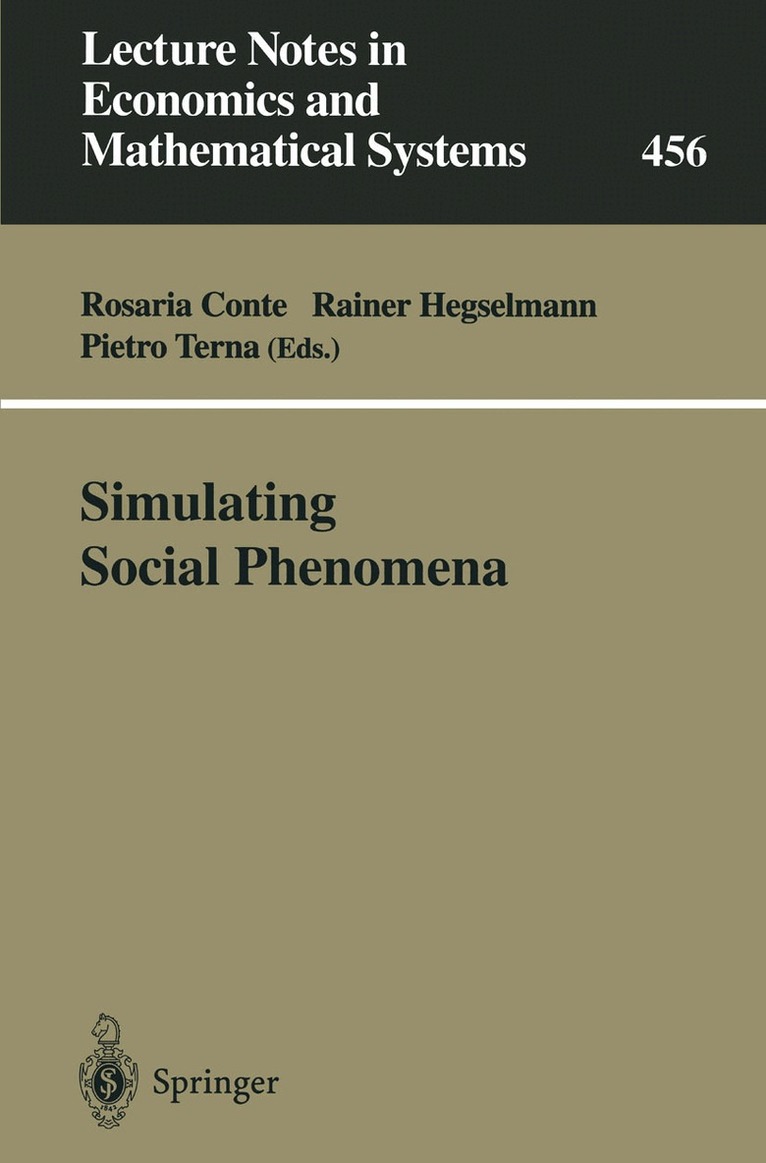
Simulating Social Phenomena
Häftad, Engelska, 1997
1 082 kr
Skickas inom 10-15 vardagar
In this book experts from quite different fields present simulations of social phenomena: economists, sociologists, political scientists, psychologists, cognitive scientists, organisational scientists, decision scientists, geographers, computer scientists, AI and AL scientists, mathematicians and statisticians. They simulate markets, organisations, economic dynamics, coalition formation, the emergence of cooperation and exchange, bargaining, decision making, learning, and adaptation. The history, problems, and perspectives of simulating social phenomena are explicitly discussed.
E-bok
PDF, Engelska, 20131 408 kr
Läs direkt efter köp
In this book experts from quite different fields present simulations of social phenomena: economists, sociologists, political scientists, psychologists, cognitive scientists, organisational scientists, decision scientists, geographers, computer scientists, AI and AL scientists, mathematicians and statisticians. They simulate markets, organisations, economic dynamics, coalition formation, the emergence of cooperation and exchange, bargaining, decision making, learning, and adaptation. The history, problems, and perspectives of simulating social phenomena are explicitly discussed.