James H. Gapinski - Böcker
Visar alla böcker från författaren James H. Gapinski. Handla med fri frakt och snabb leverans.
4 produkter
4 produkter
1 009 kr
Skickas inom 10-15 vardagar
The culmination of work begun in 1985 by the authors under the joint sponsorship of the Ekonomski Institut Zagreb and Florida State University, this book posits the most comprehensive and relevant model yet developed to explain the workings of Yugoslavia's economy. The authors have developed a model that is both theoretically oriented and empirically relevant--ensuring its appropriateness for recommending and evaluating alternative policy remedies for the acute problems of inflation, unemployment, and foreign trade now facing Yugoslavia, a country until recently noted for its economic successes. Already chosen to represent Yugoslavia in the ongoing international Project LINK, a global system for tracking and forecasting the economic conditions of some eighty countries and regions, the model is distinguished by its policy emphasis and by its ability to capture the fundamental divisions of the Yugoslav economy. Students and scholars of socialism, Marxism, and comparative economics will find this a major contribution to the literature of economic modeling.The book begins by providing essential background information about Yugoslavia including highlights of the country's economic experience, special features of its economic structure, the composition of its political system, the operation of its financial system, and the behavior of firms. Part two includes four chapters which examine the different components of the Yugoslav economy and review the theoretical basis and empirical performance of the equations which describe those components. A separate chapter presents the complete model, called the EIZFSU Mark 1.0 in recognition of its major sponsoring institutions. In the final part, the model is used to study policies for improving the performance of the economy and obstacles to their implementation. An appendix describes and quantifies the variables used in the model while a list of references provides additional information for the researcher who wishes to pursue further study in this area.
1 039 kr
Skickas inom 10-15 vardagar
For roughly three decades following World War II, Yugoslavia enjoyed economic success unparalleled in the communist world. Then came the 1980s. Economic success turned into economic failure, and before long Yugoslavia ceased to exist. This study addresses the question: Could the failure have been prevented? The work begins with a sketch of the historic and economic facts in the life of the country, turning then to theory and the relationship between economic theory and practice in Yugoslavia. It analyzes structure--that which prevailed at the time remedial action could have been taken--and simulates remedial scenarios. Finally, Gapinski draws conclusions from a comprehensive program of restructuring, from the regional composition of the country, and from the profound changes that have swept across Eastern Europe.
1 638 kr
Skickas inom 10-15 vardagar
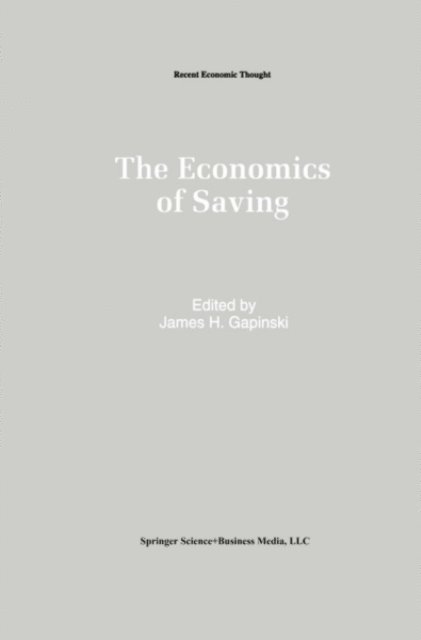
This book began when a letter reached my desk in November 1989. Written by Warren Samuels, professor of economics at Michigan State University and editor for Kluwer Academic Publishers, the letter reviewed the philosophy behind Kluwer's series on recent economic thought and accordingly expressed interest in the controversies that surround con temporary topics in the discipline. It graciously went on to invite me to organize, consonant with that philosophy, a volume of chapters on saving. Soon thereafter I learned that the chapters were to be original compositions. I also learned that I would have substantial flexibility in structuring the volume and in recruiting contributors, who logically would be authorities in the field. Succinctly, Samuels was inviting me to work with leading scholars in exploring the current controversies in saving, one of my favorite subjects. That invitation was simply too tempting to refuse. Preparation of the book's outline went smoothly. It was obvious that the statistics of saving should be covered along with the theories of saving. It was equally obvious that special issues must be addressed: Ricardian Equivalence, supply-side doctrine, and economic development among others. These themes should be handled so as to bring out the ideological tensions in the profession, and that criterion helped to shape the list of potential contributors. That is, both sides of a conflict should be represented, and both should be given the same treatment.
1 638 kr
Skickas inom 10-15 vardagar
This volume explores the principle issues in the economics of saving and features seven new essays by leading authorities in the field. The book covers the topics of theoretical constructs, measurement problems, empirical findings, Ricardian equivalence, the twin deficits, and supply-side doctrine. In addition, it relates saving to income distribution, economic growth, transition to growth, and economic development. The discussion is enriched by commentaries from a second set of scholars and throughout the volume the book notes controversies and tensions that characterize contemporary economic thought on saving. Nevertheless, the book also notes the consensus and harmonies that give fullness to the dialogue. The Economics of Saving is both a reference tool for researchers and a supplementary text for graduate students.