James T. Patterson - Böcker
Visar alla böcker från författaren James T. Patterson. Handla med fri frakt och snabb leverans.
10 produkter
10 produkter
261 kr
Skickas
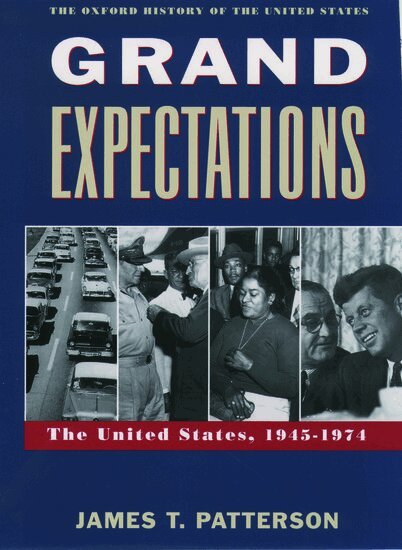
Beginning in 1945, America rocketed through a quarter-century of extraordinary economic growth, experiencing an amazing boom that soared to unimaginable heights in the 1960s. At one point, in the late 1940s, American workers produced 57 percent of the planet's steel, 62 percent of the oil, 80 percent of the automobiles. The U.S. then had three-fourths of the world's gold supplies. English Prime Minister Edward Heath later said that the United States in the post-War era enjoyed "the greatest prosperity the world has ever known." It was a boom that produced a national euphoria, a buoyant time of grand expectations and an unprecedented faith in our government, in our leaders, and in the American dream--an optimistic spirit which would be shaken by events in the '60s and '70s, and particularly by the Vietnam War.Now, in Grand Expectations, James T. Patterson has written a highly readable and balanced work that weaves the major political, cultural, and economic events of the period into a superb portrait of America from 1945 through Watergate. Here is an era teeming with memorable events--from the bloody campaigns in Korea and the bitterness surrounding McCarthyism to the assassinations of the Kennedys and Martin Luther King, to the Vietnam War, Watergate, and Nixon's resignation. Patterson excels at portraying the amazing growth after World War II--the great building boom epitomized by Levittown (the largest such development in history) and the baby boom (which exploded literally nine months after V-J Day)--as well as the resultant buoyancy of spirit reflected in everything from streamlined toasters, to big, flashy cars, to the soaring, butterfly roof of TWA's airline terminal in New York. And he shows how this upbeat, can-do mood spurred grander and grander expectations as the era progressed.Of course, not all Americans shared in this economic growth, and an important thread running through the book is an informed and gripping depiction of the civil rights movement--from the electrifying Brown v. Board of Education decision, to the violent confrontations in Little Rock, Birmingham, and Selma, to the landmark civil rights acts of 1964 and 1965. Patterson also shows how the Vietnam War--which provoked LBJ's growing credibility gap, vast defense spending that dangerously unsettled the economy, and increasingly angry protests--and a growing rights revolution (including demands by women, Hispanics, the poor, Native Americans, and gays) triggered a backlash that widened hidden rifts in our society, rifts that divided along racial, class, and generational lines. And by Nixon's resignation, we find a national mood in stark contrast to the grand expectations of ten years earlier, one in which faith in our leaders and in the attainability of the American dream was becoming shaken.Grand Expectations is the newest volume in the prestigious Oxford History of the United States. The earlier releases were highly acclaimed, and one, Battle Cry of Freedom, was both a New York Times bestseller and a winner of the Pulitzer Prize. Patterson's volume takes its rightful place beside these distinguished works. It is a brilliant summation of the years that created the America that we know today, a time of setbacks amid unmatched and lasting achievements.
494 kr
Skickas inom 5-8 vardagar
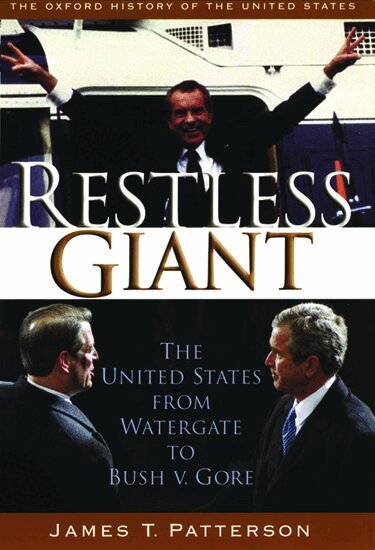
Restless Giant is a magisterial interpretation of American history between 1974, when the crisis of Watergate imperiled the nation, and November 2000, when the bitterly contested presidential election marked an all-time low in confidence in the electoral process. James T. Patterson, whose earlier contribution to the Oxford History of the United States, Grand Expectations (1996), won a Bancroft Prize for History, offers in this follow-up volume a vivid narrative of this quarter century which did so much to shape American life today. A host of memorable characters, notably Ronald Reagan and Bill Clinton, sought to transform the nation. Conservatives, including a resurgent Religious Right, battled liberals in 'culture wars' that appeared to cut the country in two. The frightening Cold War finally ended, whereupon Americans faced bewildering new developments in international relations. Though a military colossus, the United States discovered-in Panama, Somalia, Bosnia, Iraq-that it was far from easy to direct the outcome of overseas events. Restless Giant explores a wide range of cultural, social, and economic concerns. Many of these-abiding racial tensions, rising income inequality, dismal inner-city schools, tasteless popular entertainment, an ever more exuberant materialism-drove critics to label these years as an 'Era of Conflict', an 'Age of Limits', and an 'Era of Decline'. Patterson, highlighting the buoyancy of American culture, is not so pessimistic. The economy, having wallowed in 'stagflation' between 1974 and 1982, later surged ahead. By 2000, most Americans lived far more comfortably than they had in the 1970s. Thanks to rising tolerance and a powerful rights consciousness, many groups-racial and ethnic minorities, Catholics and Jews, women, the handicapped, senior citizens, gay people-encountered considerably less bigotry and discrimination than they had in the past.
Congressional Conservatism and the New Deal
The Growth of the Conservative Coalition in Congress, 1933-1939
Inbunden, Engelska, 1981
1 009 kr
Skickas inom 10-15 vardagar
Freedom Is Not Enough: The Moynihan Report and America's Struggle Over Black Family Life -- From LBJ to Obama
Häftad, Engelska, 2012
208 kr
Skickas inom 5-8 vardagar
320 kr
Skickas inom 5-8 vardagar
362 kr
Skickas inom 10-15 vardagar
This new edition of Patterson's widely used book carries the story of battles over poverty and social welfare through what the author calls the "amazing 1990s," those years of extraordinary performance of the economy. He explores a range of issues arising from the economic phenomenon--increasing inequality and demands for use of an improved poverty definition. He focuses the story on the impact of the highly controversial welfare reform of 1996, passed by a Republican Congress and signed by a Democratic President Clinton, despite the laments of anguished liberals.
506 kr
Skickas inom 10-15 vardagar
Cancer is that “loathsome beast, which seized upon the breast, drove its long claws into the surrounding tissues, derived its sustenance by sucking out the juices of its victims, and never even relaxed its hold in death,” a turn-of-the-century physician recorded. Even today cancer affects the popular imagination with dread. In a subtle and penetrating cultural history, James Patterson examines reactions to the disease through a century of American life.The modern American preoccupation with cancer was apparent during the widely publicized illness and death from that ailment of Ulysses S. Grant in 1885. Awareness of the disease soon figured heavily in the public consciousness, and individual reactions to it continue to reveal broader tensions within American society. Patterson examines responses to cancer by researchers and physicians, quacks and faith healers, by the multitude who have heard sensational media reports of “cures,” as well as by many who have had firsthand experiences with the disease.Optimistic attitudes of many experts contrast sharply with the skepticism of large segments of the population—often the less wealthy and the less educated—that reject the claims of medical science and resist the advice or, some argue, the paternalistic dictates of the government-supported cancer research establishment.Expanding expectations of a cure from a confident medical profession; the rise of a government-supported Cancer Establishment managing a large research empire; the emergence of a “cancer counterculture”; a new emphasis on prevention through control of the environment and the self; and the private fears and pessimism of millions of Americans form a telling history of American social patterns. Whether the issue is smoking, pollution, or regular checkups, attitudes toward cancer reflect more general views on medicine, public policy, and illness, as well as on death and dying. This century has witnessed both a biomedical revolution and a vastly increased role of the state in the private lives of citizens; but not everyone has bought the medical package, and many have little faith in government intervention.Readers interested in the cultural dimensions of science and medicine as well as historians, sociologists, and political scientists will be enlightened and challenged by The Dread Disease.
323 kr
Skickas inom 7-10 vardagar
Little has been written about the New Deal's effect at the state level. How did the states act before the New Deal? Did the Roosevelt administration promote progressive policies on the state level? Did it destroy state initiative? Was it discriminatory? In what kinds of states did it seem to have the greatest impact, and why? What barriers were placed in the way of New Deal planning? Professor Patterson traces trends in state affairs and in American federalism between 1920 and 1940, focusing on the states in relation to the federal government. Though he pays attention to individual state variations, he searches for generalizations which explain the pattern instead of presenting a routine state-by-state survey. Originally published in 1969. The Princeton Legacy Library uses the latest print-on-demand technology to again make available previously out-of-print books from the distinguished backlist of Princeton University Press. These editions preserve the original texts of these important books while presenting them in durable paperback and hardcover editions.The goal of the Princeton Legacy Library is to vastly increase access to the rich scholarly heritage found in the thousands of books published by Princeton University Press since its founding in 1905.
1 656 kr
Skickas inom 3-6 vardagar
Little has been written about the New Deal's effect at the state level. How did the states act before the New Deal? Did the Roosevelt administration promote progressive policies on the state level? Did it destroy state initiative? Was it discriminatory? In what kinds of states did it seem to have the greatest impact, and why? What barriers were placed in the way of New Deal planning? Professor Patterson traces trends in state affairs and in American federalism between 1920 and 1940, focusing on the states in relation to the federal government. Though he pays attention to individual state variations, he searches for generalizations which explain the pattern instead of presenting a routine state-by-state survey. Originally published in 1969. The Princeton Legacy Library uses the latest print-on-demand technology to again make available previously out-of-print books from the distinguished backlist of Princeton University Press. These editions preserve the original texts of these important books while presenting them in durable paperback and hardcover editions.The goal of the Princeton Legacy Library is to vastly increase access to the rich scholarly heritage found in the thousands of books published by Princeton University Press since its founding in 1905.
512 kr
Skickas inom 3-6 vardagar
Faced by the disaster of depression, Congress in the early 1930s proved amenable to the far-reaching demands and programs presented to it by the newly elected President, Franklin D. Roosevelt, but by 1937 it showed increasing resistance, even outright opposition, to many New Deal measures. In this study, James T. Patterson examines this resurgence of conservative strength in Congress, focusing upon the personalities and backgrounds of the men involved and upon the key domestic issues which brought them together in an informal coalition opposed to executive plans, especially for the years 1937--1939.From the first the Roosevelt Congress had had its "irreconcilables" -- men like Carter Glass, Millard Tydings, and Harry Byrd -- who viewed the New Deal with dismay, and in the voting on the public utilities holding company bill and the surprise tax measure of 1935 they were joined by a significant number of other congressmen who had hitherto supported the administration. It was, however, Roosevelt's plan to enlarge the Supreme Court that proved to be the turning point. This controversial measure provided a common issue on which conservatives, both Republican and Democratic, could unite -- the "irreconcilables," Republicans like Arthur Vandenberg, others like Charles McNary, and nominal Democratic progressives like Burton K. Wheeler. Following this crucial confrontation, the bipartisan conservative coalition was able to control enough votes to oppose the administration on such key measures as the fair labor standards and housing bills of 1937, the reorganization and tax bills of 1938, and the relief and tax bills of 1939. Incited by grievances over patronage, a feeling that the emergency was past, and fears of radicalism, congressmen increasingly asserted their independence of executive leadership.In this 1966 Organization of American Historians award-winning book, Patterson has provided a new exploration of one of the most significant developments in recent American history-the creation by conservative congressmen of a pattern of cooperation that continues to exert a potent influence upon the course of legislation.