Jan Philip Solovej – författare
Visar alla böcker från författaren Jan Philip Solovej. Handla med fri frakt och snabb leverans.
10 produkter
10 produkter
Inbunden, Engelska, 2004
1 082 kr
Skickas inom 10-15 vardagar
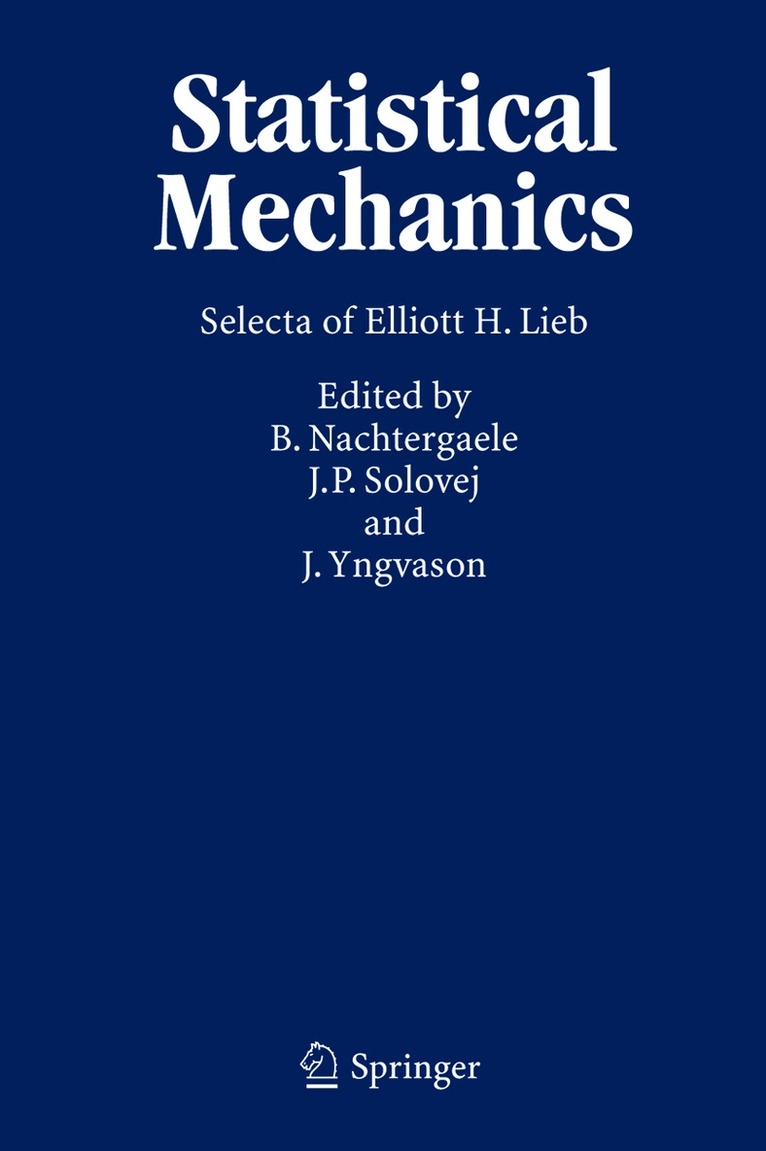
In Statistical Physics one of the ambitious goals is to derive rigorously, from statistical mechanics, the thermodynamic properties of models with realistic forces. Elliott Lieb is a mathematical physicist who meets the challenge of statistical mechanics head on, taking nothing for granted and not being content until the purported consequences have been shown, by rigorous analysis, to follow from the premises. The present volume contains a selection of his contributions to the field, in particular papers dealing with general properties of Coulomb systems, phase transitions in systems with a continuous symmetry, lattice crystals, and entropy inequalities. It also includes work on classical thermodynamics, a discipline that, despite many claims to the contrary, is logically independent of statistical mechanics and deserves a rigorous and unambiguous foundation of its own. The articles in this volume have been carefully annotated by the editors.
Inbunden, Engelska, 2004
1 184 kr
Skickas inom 5-8 vardagar
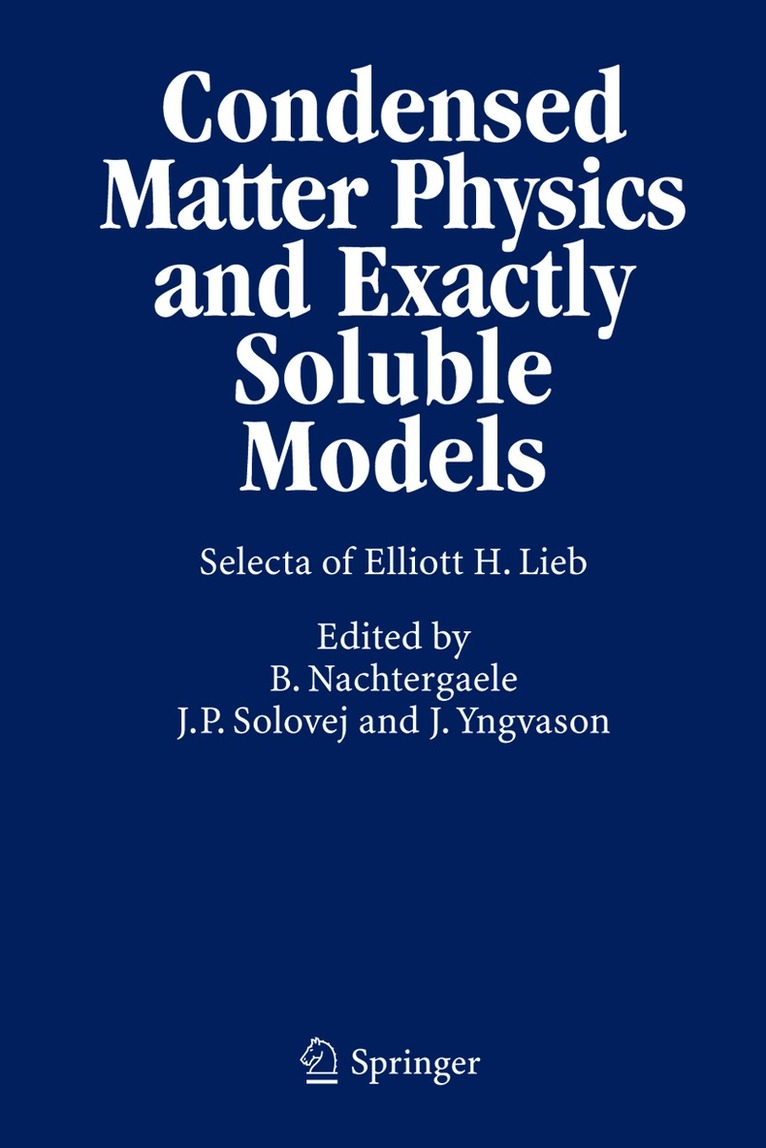
The first part of this book contains E. Lieb's fundamental contributions to the mathematical theory of Condensed Matter Physics. Often considered the founding father of the field, E. Lieb demonstrates his ability to select the most important issues and to formulate them as well-defined mathematical problems and, finally, to solve them. The second part presents Lieb's work on integrable models. His groundbreaking articles helped to establish Exactly Soluble Models as a flourishing research field in its own right. The papers collected in this volume have also been carefully annotated by the editors.
Häftad, Engelska, 2010
1 082 kr
Skickas inom 10-15 vardagar
In Statistical Physics one of the ambitious goals is to derive rigorously, from statistical mechanics, the thermodynamic properties of models with realistic forces. Elliott Lieb is a mathematical physicist who meets the challenge of statistical mechanics head on, taking nothing for granted and not being content until the purported consequences have been shown, by rigorous analysis, to follow from the premises. The present volume contains a selection of his contributions to the field, in particular papers dealing with general properties of Coulomb systems, phase transitions in systems with a continuous symmetry, lattice crystals, and entropy inequalities. It also includes work on classical thermodynamics, a discipline that, despite many claims to the contrary, is logically independent of statistical mechanics and deserves a rigorous and unambiguous foundation of its own. The articles in this volume have been carefully annotated by the editors.
Häftad, Engelska, 2010
1 189 kr
Skickas inom 10-15 vardagar
The first part of this book contains E. Lieb's fundamental contributions to the mathematical theory of Condensed Matter Physics. Often considered the founding father of the field, E. Lieb demonstrates his ability to select the most important issues and to formulate them as well-defined mathematical problems and, finally, to solve them. The second part presents Lieb's work on integrable models. His groundbreaking articles helped to establish Exactly Soluble Models as a flourishing research field in its own right. The papers collected in this volume have also been carefully annotated by the editors.
Del 2051 - Lecture Notes in Mathematics
Quantum Many Body Systems
Cetraro, Italy 2010, Editors: Alessandro Giuliani, Vieri Mastropietro, Jakob Yngvason
Häftad, Engelska, 2012
383 kr
Skickas inom 10-15 vardagar
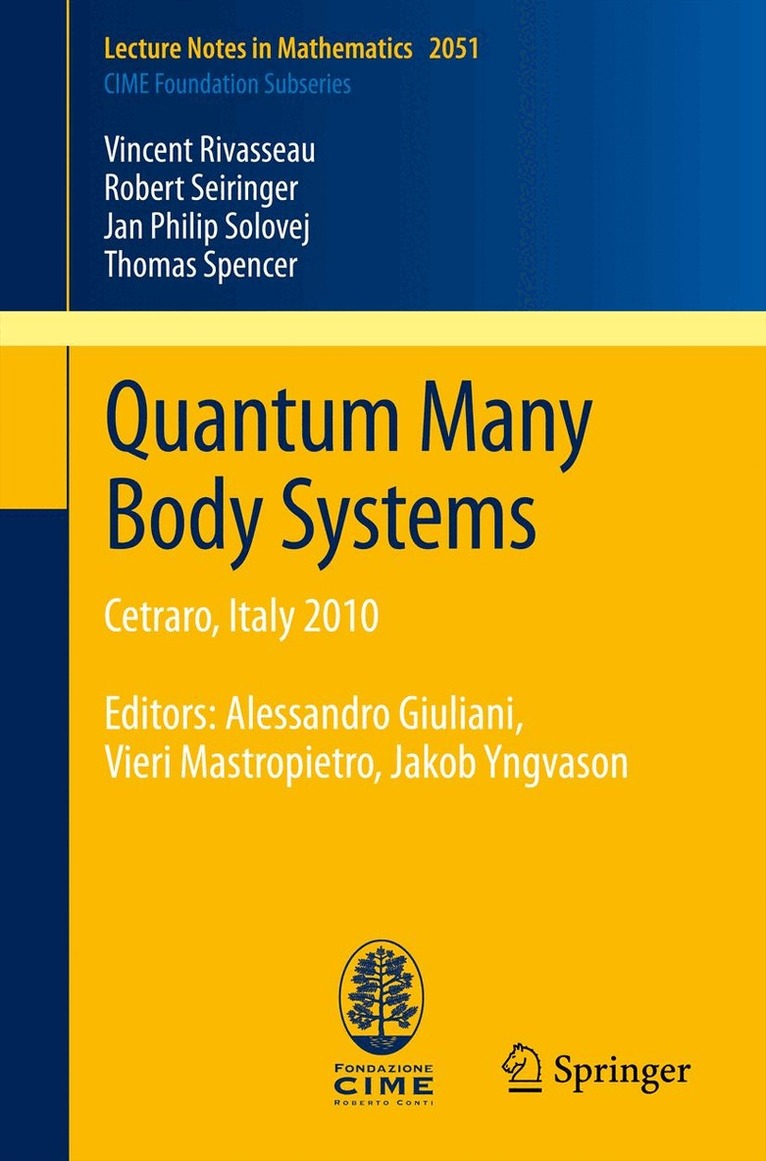
The book is based on the lectures given at the CIME school "Quantum many body systems" held in the summer of 2010. It provides a tutorial introduction to recent advances in the mathematics of interacting systems, written by four leading experts in the field: V. Rivasseau illustrates the applications of constructive Quantum Field Theory to 2D interacting electrons and their relation to quantum gravity; R. Seiringer describes a proof of Bose-Einstein condensation in the Gross-Pitaevski limit and explains the effects of rotating traps and the emergence of lattices of quantized vortices; J.-P. Solovej gives an introduction to the theory of quantum Coulomb systems and to the functional analytic methods used to prove their thermodynamic stability; finally, T. Spencer explains the supersymmetric approach to Anderson localization and its relation to the theory of random matrices. All the lectures are characterized by their mathematical rigor combined with physical insights.
E-bok
PDF, Engelska, 2012489 kr
Läs direkt efter köp
The book is based on the lectures given at the CIME school "Quantum many body systems" held in the summer of 2010. It provides a tutorial introduction to recent advances in the mathematics of interacting systems, written by four leading experts in the field: V. Rivasseau illustrates the applications of constructive Quantum Field Theory to 2D interacting electrons and their relation to quantum gravity; R. Seiringer describes a proof of Bose-Einstein condensation in the Gross-Pitaevski limit and explains the effects of rotating traps and the emergence of lattices of quantized vortices; J.-P. Solovej gives an introduction to the theory of quantum Coulomb systems and to the functional analytic methods used to prove their thermodynamic stability; finally, T. Spencer explains the supersymmetric approach to Anderson localization and its relation to the theory of random matrices. All the lectures are characterized by their mathematical rigor combined with physical insights.
E-bok
PDF, Engelska, 20131 474 kr
Läs direkt efter köp
This is the third Selecta of publications of Elliott Lieb, the first two being Stabil ity of Matter: From Atoms to Stars, edited by Walter Thirring, and Inequalities, edited by Michael Loss and Mary Beth Ruskai. A companion fourth Selecta on Statistical Mechanics is also edited by us. Elliott Lieb has been a pioneer of the discipline of mathematical physics as it is nowadays understood and continues to lead several of its most active directions today. For the first part of this selecta we have made a selection of Lieb''s works on Condensed Matter Physics. The impact of Lieb''s work in mathematical con densed matter physics is unrivaled. It is fair to say that if one were to name a founding father of the field, Elliott Lieb would be the only candidate to claim this singular position. While in related fields, such as Statistical Mechanics and Atomic Physics, many key problems are readily formulated in unambiguous mathematical form, this is less so in Condensed Matter Physics, where some say that rigor is "probably impossible and certainly unnecessary". By carefully select ing the most important questions and formulating them as well-defined mathemat ical problems, and then solving a good number of them, Lieb has demonstrated the quoted opinion to be erroneous on both counts. What is true, however, is that many of these problems turn out to be very hard. It is not unusual that they take a decade (even several decades) to solve.
E-bok
PDF, Engelska, 20131 367 kr
Läs direkt efter köp
In Statistical Physics one of the ambitious goals is to derive rigorously, from statistical mechanics, the thermodynamic properties of models with realistic forces. Elliott Lieb is a mathematical physicist who meets the challenge of statistical mechanics head on, taking nothing for granted and not being content until the purported consequences have been shown, by rigorous analysis, to follow from the premises. The present volume contains a selection of his contributions to the field, in particular papers dealing with general properties of Coulomb systems, phase transitions in systems with a continuous symmetry, lattice crystals, and entropy inequalities. It also includes work on classical thermodynamics, a discipline that, despite many claims to the contrary, is logically independent of statistical mechanics and deserves a rigorous and unambiguous foundation of its own. The articles in this volume have been carefully annotated by the editors.
Häftad, Engelska, 2005
459 kr
Skickas inom 10-15 vardagar
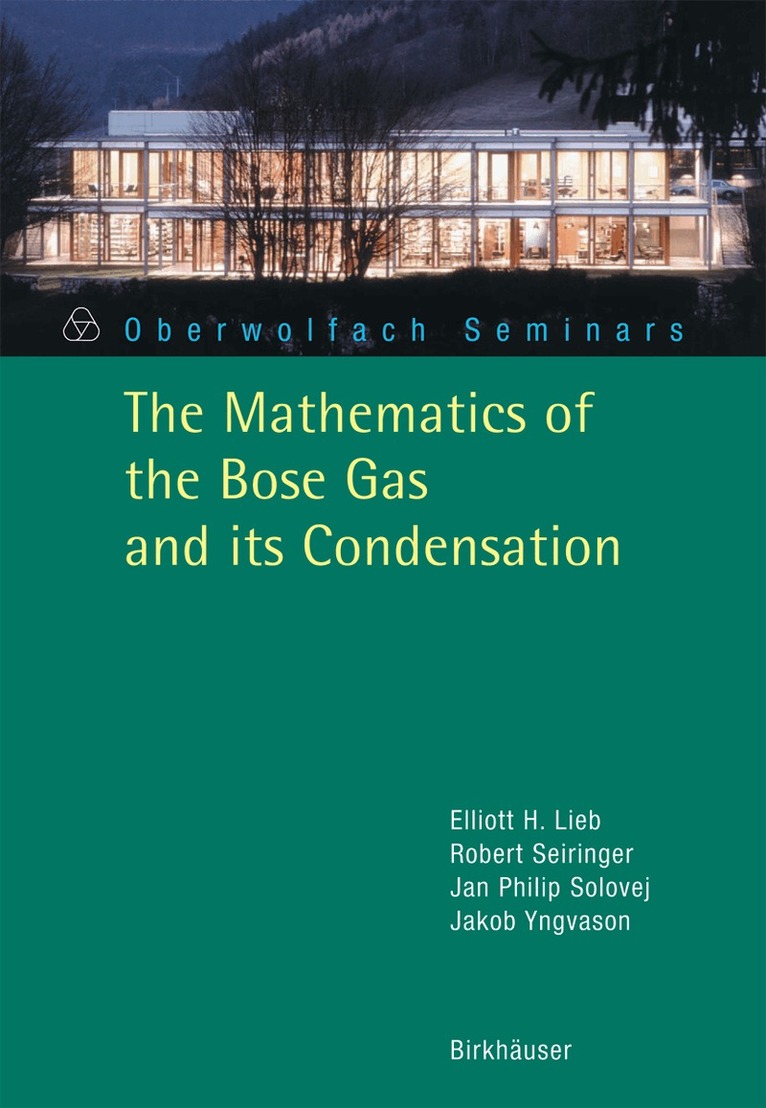
The mathematical study of the Bose gas goes back to the ?rst quarter of the twentieth century, with the invention of quantum mechanics. The name refers to the Indian physicist S.N. Bose who realized in 1924 that the statistics governing photons(essentiallyinventedbyMaxPlanckin1900)isdetermined(usingmodern terminology) by restricting the physical Hilbert space to be the symmetric tensor product of single photon states. Shortly afterwards, Einstein applied this idea to massive particles, such as a gas of atoms, and discovered the phenomenon that we now call Bose-Einstein condensation. At that time this was viewed as a mathematical curiosity with little experimental interest, however. The peculiar properties of liquid Helium (?rst lique?ed by Kammerlingh Onnes in 1908) were eventually viewed as an experimental realization of Bose- Einstein statistics applied to Helium atoms. The unresolved mathematical pr- lem was that the atoms in liquid Helium are far from the kind of non-interacting particles envisaged in Einstein’s theory, and the question that needed to be - solved was whether Bose-Einstein condensation really takes place in a strongly interacting system — or even in a weakly interacting system. That question is still with us, three quarters of a century later! The ?rst systematic and semi-rigorous mathematical treatment of the pr- lem was due to Bogoliubov in 1947, but that theory, while intuitively appealing and undoubtedly correct in many aspects, has major gaps and some ?aws. The 1950’s and 1960’s brought a renewed ?urry of interest in the question, but while theoreticalintuitionbene?tedhugelyfromthisactivitythemathematicalstructure did not signi?cantly improve.
E-bok
PDF, Engelska, 2006611 kr
Läs direkt efter köp
The mathematical study of the Bose gas goes back to the ?rst quarter of the twentieth century, with the invention of quantum mechanics. The name refers to the Indian physicist S.N. Bose who realized in 1924 that the statistics governing photons(essentiallyinventedbyMaxPlanckin1900)isdetermined(usingmodern terminology) by restricting the physical Hilbert space to be the symmetric tensor product of single photon states. Shortly afterwards, Einstein applied this idea to massive particles, such as a gas of atoms, and discovered the phenomenon that we now call Bose-Einstein condensation. At that time this was viewed as a mathematical curiosity with little experimental interest, however. The peculiar properties of liquid Helium (?rst lique?ed by Kammerlingh Onnes in 1908) were eventually viewed as an experimental realization of Bose- Einstein statistics applied to Helium atoms. The unresolved mathematical pr- lem was that the atoms in liquid Helium are far from the kind of non-interacting particles envisaged in Einstein’s theory, and the question that needed to be - solved was whether Bose-Einstein condensation really takes place in a strongly interacting system — or even in a weakly interacting system. That question is still with us, three quarters of a century later! The ?rst systematic and semi-rigorous mathematical treatment of the pr- lem was due to Bogoliubov in 1947, but that theory, while intuitively appealing and undoubtedly correct in many aspects, has major gaps and some ?aws. The 1950’s and 1960’s brought a renewed ?urry of interest in the question, but while theoreticalintuitionbene?tedhugelyfromthisactivitythemathematicalstructure did not signi?cantly improve.