Robert Seiringer - Böcker
Visar alla böcker från författaren Robert Seiringer. Handla med fri frakt och snabb leverans.
3 produkter
3 produkter
626 kr
Skickas inom 7-10 vardagar
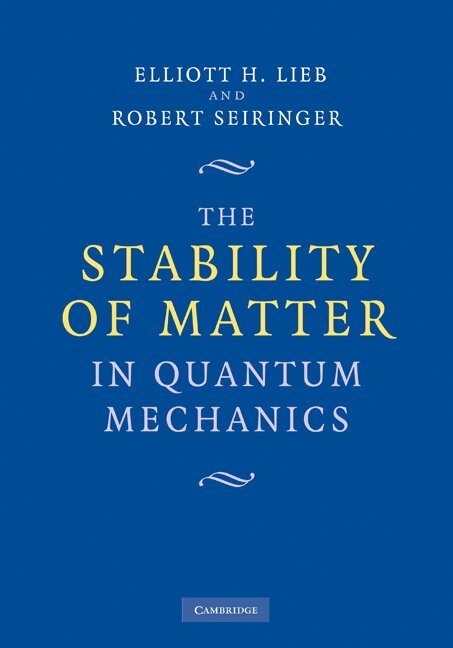
Research into the stability of matter has been one of the most successful chapters in mathematical physics, and is a prime example of how modern mathematics can be applied to problems in physics. A unique account of the subject, this book provides a complete, self-contained description of research on the stability of matter problem. It introduces the necessary quantum mechanics to mathematicians, and aspects of functional analysis to physicists. The topics covered include electrodynamics of classical and quantized fields, Lieb-Thirring and other inequalities in spectral theory, inequalities in electrostatics, stability of large Coulomb systems, gravitational stability of stars, basics of equilibrium statistical mechanics, and the existence of the thermodynamic limit. The book is an up-to-date account for researchers, and its pedagogical style makes it suitable for advanced undergraduate and graduate courses in mathematical physics.
Del 2051 - Lecture Notes in Mathematics
Quantum Many Body Systems
Cetraro, Italy 2010, Editors: Alessandro Giuliani, Vieri Mastropietro, Jakob Yngvason
Häftad, Engelska, 2012
376 kr
Skickas inom 10-15 vardagar
The book is based on the lectures given at the CIME school "Quantum many body systems" held in the summer of 2010. It provides a tutorial introduction to recent advances in the mathematics of interacting systems, written by four leading experts in the field: V. Rivasseau illustrates the applications of constructive Quantum Field Theory to 2D interacting electrons and their relation to quantum gravity; R. Seiringer describes a proof of Bose-Einstein condensation in the Gross-Pitaevski limit and explains the effects of rotating traps and the emergence of lattices of quantized vortices; J.-P. Solovej gives an introduction to the theory of quantum Coulomb systems and to the functional analytic methods used to prove their thermodynamic stability; finally, T. Spencer explains the supersymmetric approach to Anderson localization and its relation to the theory of random matrices. All the lectures are characterized by their mathematical rigor combined with physical insights.
451 kr
Skickas inom 10-15 vardagar
The mathematical study of the Bose gas goes back to the ?rst quarter of the twentieth century, with the invention of quantum mechanics. The name refers to the Indian physicist S.N. Bose who realized in 1924 that the statistics governing photons(essentiallyinventedbyMaxPlanckin1900)isdetermined(usingmodern terminology) by restricting the physical Hilbert space to be the symmetric tensor product of single photon states. Shortly afterwards, Einstein applied this idea to massive particles, such as a gas of atoms, and discovered the phenomenon that we now call Bose-Einstein condensation. At that time this was viewed as a mathematical curiosity with little experimental interest, however. The peculiar properties of liquid Helium (?rst lique?ed by Kammerlingh Onnes in 1908) were eventually viewed as an experimental realization of Bose- Einstein statistics applied to Helium atoms. The unresolved mathematical pr- lem was that the atoms in liquid Helium are far from the kind of non-interacting particles envisaged in Einstein’s theory, and the question that needed to be - solved was whether Bose-Einstein condensation really takes place in a strongly interacting system — or even in a weakly interacting system. That question is still with us, three quarters of a century later! The ?rst systematic and semi-rigorous mathematical treatment of the pr- lem was due to Bogoliubov in 1947, but that theory, while intuitively appealing and undoubtedly correct in many aspects, has major gaps and some ?aws. The 1950’s and 1960’s brought a renewed ?urry of interest in the question, but while theoreticalintuitionbene?tedhugelyfromthisactivitythemathematicalstructure did not signi?cantly improve.